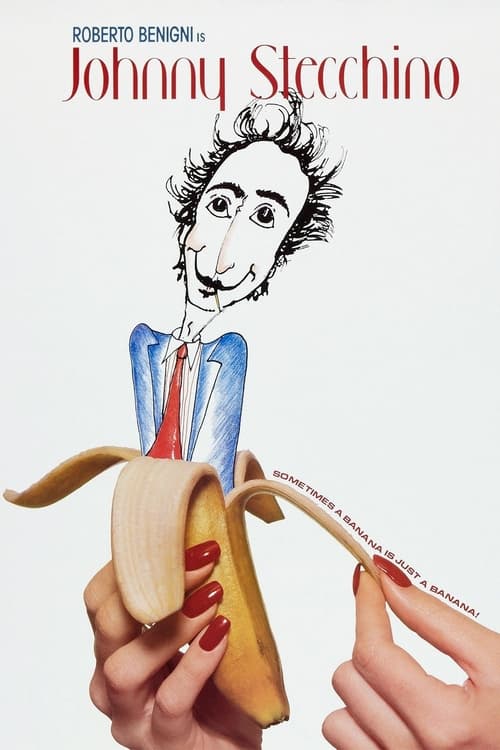
Johnny Stecchino (1991)
Directed by Roberto Benigni
No — Johnny Stecchino is not woke, scoring 6 out of 100 on our wokeness meter.
Roberto Benigni directs himself in two roles here, a Palermo mobster named Johnny Stecchino and a guileless Cesena bus driver named Dante who happens to wear the same face.
Consciousness Markers
The film prominently features characters with Down syndrome (notably Lillo, a major supporting role), but they are deployed as comedic foils rather than as a deliberate representation statement, and the casting reflects 1991 Italian cinema norms rather than modern representation politics.
Down syndrome characters (Lillo and the school bus students) are central to the plot, which touches the neurodiversity umbrella, but the treatment is comedic and dated rather than a modern neurodivergence-affirming statement.
There is mild satire of government disability fraud and corrupt politicians in league with the Mafia, but this is incidental comic texture rather than an anti-capitalist or eat-the-rich thesis.
No LGBTQ+ characters, themes, or subtext appear anywhere in the film.
Maria is a classic femme fatale manipulating men to save her gangster husband; the film offers no feminist critique or agenda, and her agency serves a traditional noir trope rather than any gender-political message.
The film contains no engagement with racial identity, racism, or racial justice themes.
No environmental or climate themes are present.
No body positivity themes or messaging about body image appear in the film.
The film is a fictional farce about mistaken identity and the Sicilian Mafia, with no revisionist or counter-narrative historical claims.
This is a broad slapstick comedy with no preachy or didactic messaging; it aims to amuse rather than lecture.
Why it received this score
Roberto Benigni directs himself in two roles here, a Palermo mobster named Johnny Stecchino and a guileless Cesena bus driver named Dante who happens to wear the same face. The machinery is pure farce: a femme fatale wife, a case of mistaken identity, a toothpick, a faux mole, a bag of cocaine mistaken for diabetes medicine. The film was the highest-grossing Italian release of its era, which tells us the audience of 1991 was content to laugh at a plot that hinges on a man being shot at for stealing a banana.
The supporting cast includes Lillo, a boy with Down syndrome who serves as Dante's closest friend and running gag, forever being pried away from sweets. The school bus full of students with Down syndrome functions as set dressing and punchline, which registers as a modest flicker of representation casting and a faint touch of the neurodiversity register, though the intent is comic texture, not advocacy. Dante also defrauds the state into paying him disability benefits, and a politician in league with the mob hands out favors, giving the proceedings a whiff of anti-capitalist grumbling. That is where the social conscience stops. Maria is a stock noir manipulator, the racial and environmental questions never surface, and no character so much as glances toward a gender politics.
The film wants nothing from us but laughter, and it makes no attempt to instruct. There is no sermon, no moral ledger, no scene in which a character turns to the camera to explain how we ought to live. It is a broad slapstick entertainment from a pre-smartphone Italy, content to let its ethics stay as loose as its plot. For a cataloguer, this is a restful specimen: a comedy that offends in scattered, dated ways without ever aspiring to a thesis.
Analysis generated by our Consciousness Algorithm

Synopsis
Good hearted but not very wordly-wise, Dante is happy driving the school bus for a group of mentally handicapped children, while feeling he is somehow missing out on life and love. So he is very excited when after nearly being knocked down by her car he meets Maria, who seems immediately enamoured of him. He is soon invited to her sumptuous Palermo villa, little suspecting that this is part of a plot. He bears an amazing likeness to Maria's stool-pigeon gangster husband and it would be convenient for them if the mobster, in the shape of Dante, was seen to be dead and buried.
Questions about Johnny Stecchino
Is Johnny Stecchino woke?
No — Johnny Stecchino is not woke, scoring 6 out of 100 on our wokeness meter. That earns it a verdict of Ultra Based.
Does Johnny Stecchino have any woke elements?
Very few. None of the 10 markers reaches 30, the level where a marker counts as present; the highest is Neurodivergence at 15.
How does Johnny Stecchino compare to other 1991 movies?
It ranks #40 of the 68 films from 1991 we've scored; their average is 14. The wokest is Paris Is Burning (77).
How is the Woke Score calculated?
An AI-assisted process researches the film and its reception, scores it 0–100 on ten markers, then combines those into one 0–100 Woke Score. It measures a specific set of 2020s cultural themes, not film quality.