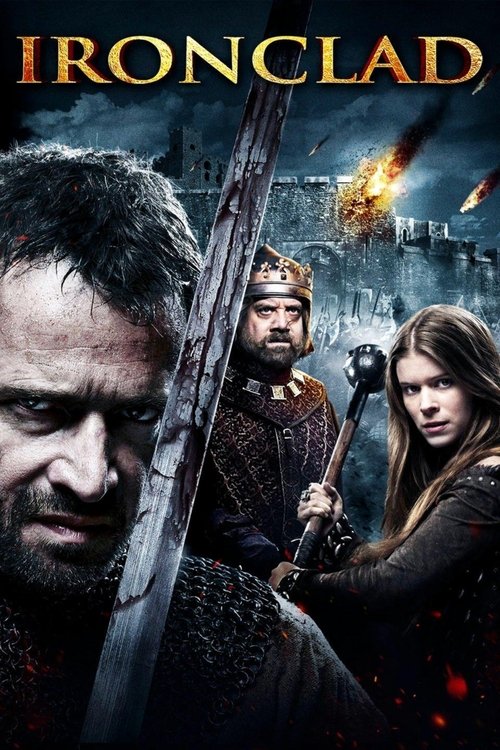
Ironclad (2011)
Directed by Jonathan English
No — Ironclad is not woke, scoring 0 out of 100 on our wokeness meter.
Ironclad arrives from 2011 with mud on its boots and a trebuchet in the yard, a British siege picture that treats the Magna Carta as a blunt instrument for cracking skulls.
Consciousness Markers
The film includes some speeches about freedom and the Magna Carta, but these are generic historical drama elements rather than modern preachy lectures.
The cast is entirely white, with no meaningful racial or ethnic diversity. Kate Mara's presence as a female lead does not constitute representation casting in the modern sense.
There are no LGBTQ+ characters, themes, or subtext whatsoever.
The female character, Isabel, exists primarily as a romantic subplot and has no agency or feminist messaging. The film is a male-dominated medieval siege story.
The film is set in 13th-century England and features an all-white cast with no engagement with racial issues or consciousness.
There is no environmental or climate-related theme in the film.
The conflict is about royal tyranny and the Magna Carta, not capitalism or economic inequality. No anti-capitalist messaging is present.
The film does not address body image, body positivity, or related themes.
There are no neurodivergent characters or themes depicted.
While the film takes liberties with historical facts, these inaccuracies are not driven by modern ideological revisionism. It is a conventional action-drama retelling, not a woke reinterpretation.
Why it received this score
Ironclad arrives from 2011 with mud on its boots and a trebuchet in the yard, a British siege picture that treats the Magna Carta as a blunt instrument for cracking skulls. Jonathan English directs with the enthusiasm of a man who has read one chapter of a history book and decided the rest could be improvised. King John is a sneering tyrant, the Templars are grim, the Danes speak Hungarian for reasons nobody explains, and Rochester Castle absorbs punishment for two hours. It is a film about freedom, in the general sense that every film about swordsmen is about freedom.
For our purposes, we examine the cultural ledger, and the ledger is bare. The cast is uniformly white, the setting is thirteenth-century England, and no effort is made to interrogate that arrangement or to comment upon it. The one woman of note, Isabel, exists to be widowed and then comforted, which is not a feminist program so much as a plot convenience. There is no queer subtext, no environmental lament, no critique of wealth, no body politics, no neurodivergent interiority. The rebels fight a king, not a system of capital. Their grievance is tyranny, which is an old grievance, and the film has no interest in updating it for modern appetites.
The sole item of note is the speechmaking, which registers as faint. Men stand on battlements and announce that free men deserve rights. This is the rhetoric of the historical drama, sincere and unremarkable, delivered by actors who know how to hold a sword and a sentence at the same time. The film believes in the Magna Carta the way it believes in the trebuchet: as a device that moves the plot. We score it accordingly. A sturdy, muddy, largely harmless entertainment, and a quiet one on the cultural front.
Analysis generated by our Consciousness Algorithm


Synopsis
In the year 1215, the rebel barons of England have forced their despised King John to put his royal seal on the Magna Carta, a seminal document that upheld the rights of free men. Yet within months of pledging himself to the great charter, the King reneged on his word and assembled a mercenary army on the south coast of England with the intention of bringing the barons and the country back under his tyrannical rule. Barring his way stood the mighty Rochester castle, a place that would become the symbol of the rebel's momentous struggle for justice and freedom.
Questions about Ironclad
Is Ironclad woke?
No — Ironclad is not woke, scoring 0 out of 100 on our wokeness meter. That earns it a verdict of Ultra Based.
Does Ironclad have any woke elements?
Very few. None of the 10 markers reaches 30, the level where a marker counts as present; the highest is Lecture Energy at 10.
How does Ironclad compare to other 2011 movies?
It ranks #216 of the 245 films from 2011 we've scored; their average is 11. The wokest is Paul (68).
How is the Woke Score calculated?
An AI-assisted process researches the film and its reception, scores it 0–100 on ten markers, then combines those into one 0–100 Woke Score. It measures a specific set of 2020s cultural themes, not film quality.