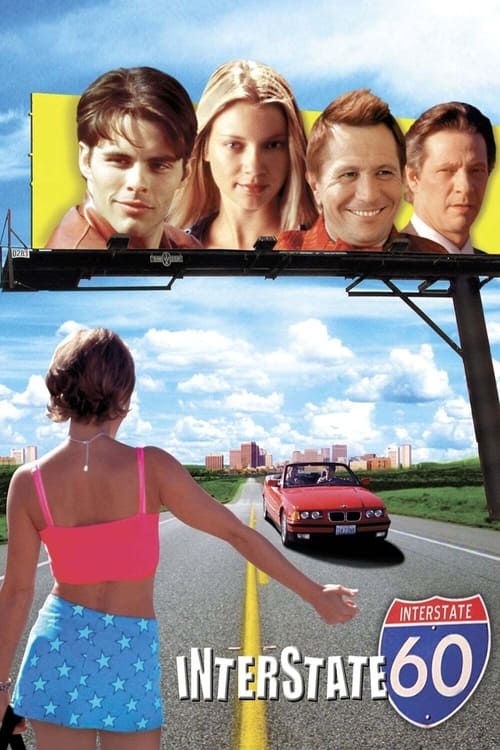
Interstate 60 (2002)
Directed by Bob Gale
No — Interstate 60 is not woke, scoring 13 out of 100 on our wokeness meter.
Interstate 60 is a feature that attempts to be a meditation on the American spirit, yet it largely settles for a series of highly predictable life lessons delivered across a sprawling, uninspired landscape.
Consciousness Markers
The film is structured around explicit life lessons — 'things are not always what they seem,' the pigeon-hole speech, and the injunction to live your own life — delivered with a gently moralizing, inspirational tone.
A subplot features a dying ex-advertiser crusading against dishonesty in advertising, and the town of Morlaw satirizes litigious self-interest, offering a mild critique of commercial and professional culture.
The cast is overwhelmingly white, with no deliberate diverse or inclusive casting choices evident in the ensemble.
No LGBTQ+ characters, relationships, or themes appear anywhere in the film.
Women are framed through the 'dream girl' trope and as romantic or sexual quest objects; there is no feminist critique or agency-driven framing.
The film engages no racial themes, commentary, or consciousness whatsoever.
No environmental or climate-related content is present.
The character who can consume vast quantities of food is played purely for comic absurdity, not as a body-positivity statement.
No neurodivergent characters or themes are present.
The film is a surreal fantasy with no historical subject matter to revise.
Why it received this score
Interstate 60 is a feature that attempts to be a meditation on the American spirit, yet it largely settles for a series of highly predictable life lessons delivered across a sprawling, uninspired landscape. We observe an aspiring artist embark on a journey to find meaning, encountering various archetypes along the way, but the film never transcends its self-imposed mission of inspirational sentiment. The cast, which consists entirely of established white actors, fails to offer any meaningful engagement with contemporary representation. The themes of progressive social consciousness, such as environmental advocacy or critiques of systemic inequality, are entirely absent. The film offers no notable commentary on modern social structures, which is perhaps its greatest failure of the modern cinematic era.
We find some utility in the film's specific structural choices. The subplot involving a dying former advertiser offers a mild skew at professional culture and commercial dishonesty. Furthermore, the film utilizes a heavily lecture-oriented structure, where characters frequently deliver heavily-handed pronouncements about life and existence. This constant stream of moralizing platitudes provides a certain predictable energy, even if that energy is ultimately hollow. The movie is an exercise in earnest, albeit slightly absurd, road-trip fantasy. It is a film about looking for answers that only finds generic advice.
Ultimately, Interstate 60 functions as a self-contained fable that takes itself far too seriously. The creative team prioritizes philosophical musings over substantive cultural critique. The narrative is a meandering quest through a world of surreal highway imagery, but it avoids any complex engagement with the issues defining our current cultural moment. It is a comfortably predictable piece of Americana that prefers grand, if unearned, thematic statements to actual depth. It is a tedious journey to find anything worth retaining.
Analysis generated by our Consciousness Algorithm


Synopsis
An aspiring painter meets various characters and learns valuable lessons while traveling across America.
Questions about Interstate 60
Is Interstate 60 woke?
No — Interstate 60 is not woke, scoring 13 out of 100 on our wokeness meter. That earns it a verdict of Ultra Based.
Does Interstate 60 have any woke elements?
Very few. None of the 10 markers reaches 30, the level where a marker counts as present; the highest is Lecture Energy at 25.
How does Interstate 60 compare to other 2002 movies?
It ranks #40 of the 150 films from 2002 we've scored; their average is 12. The wokest is Far from Heaven (78).
How is the Woke Score calculated?
An AI-assisted process researches the film and its reception, scores it 0–100 on ten markers, then combines those into one 0–100 Woke Score. It measures a specific set of 2020s cultural themes, not film quality.