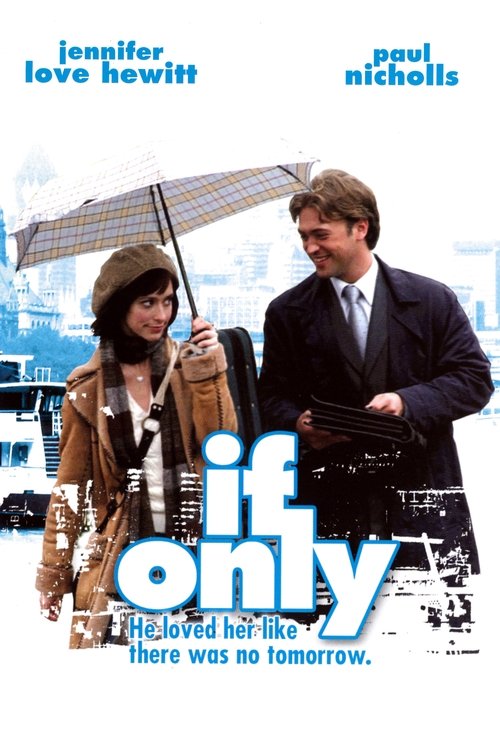
If Only (2004)
Directed by Gil Junger
No — If Only is not woke, scoring 5 out of 100 on our wokeness meter.
Gil Junger's "If Only" arrives from 2004 as a romantic fantasy of the time-loop variety, in which a London businessman named Ian loses his American musician girlfriend Samantha to a traffic accident, then wakes to find the day reset and a second chance at hand.
Consciousness Markers
The film carries a gentle moral about prioritizing love over work, delivered partly through a wise taxi driver, but it is a personal-life lesson rather than a social or political sermon.
A brief backstory notes Ian's father was laid off when the town's factory closed and became an alcoholic, a faint gesture at deindustrialization's human cost, but it is never developed into a critique of capital.
Samantha is a working musician with her own ambitions, but the film frames her chiefly as the girlfriend who wants to be loved; there is no feminist critique or gendered power analysis.
The cast is overwhelmingly white British and American performers with no evident effort at diverse or color-conscious casting; the story is a two-hander romance with no representation agenda.
No LGBTQ+ characters, themes, or subtext appear anywhere in the film.
No engagement with race, racism, or racial identity; the London setting is presented as racially unmarked.
No environmental or climate themes whatsoever.
No body-positivity themes or messaging about body image.
No neurodivergent characters or themes are present.
No historical revisionism; the film is a contemporary romantic fantasy with no historical subject matter.
Why it received this score
Gil Junger's "If Only" arrives from 2004 as a romantic fantasy of the time-loop variety, in which a London businessman named Ian loses his American musician girlfriend Samantha to a traffic accident, then wakes to find the day reset and a second chance at hand. The cast is a two-hander of Hewitt and Nicholls, supplemented by Tom Wilkinson as a taxi driver with wisdom to dispense. London appears as a backdrop of tube stations and the London Eye, a city rendered without racial texture or social friction. The film has no interest in the identity of its players beyond their romantic function, and no discernible effort to widen the frame.
Samantha plays violin, writes songs, and has ambitions of her own, but the screenplay positions her chiefly as the woman who wants to be loved. There is no gendered analysis at work, no examination of the power between them. The only gesture toward a social world comes in Ian's recollection of his hometown, where a factory closed and left his father jobless and drinking. It is a single line of backstory, a flicker of deindustrialization's cost, and it is never developed into an argument about capital or class. The rest is interior: one man learning to stop prioritizing his meeting.
The film does carry a moral, delivered mostly through Wilkinson's driver, who instructs Ian that love matters more than work. It is a lesson about personal conduct, not a sermon about society. No environmental concern intrudes. No character grapples with body image, neurodivergence, or the legacy of empire. The film is a small, earnest romance that believes in grand gestures and charm bracelets, and it asks nothing of the audience except a willingness to cry at the right moment. As a document of contemporary cultural awareness, it registers as almost perfectly blank. As a romance, it is competent and forgettable in equal measure.
Analysis generated by our Consciousness Algorithm


Synopsis
After his impetuous musician girlfriend, Samantha, dies in an accident shortly after they had a fight (and nearly broke up), Ian Wyndham, a grief-stricken British businessman living in London gets a chance to relive the day all over again, in the hope of changing the events that led up to her getting killed.
Questions about If Only
Is If Only woke?
No — If Only is not woke, scoring 5 out of 100 on our wokeness meter. That earns it a verdict of Ultra Based.
Does If Only have any woke elements?
Very few. None of the 10 markers reaches 30, the level where a marker counts as present; the highest is Lecture Energy at 15.
How does If Only compare to other 2004 movies?
It ranks #116 of the 178 films from 2004 we've scored; their average is 12. The wokest is Tropical Malady (62).
How is the Woke Score calculated?
An AI-assisted process researches the film and its reception, scores it 0–100 on ten markers, then combines those into one 0–100 Woke Score. It measures a specific set of 2020s cultural themes, not film quality.