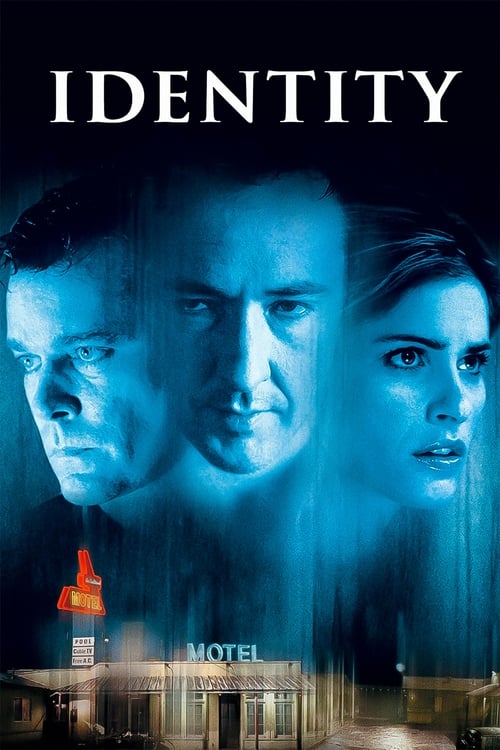
Identity (2003)
Directed by James Mangold
No — Identity is not woke, scoring 7 out of 100 on our wokeness meter.
James Mangold's Identity arrives with the modest ambition of stranding ten strangers in a Nevada rainstorm and killing them in room-key order.
Consciousness Markers
The ensemble is reasonably mixed for 2003, including a Black motel owner and several women in substantive roles, but the diversity is incidental to the whodunit and carries no commentary.
Dissociative identity disorder is the film's central twist, but it is deployed as a stigmatizing horror trope (the killer's 'evil' personality) rather than affirming neurodivergent representation.
Amanda Peet's Paris is a capable survivor and the last personality standing, but the film offers no feminist thesis or gendered critique of its violence.
The psychiatrist's courtroom exposition explains DID, but it functions as plot mechanics rather than moral instruction to the audience.
A Native American burial ground is invoked as a throwaway supernatural red herring, and the Black character is a suspect; there is no racial consciousness at work.
No LGBTQ+ characters, themes, or subtext appear; the newlywed couple and all relationships are strictly heterosexual.
The torrential rain is a claustrophobic plot device, not an environmental statement of any kind.
No economic critique or class commentary; the motel is simply a setting for murder.
No engagement with body image or size acceptance whatsoever.
No historical events or figures are revised or reinterpreted; the film is entirely fictional.
Why it received this score
James Mangold's Identity arrives with the modest ambition of stranding ten strangers in a Nevada rainstorm and killing them in room-key order. The Agatha Christie scaffolding is unapologetic, and the film knows it. What it does not advertise is that the entire damp exercise is a psychiatric thought experiment unfolding inside the skull of a condemned murderer. The ensemble is competent and, for 2003, unremarkably varied: a Black motel proprietor among the suspects, women who get to do more than scream. None of this carries any argument. The diversity is furniture, and the film never asks us to consider it.
Then the third act explains itself, and the explanation is a psychiatrist in a courtroom patiently describing dissociative identity disorder to a judge. The condition serves as the monster. The murderous alter ego, a child with a rake, is the payoff. This is the old stigmatizing arrangement, where a diagnosis becomes a twist and the afflicted become the threat. The film shows no interest in the interior life of Malcolm Rivers beyond his usefulness as a plot device. His personalities are named after states. That is the level of psychological inquiry on offer.
Amanda Peet's Paris survives longest and gets the last word, a small courtesy the film extends without ever examining why. A Native American burial ground surfaces as superstition, then evaporates. The rain is weather, not warning. There is no economic subtext in a motel full of strangers, no body politics, no historical revision. What remains is a clever, clammy thriller that mistakes a diagnosis for a demon and a twist for a thesis.
Analysis generated by our Consciousness Algorithm


Synopsis
Complete strangers stranded at a remote desert motel during a raging storm soon find themselves the target of a deranged murderer. As their numbers thin out, the travelers begin to turn on each other, as each tries to figure out who the killer is.
Questions about Identity
Is Identity woke?
No — Identity is not woke, scoring 7 out of 100 on our wokeness meter. That earns it a verdict of Ultra Based.
Does Identity have any woke elements?
Very few. None of the 10 markers reaches 30, the level where a marker counts as present; the highest is Representation Casting at 18.
How does Identity compare to other 2003 movies?
It ranks #88 of the 150 films from 2003 we've scored; their average is 12. The wokest is Mona Lisa Smile (60).
How is the Woke Score calculated?
An AI-assisted process researches the film and its reception, scores it 0–100 on ten markers, then combines those into one 0–100 Woke Score. It measures a specific set of 2020s cultural themes, not film quality.