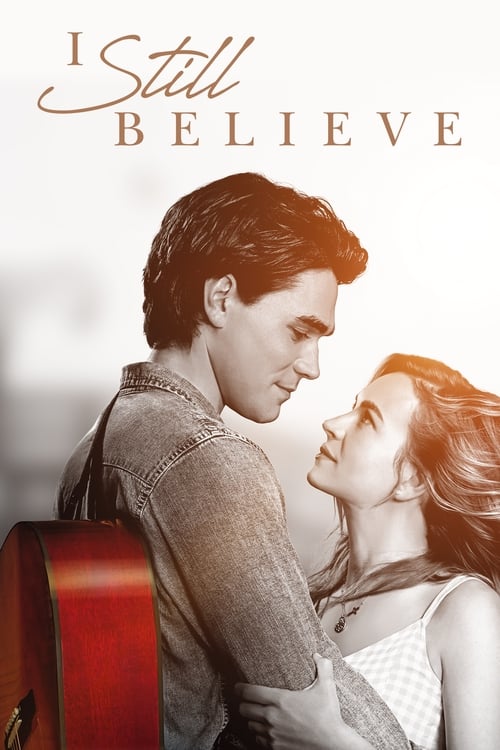
I Still Believe (2020)
Directed by Andrew Erwin
No — I Still Believe is not woke, scoring 6 out of 100 on our wokeness meter.
The Erwin brothers return with another faith-based music biopic, this time the story of Jeremy Camp and his first wife Melissa, who was diagnosed with ovarian cancer shortly before their marriage.
Consciousness Markers
The cast is overwhelmingly white, with the notable exception of KJ Apa (Samoan descent) in the lead, but this reflects standard casting rather than any conscious diversity initiative.
The film is openly didactic about Christian faith and God's purpose in suffering, but this is religious sermonizing rather than the modern progressive moralizing the marker targets.
Melissa is given some agency and a career-adjacent presence, but the film frames her primarily as a suffering muse whose death inspires the male protagonist's art.
No LGBTQ+ characters, themes, or subtext appear anywhere in this traditional Christian romance.
The film engages no racial themes whatsoever; it is a story about white evangelical college students in California and Indiana.
There is no environmental or climate content in the film.
The film celebrates the Christian music industry and the protagonist's rise within it, with no critique of wealth or capitalism.
No body-positivity themes; the narrative centers on illness and physical decline without any body-acceptance messaging.
No neurodivergent characters or themes are present.
The film is a straightforward faith-based biography of Jeremy Camp and does not reinterpret history through a modern ideological lens.
Why it received this score
The Erwin brothers return with another faith-based music biopic, this time the story of Jeremy Camp and his first wife Melissa, who was diagnosed with ovarian cancer shortly before their marriage. The film is sincere. It is also, judged against the cultural markers of the present decade, remarkably bare. This is a story about white evangelical college students in California and Indiana, and it makes no apology for that, nor does it appear aware that an apology might be expected of it.
The romance grants Melissa a measure of agency, a spark of personality, a life adjacent to her own story. The machinery of the plot then positions her as a suffering muse whose death supplies the male protagonist with his art. Her function is to decline beautifully and leave a note inside a guitar. There is no racial content, no environmental content, no critique of the Christian music industry that makes Jeremy a star. The film celebrates that industry without a flicker of doubt. Illness arrives as an obstacle to be overcome by faith, not as an identity to be embraced, so body acceptance never enters the frame. No LGBTQ characters appear. No neurodivergent characters appear. The camera studies the couple's devotion with a tenderness it never extends to anything resembling a social question.
The film is openly preachy about God's purpose in suffering, and it wants us to understand that suffering strengthens belief instead of damaging it. This is sermonizing of an old and durable kind, aimed squarely at the choir and delivered without embarrassment. It is not the modern progressive moralizing that has become a cultural flashpoint, and we should not inflate the distinction. The earnestness is total. The invitation to outsiders is polite and faint. A modest entry in the faith-based catalogue, and a nearly empty ledger for our purposes, which is its own kind of distinction in a crowded field.
Analysis generated by our Consciousness Algorithm
Part of


Synopsis
The true-life story of Christian music star Jeremy Camp and his journey of love and loss that looks to prove there is always hope.
Questions about I Still Believe
Is I Still Believe woke?
No — I Still Believe is not woke, scoring 6 out of 100 on our wokeness meter. That earns it a verdict of Ultra Based.
Does I Still Believe have any woke elements?
Very few. None of the 10 markers reaches 30, the level where a marker counts as present; the highest is Lecture Energy at 10.
How does I Still Believe compare to other 2020 movies?
It ranks #177 of the 227 films from 2020 we've scored; their average is 21. The wokest is One Night in Miami... (83).
How is the Woke Score calculated?
An AI-assisted process researches the film and its reception, scores it 0–100 on ten markers, then combines those into one 0–100 Woke Score. It measures a specific set of 2020s cultural themes, not film quality.