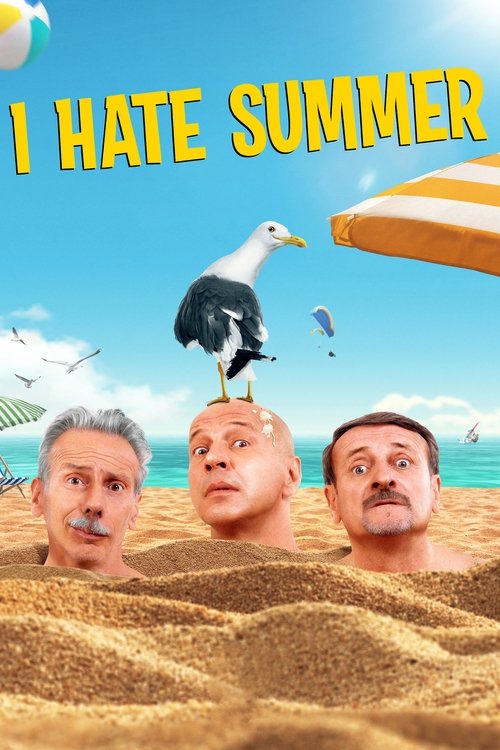
I Hate Summer (2020)
Directed by Massimo Venier
No — I Hate Summer is not woke, scoring 0 out of 100 on our wokeness meter.
Three Milanese fathers, each carrying a different variety of domestic grievance, arrive on a southern island to find they have rented the same house.
Consciousness Markers
The cast is entirely Italian and white, with no deliberate multicultural or representational casting agenda.
No LGBTQ+ characters, relationships, or themes appear in the film.
Female characters exist as wives and mothers, but the film advances no feminist critique or agenda.
Race and racial identity are not addressed or thematized in any way.
There is no environmental or climate-related message or concern.
A failing family shop appears as a plot detail, but the film contains no anti-capitalist or eat-the-rich argument.
Body image, size acceptance, or related themes are absent.
A withdrawn boy who plays video games is not framed through neurodivergence or mental-health advocacy.
The film is a contemporary comedy with no historical revisionism or reclamation.
The film aims for warm comedy and sentiment rather than preachy social instruction.
Why it received this score
Three Milanese fathers, each carrying a different variety of domestic grievance, arrive on a southern island to find they have rented the same house. The premise delivers a summer of forced proximity, a lost dog, a runaway boy, a Massimo Ranieri concert, and a great deal of shouting in the kitchen. Massimo Venier directs the trio Aldo, Giovanni and Giacomo with the easy rhythm of a troupe that knows its audience, and the result became the third highest grossing Italian film of 2020. It is a warm, well-made comedy about men learning to say the things they have been avoiding.
For the purposes of cultural classification, the cupboard is bare. The cast is Italian and white, and the film shows no interest in commenting on that fact. The wives are wives, the mothers are mothers, and nobody stages an intervention about it. Ludovico, the twelve-year-old who retreats into video games, is treated as a boy with a pen pal and a mood, not as a case study. Giovanni's failing shoe-accessory shop is a device for marital concealment, not an indictment of late capitalism. When Aldo's terminal diagnosis arrives in the final act, it lands as sentiment earned through character, not as a sermon. The film wants us to cry a little and laugh more.
There is no lecture here, no lesson appended to the closing fireworks. The film's virtues are the old ones: patience, craft, a good ensemble, a well-timed silence. A sommelier presented with this bottle would note its clarity and its complete absence of additives, then be obliged to record a score of zero. The summer is agreeable. The audit is uneventful. We mark the file complete and move to the next screening.
Analysis generated by our Consciousness Algorithm
Synopsis
Three families end up in the same rented house. Throughout the summer, they become friends and rediscover how to enjoy life.
Questions about I Hate Summer
Is I Hate Summer woke?
No — I Hate Summer is not woke, scoring 0 out of 100 on our wokeness meter. That earns it a verdict of Ultra Based.
Does I Hate Summer have any woke elements?
No. All 10 markers score zero.
How does I Hate Summer compare to other 2020 movies?
It ranks #210 of the 227 films from 2020 we've scored; their average is 21. The wokest is One Night in Miami... (83).
How is the Woke Score calculated?
An AI-assisted process researches the film and its reception, scores it 0–100 on ten markers, then combines those into one 0–100 Woke Score. It measures a specific set of 2020s cultural themes, not film quality.