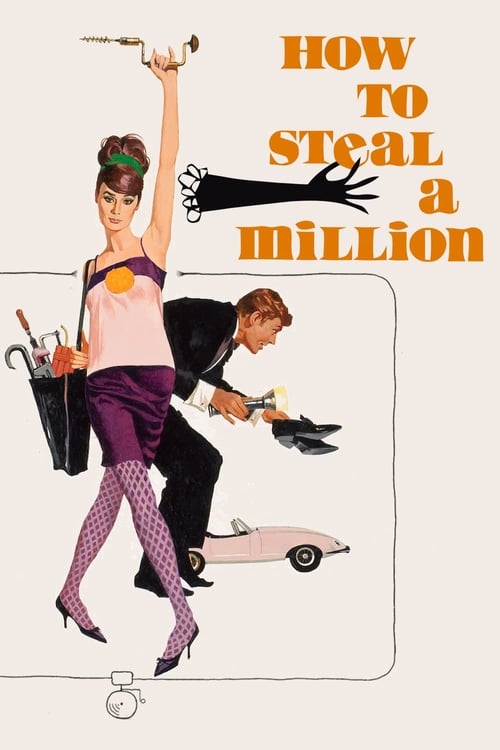
How to Steal a Million (1966)
Directed by William Wyler
No — How to Steal a Million is not woke, scoring 0 out of 100 on our wokeness meter.
William Wyler's How to Steal a Million arrives from 1966 with its Givenchy wardrobe, its Parisian postcards, and its complete indifference to the moral instruction of later decades.
Consciousness Markers
The cast is entirely white and European or American, with no modern diversity-conscious casting choices or commentary.
There are no LGBTQ+ characters, themes, or subtext in the film.
Audrey Hepburn's Nicole is a central character, but the film is a light romantic heist comedy with no feminist agenda or gender-political critique.
Race is not a subject of the film, and no racial consciousness or commentary is present.
There is no environmental or climate-related theme in the film.
The film features wealthy art collectors and forgers, but it treats these as comic caper elements rather than offering an anti-capitalist critique.
There is no body-positivity theme or messaging in the film.
There is no exploration or representation of neurodivergence in the film.
The film is a fictional caper comedy and does not engage in historical revisionism.
The film is a light entertainment caper and contains no preachy or lecture-like messaging.
Why it received this score
William Wyler's How to Steal a Million arrives from 1966 with its Givenchy wardrobe, its Parisian postcards, and its complete indifference to the moral instruction of later decades. Audrey Hepburn plays Nicole, the daughter of a forger, and Peter O'Toole plays the man she recruits to lift a fake Cellini Venus out of a museum before a forensic examination exposes the family trade. The premise is fraud. The tone is champagne. Nobody involved appears to have consulted a sociologist. It is a caper, and it knows it is a caper, and it declines to be anything else.
The film's pleasures are entirely of surface and craft. Hepburn models a succession of frocks. O'Toole smolders with the specific smugness of a man who has been told he is charming. The central heist, staged across a utility closet and a darkened museum floor, is engineered with real comic precision. There is a wealthy American collector who covets the statue and a father who mourns the insurance payout that will never come. Money is discussed constantly. Nobody in the screenplay is indicted for it.
We searched, as is our duty, for the markers of contemporary social consciousness. We found none. The cast is uniformly white and European. The women exist to be lovely and worried. Race, climate, class grievance, identity, and the question of neurodivergence go unmentioned and unexamined. The film has no thesis, no sermon, and no interest in improving anybody. It is an empty ledger, and the emptiness is, in its way, restful. A clean zero. Rare, and almost admirable.
Analysis generated by our Consciousness Algorithm


Synopsis
A woman must steal a statue from a Paris museum to help conceal her father's art forgeries.
Questions about How to Steal a Million
Is How to Steal a Million woke?
No — How to Steal a Million is not woke, scoring 0 out of 100 on our wokeness meter. That earns it a verdict of Ultra Based.
Does How to Steal a Million have any woke elements?
No. All 10 markers score zero.
How does How to Steal a Million compare to other 1966 movies?
It ranks #14 of the 18 films from 1966 we've scored; their average is 7. The wokest is Daisies (28).
How is the Woke Score calculated?
An AI-assisted process researches the film and its reception, scores it 0–100 on ten markers, then combines those into one 0–100 Woke Score. It measures a specific set of 2020s cultural themes, not film quality.