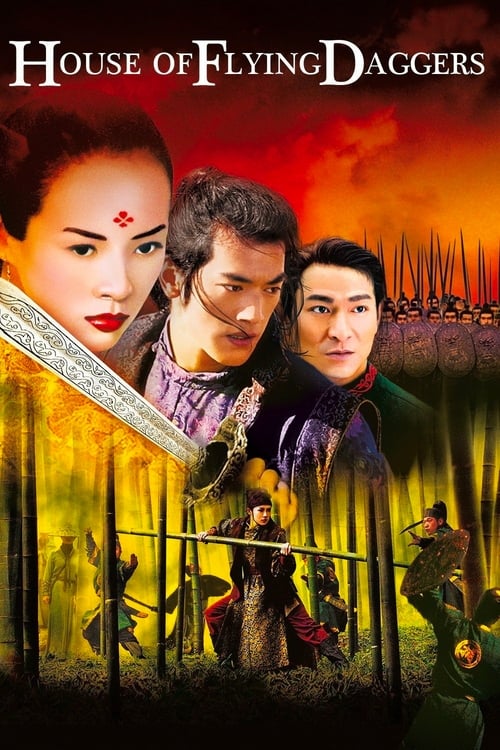
House of Flying Daggers (2004)
Directed by Zhang Yimou
No — House of Flying Daggers is not woke, scoring 6 out of 100 on our wokeness meter.
House of Flying Daggers arrives from 2004, a year when a director could still stage a love triangle among imperial police and call it entertainment.
Consciousness Markers
The cast is entirely East Asian in a Chinese-language wuxia, but this reflects the film's authentic setting rather than a modern diversity-casting agenda.
The Flying Daggers are rebels who steal from the rich and give to the poor, but this is a pre-modern Robin Hood motif rather than modern anti-capitalist critique.
Mei is a capable central figure, but the film treats her largely as a romantic prize between two men and includes attempted sexual assault without a feminist critique.
No LGBTQ+ themes, characters, or subtext are present.
The conflict is dynastic and political, not racial; no racial consciousness or commentary is present.
There is no environmental or climate-related theme.
No body-positivity themes or messaging are present.
Mei's blindness is a plot device and disability, not neurodivergence, and it is revealed to be feigned.
The film is a fictional wuxia set in the Tang dynasty, not a revisionist historical narrative.
The film is a romantic martial-arts spectacle and does not lecture the audience on social or political issues.
Why it received this score
House of Flying Daggers arrives from 2004, a year when a director could still stage a love triangle among imperial police and call it entertainment. Zhang Yimou fills the Tang dynasty with bamboo, snow, and the wuxing colour theory, and the result is gorgeous enough that Roger Ebert advised ignoring the plot entirely. The plot concerns Mei, a blind dancer at the Peonyhouse, two officers named Jin and Liu, and a rebel army that steals from the rich and gives to the poor. That arrangement earns a modest nod in our accounting, though the Flying Daggers predate the modern critique of capital by eleven centuries and appear to have no shareholders to dispossess. A Robin Hood motif is not a manifesto.
The film's social consciousness is otherwise thin, and we record this without malice. The cast is entirely East Asian, which reflects a Chinese-language production set in ninth-century China, not a directive from a studio diversity office. Mei is a capable fighter and the emotional centre of the piece, but the screenplay positions her as the prize in a contest between two men, and a scene of attempted assault in the brothel is staged as a ruse and never revisited. Her blindness turns out to be an act, which removes the disability from consideration and leaves nothing to file under neurodivergence. There is no racial commentary, no climate anxiety, no body-positivity messaging, and no sermon at the end. The film wants to show us daggers flying through a bamboo grove, and it does.
The result is a romantic martial-arts spectacle of high craft and low ideological content. It was nominated for an Academy Award for cinematography and won nothing. Cannes gave it a twenty-minute ovation, nineteen minutes longer than most films deserve. We recommend it for the visuals, and for the melancholy fact that a beautiful woman destroying two men remains, as the Han poet Li Yannian observed, a theme with remarkable staying power.
Analysis generated by our Consciousness Algorithm


Synopsis
In 9th century China, a corrupt government wages war against a rebel army called the Flying Daggers. A romantic warrior breaks a beautiful rebel out of prison to help her rejoin her fellows, but things are not what they seem.
Questions about House of Flying Daggers
Is House of Flying Daggers woke?
No — House of Flying Daggers is not woke, scoring 6 out of 100 on our wokeness meter. That earns it a verdict of Ultra Based.
Does House of Flying Daggers have any woke elements?
Very few. None of the 10 markers reaches 30, the level where a marker counts as present; the highest is Eat the Rich at 15.
How does House of Flying Daggers compare to other 2004 movies?
It ranks #104 of the 178 films from 2004 we've scored; their average is 12. The wokest is Tropical Malady (62).
How is the Woke Score calculated?
An AI-assisted process researches the film and its reception, scores it 0–100 on ten markers, then combines those into one 0–100 Woke Score. It measures a specific set of 2020s cultural themes, not film quality.