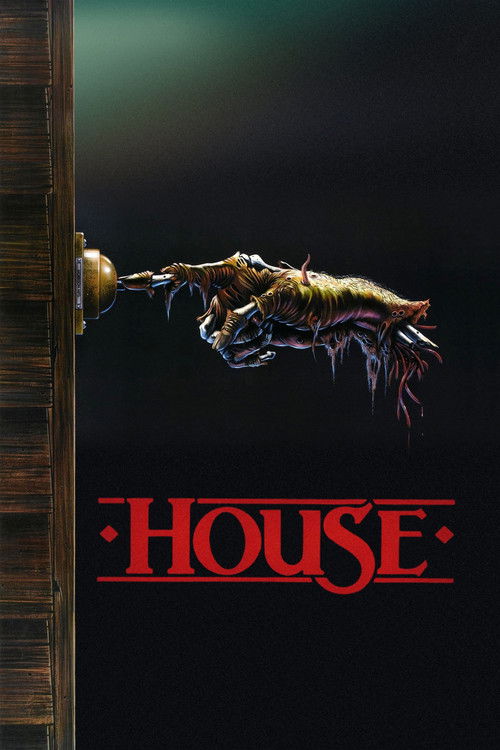
House (1985)
Directed by Steve Miner
No — House is not woke, scoring 0 out of 100 on our wokeness meter.
Steve Miner's House arrives from 1985 with a screenplay by Ethan Wiley and a premise that sounds, on paper, like a thesis waiting to happen: a divorced horror novelist, a vanished son, a mansion inherited from a dead aunt, and a Vietnam flashback structure that keeps interrupting the ghost business.
Consciousness Markers
The cast is uniformly white — William Katt, George Wendt, Richard Moll, Kay Lenz — with no deliberate representation casting or diverse ensemble constructed around identity.
There are no LGBTQ+ characters, themes, or subtext anywhere in the film.
The female characters (the movie-star ex-wife, the late aunt, the flirty neighbor) are peripheral plot devices; the film carries no feminist argument or gendered critique.
The Vietnam flashbacks feature Viet Cong antagonists as generic wartime threats, not as a vehicle for racial consciousness or commentary on race.
There is no environmental or climate theme in the film whatsoever.
The film offers no economic critique; capital and class are simply not its concerns.
The only body-related content is the grotesque 'obese witch' monster played for horror, which is the opposite of a body-positivity message.
No neurodivergent characters or themes of neurodiversity are present; the 'senile' aunt is a horror trope, not representation.
The Vietnam material is personal survivor's guilt and war trauma, dramatized as horror rather than as an ideological revision of the historical record.
This is a tongue-in-cheek 1985 haunted-house comedy; the war trauma is story fuel, never delivered as a sermon to the audience.
Why it received this score
Steve Miner's House arrives from 1985 with a screenplay by Ethan Wiley and a premise that sounds, on paper, like a thesis waiting to happen: a divorced horror novelist, a vanished son, a mansion inherited from a dead aunt, and a Vietnam flashback structure that keeps interrupting the ghost business. The film declines every invitation to make a point. Roger Cobb moves in, fights a mounted swordfish, shoots a witch, and descends through his bathroom medicine cabinet into a void dimension to retrieve his kidnapped child. The war material exists to explain why the man is sad. It is not there to instruct anyone about the war.
As a cultural document, the picture is a vacuum. The cast is uniformly white, assembled with no gesture toward representation as a value in itself. The women in the story, the movie-star ex-wife, the aunt who hangs herself, the neighbor who needs a babysitter, function as plot machinery and nothing more. There is no same-sex romance, no racial reckoning, no carbon footprint, no class grievance. The one body-adjacent joke is an obese witch monster, staged for disgust, which is the exact opposite of an affirming message. The senile aunt is a horror trope, not a portrait of cognitive difference.
The Vietnam passages dramatize survivor's guilt, a personal wound, not a revised historical record. Nothing here lectures. This is a tongue-in-cheek haunted-house comedy that wants a laugh and a jump, in that order, and gets them often enough to have earned a modest cult. The sequel machine ground out three more of these. The whole enterprise registers as a clean slate, which in this line of work is its own kind of rarity.
Analysis generated by our Consciousness Algorithm


Synopsis
A divorced horror novelist coming to terms with the disappearance of his young son inherits an old mansion home to malevolent supernatural residents.
Questions about House
Is House woke?
No — House is not woke, scoring 0 out of 100 on our wokeness meter. That earns it a verdict of Ultra Based.
Does House have any woke elements?
No. All 10 markers score zero.
How does House compare to other 1985 movies?
It ranks #51 of the 68 films from 1985 we've scored; their average is 8. The wokest is The Color Purple (62).
How is the Woke Score calculated?
An AI-assisted process researches the film and its reception, scores it 0–100 on ten markers, then combines those into one 0–100 Woke Score. It measures a specific set of 2020s cultural themes, not film quality.