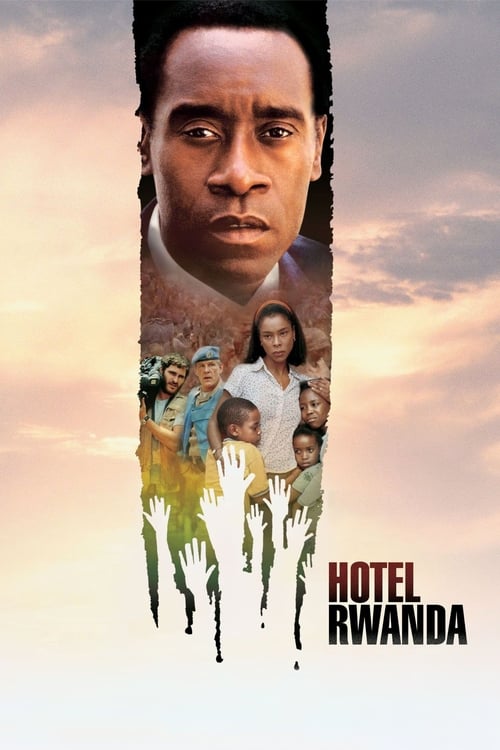
Hotel Rwanda (2004)
Directed by Terry George
No — Hotel Rwanda is not especially woke, scoring 28 out of 100 on our wokeness meter.
Hotel Rwanda arrives with the full weight of a genuine atrocity behind it, and there is no arguing with the material.
Consciousness Markers
The film explicitly indicts the world's indifference to African lives, with the director noting 'African lives are not seen as valuable as the lives of Europeans or Americans' — a genuine engagement with racial devaluation, though framed as humanist outrage rather than modern identity politics.
The cast is overwhelmingly Black African actors (Cheadle, Okonedo, Mokoena, Kae-Kazim) portraying Rwandan characters, which is authentic to the story rather than a deliberate diversity gesture for a Western narrative.
The film carries a moralizing message about international inaction and ends with a textual epilogue, prompting one critic to call it 'more overlectured than properly overwhelmed,' though the sermon is humanist rather than identitarian.
Sophie Okonedo's Tatiana has moments of agency and desperation, but the film is squarely a male-centered hero narrative built around Paul Rusesabagina.
The 'rich cockroaches' line gestures at the economic dimension of the genocide and Paul's bribery of officials, but there is no systemic anti-capitalist critique.
The film dramatizes real events but has drawn criticism for glorifying Rusesabagina and simplifying contested history; this is historical embellishment rather than modern ideological revisionism.
There are no LGBTQ+ characters, themes, or subtext anywhere in the film.
No environmental or climate themes appear in the film.
No body positivity themes are present.
No neurodivergence themes or characters are present.
Why it received this score
Hotel Rwanda arrives with the full weight of a genuine atrocity behind it, and there is no arguing with the material. Terry George's 2004 drama follows Paul Rusesabagina, a hotel manager who kept more than a thousand Tutsis and moderate Hutus alive inside the Hôtel des Mille Collines while the world's peacekeepers stood by. The cast is almost entirely Black African, led by Don Cheadle and Sophie Okonedo, and this reads as fidelity to the story, not as a contemporary casting directive. There are no queer characters, no environmental subplot, no meditation on body image or neurodivergence. The film is uninterested in those registers. That is neither a failing nor an achievement. It is a different kind of picture, made in a different cultural moment.
The film's social conscience is real but of an older vintage. George has spoken plainly about a world that does not value African lives as it values European ones, and the screenplay builds its indictment around that indifference: the Belgian owner apologizing by telephone, the evacuation of foreign nationals, the UN colonel explaining that he is not permitted to intervene. This is moral outrage in a humanist key, aimed at the audience's conscience, not its vocabulary. The closing text, listing who lived, who was tried, and who was never found, does the work of a sermon. A critic at the time complained of being overlectured. That complaint has aged well.
Where the film brushes against economic critique, it does so glancingly. Georges Rutaganda's remark that the money of the rich cockroaches will soon be worthless gestures at the material dimension of the killing, and Paul's steady bribery of generals and militiamen is presented as pragmatism, not as a system to be dismantled. The narrative remains a man's story, with Tatiana's desperation and courage carried along in his wake. On historical accuracy, the film has drawn sustained criticism from survivors and from Roméo Dallaire, who felt his men were shortchanged. That is the ordinary friction of dramatizing contested events, not the imposition of a modern ideological frame. The result is a film of undoubted moral seriousness that keeps its politics in the past tense.
Analysis generated by our Consciousness Algorithm


Synopsis
Inspired by true events, this film takes place in Rwanda in the 1990s when more than a million Tutsis were killed in a genocide that went mostly unnoticed by the rest of the world. Hotel owner Paul Rusesabagina houses over a thousand refuges in his hotel in attempt to save their lives.
Questions about Hotel Rwanda
Is Hotel Rwanda woke?
No — Hotel Rwanda is not especially woke, scoring 28 out of 100 on our wokeness meter. That earns it a verdict of Based.
Does Hotel Rwanda have any woke elements?
3 of the 10 markers register at 30 or above, led by Racial Consciousness (55), Representation Casting (45) and Lecture Energy (30). On Racial Consciousness: The film explicitly indicts the world's indifference to African lives, with the director noting 'African lives are not seen as valuable as the lives of Europeans or Americans' — a genuine engagement with racial devaluation, though framed as humanist outrage rather than modern identity politics.
How does Hotel Rwanda compare to other 2004 movies?
It ranks #16 of the 178 films from 2004 we've scored; their average is 12. The wokest is Tropical Malady (62).
How is the Woke Score calculated?
An AI-assisted process researches the film and its reception, scores it 0–100 on ten markers, then combines those into one 0–100 Woke Score. It measures a specific set of 2020s cultural themes, not film quality.