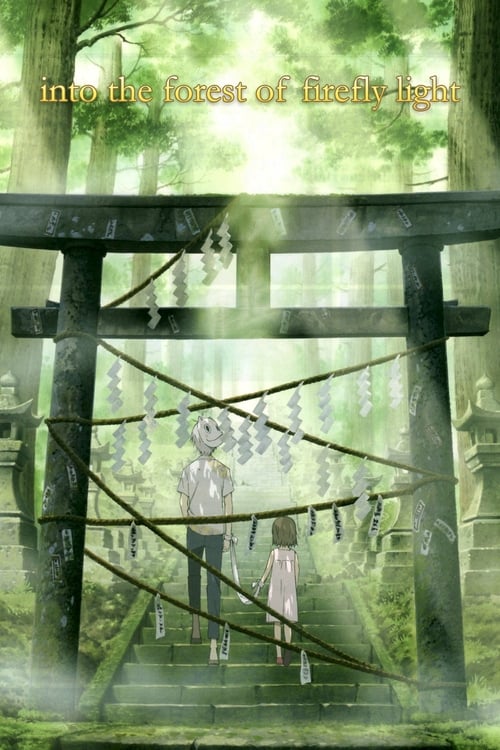
Hotarubi no Mori e (2011)
Directed by Takahiro Omori
No — Hotarubi no Mori e is not woke, scoring 0 out of 100 on our wokeness meter.
Hotarubi no Mori e runs roughly forty-five minutes, which is enough time for a little girl named Hotaru to get lost in a mountain god's forest, meet a masked boy named Gin, and spend a decade of summers learning that she cannot touch him without erasing him.
Consciousness Markers
The film features an entirely Japanese cast and characters, with no deliberate diverse or inclusive casting choices that would register as modern representation casting.
There are no LGBTQ+ characters, relationships, or themes in the story.
Although the protagonist is a girl, the film is a supernatural romance and does not advance a feminist agenda or critique patriarchal structures.
The film does not engage with racial identity, racism, or racial justice themes.
The forest and spirit world are fantastical settings, not vehicles for climate activism or environmental messaging.
There is no critique of capitalism, wealth inequality, or economic systems in the film.
The film does not address body image, size diversity, or body positivity themes.
No characters are depicted as neurodivergent, and the film does not explore neurodiversity.
The story is a fictional supernatural romance and does not revise or reinterpret historical events.
The film is a quiet, emotional fantasy romance and does not contain preachy or didactic social messaging.
Why it received this score
Hotarubi no Mori e runs roughly forty-five minutes, which is enough time for a little girl named Hotaru to get lost in a mountain god's forest, meet a masked boy named Gin, and spend a decade of summers learning that she cannot touch him without erasing him. Brain's Base animates the thing with a softness that borders on the pastoral, and the source material is a shoujo manga by Yuki Midorikawa. The emotional engine is simple. Two people care for each other across a boundary neither can cross, and time does what time does.
Assessing this against the contemporary cultural ledger is a brisk exercise. Hotaru is a girl, and the story belongs to her, yet the film has no argument to make about gender, power, or patriarchy. The forest is populated by spirits and folklore, not by ecological anxieties, and the mountain god is not a metaphor for carbon offsets. Nobody is sorted into an identity category for the viewer's edification. There is no wealth to redistribute, no institution to indict, no body to celebrate, no diagnosis to normalize, and no history to correct. The film's only sermon concerns impermanence, and it delivers that with a firefly and a mask.
Some vintages simply refuse the modern palate. This is a delicate, melancholy romance with a supernatural premise, and it wants nothing more than to make the viewer feel the ache of a season ending. We can respect the craft and still mark the absence. A quiet film can be a fine film. This is a quiet film, and very little else besides.
Analysis generated by our Consciousness Algorithm
Synopsis
One hot summer day a little girl gets lost in an enchanted forest of the mountain god where spirits reside. A young boy appears before her, but she cannot touch him for fear of making him disappear. And so a wondrous adventure awaits...
Questions about Hotarubi no Mori e
Is Hotarubi no Mori e woke?
No — Hotarubi no Mori e is not woke, scoring 0 out of 100 on our wokeness meter. That earns it a verdict of Ultra Based.
Does Hotarubi no Mori e have any woke elements?
No. All 10 markers score zero.
How does Hotarubi no Mori e compare to other 2011 movies?
It ranks #216 of the 245 films from 2011 we've scored; their average is 11. The wokest is Paul (68).
How is the Woke Score calculated?
An AI-assisted process researches the film and its reception, scores it 0–100 on ten markers, then combines those into one 0–100 Woke Score. It measures a specific set of 2020s cultural themes, not film quality.