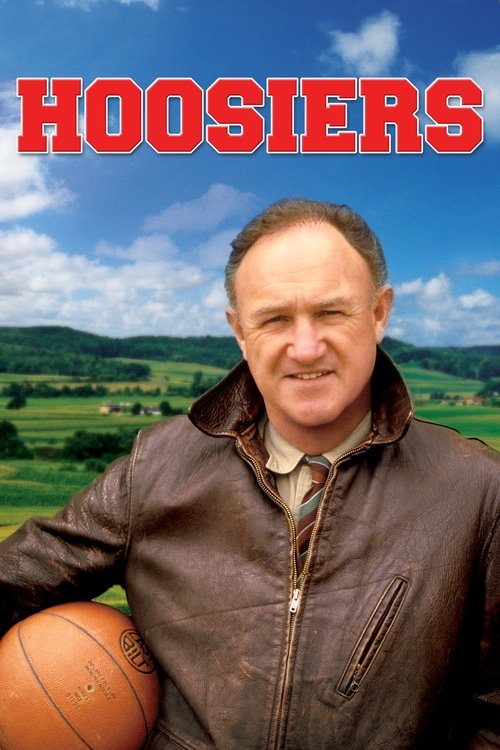
Hoosiers (1986)
Directed by David Anspaugh
No — Hoosiers is not woke, scoring 4 out of 100 on our wokeness meter.
Hoosiers arrives from 1986 with the confidence of a film that knows exactly what it is and has no intention of apologizing for it.
Consciousness Markers
The film is inspirational and sentimental about teamwork and redemption, but its moralizing is classic underdog-sports uplift rather than modern social-justice preaching.
Barbara Hershey's Myra Fleener is a teacher with some agency who advocates for Jimmy's education and speaks at the town meeting, but the role is largely a one-note romantic subplot that goes nowhere.
The cast is almost entirely white, set in 1950s rural Indiana; a contemporary critic noted the film's world where 'blacks are only a rumor.' No meaningful diverse casting.
No LGBTQ+ characters, themes, or subtext of any kind.
The film contains no engagement with race whatsoever; its small-town Indiana setting is depicted as uniformly white.
No environmental or climate themes present.
No critique of capitalism or wealth; the story is a community underdog sports narrative.
No body positivity themes; the film's underdog angle is about height and athleticism, not body acceptance.
No neurodivergent characters or themes; Shooter's arc concerns alcoholism, not neurodivergence.
While 'inspired by' the 1954 Milan team, the film does not reinterpret history through a modern progressive lens; it is a nostalgic period piece.
Why it received this score
Hoosiers arrives from 1986 with the confidence of a film that knows exactly what it is and has no intention of apologizing for it. It plants itself in Hickory, Indiana, in 1951, and populates that town with a monochrome cast of farmers, shopkeepers, and seven boys in short shorts. Race does not enter the frame, not as a subject and not as a face in the crowd. One critic at the time observed that the film takes place in a decade where Black people are only a rumor. The observation stands. There is no LGBTQ presence, no environmental anxiety, no grudge against money, and no interest in bodies except as instruments of height and stamina. The underdog premise rests on the Huskers being short and slow, which is a matter of athleticism, not acceptance. Shooter Flatch drinks, and his drinking is handled as a moral failing with a redemption arc attached, not as a condition to be understood.
Barbara Hershey's Myra Fleener supplies the single faint tremor of agency in the entire enterprise. She is a teacher who argues for Jimmy Chitwood's education and stands at a lectern prepared to expose the coach's past. Then she changes her mind, and the character settles into a courtship the film never bothers to finish. The picture's historical posture is reverence, not revision: the Milan team of 1954 is honored, softened, and rearranged into a fable, which is nostalgia dressed as memory.
The moralizing that does occur is the old kind. Teamwork. Second chances. A coach who loves his players and says so in a voiceover. It is a pep talk delivered in a gymnasium, not a sermon about society, and the difference matters when we sit down to classify. As a specimen of contemporary cultural consciousness, this one is close to inert. As a time capsule of what 1986 believed about 1951, it is immaculate.
Analysis generated by our Consciousness Algorithm


Synopsis
Failed college coach Norman Dale gets a chance at redemption when he is hired to coach a high school basketball team in a tiny Indiana town. After a teacher persuades star player Jimmy Chitwood to quit and focus on his long-neglected studies, Dale struggles to develop a winning team in the face of community criticism for his temper and his unconventional choice of assistant coach: Shooter, a notorious alcoholic.
Questions about Hoosiers
Is Hoosiers woke?
No — Hoosiers is not woke, scoring 4 out of 100 on our wokeness meter. That earns it a verdict of Ultra Based.
Does Hoosiers have any woke elements?
Very few. None of the 10 markers reaches 30, the level where a marker counts as present; the highest is Lecture Energy at 10.
How does Hoosiers compare to other 1986 movies?
It ranks #28 of the 62 films from 1986 we've scored; their average is 7. The wokest is Star Trek IV: The Voyage Home (42).
How is the Woke Score calculated?
An AI-assisted process researches the film and its reception, scores it 0–100 on ten markers, then combines those into one 0–100 Woke Score. It measures a specific set of 2020s cultural themes, not film quality.