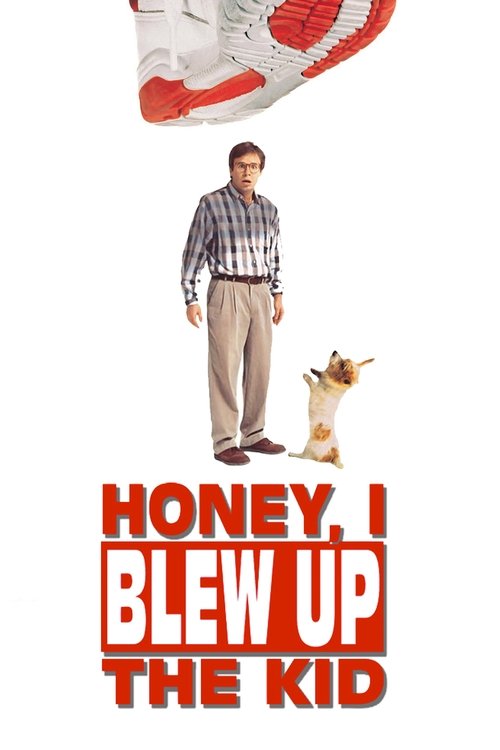
Honey, I Blew Up the Kid (1992)
Directed by Randal Kleiser
No — Honey, I Blew Up the Kid is not woke, scoring 6 out of 100 on our wokeness meter.
Honey, I Blew Up the Kid arrives as the second installment in a franchise about an inventor whose machines cannot behave.
Consciousness Markers
Diane Szalinski is competent and ultimately the one who deduces the solution and grows giant to comfort Adam, but this is standard capable-mom characterization rather than a feminist thesis.
The cast is overwhelmingly white, with Ron Canada and Gregory Sierra appearing in minor supporting roles as a marshal and a board member respectively. There is no deliberate, commented-upon diversity casting.
Dr. Hendrickson is a mildly avaricious corporate colleague scheming for control of the invention, but the film resolves this by having the chairman fire him, offering no systemic critique of capital.
No LGBTQ+ characters, themes, or subtext of any kind appear in this 1992 Disney family comedy.
No engagement with race, racism, or racial identity whatsoever; the film is a suburban white-family farce.
No environmental or climate themes are present.
No body-positivity themes; the giant toddler is played for slapstick spectacle, not self-acceptance messaging.
No neurodivergent characters or themes are depicted.
No historical revisionism; the film is a contemporary fantasy comedy with no historical subject matter.
The film is a light one-joke family comedy with no preachy messaging or moralizing monologues.
Why it received this score
Honey, I Blew Up the Kid arrives as the second installment in a franchise about an inventor whose machines cannot behave. This 1992 Disney comedy sends a two-year-old named Adam through a growth ray, then watches him become seven feet, fourteen feet, fifty feet, and finally a Las Vegas attraction. The film is a one-joke contraption, and the joke is scale. It is also, for our purposes, a remarkably quiet specimen. The cast is almost entirely white and suburban. Ron Canada and Gregory Sierra appear in minor supporting roles, a marshal and a board member, but the film never comments on their presence or builds any multicultural thesis around them. There is no LGBTQ material, no racial consciousness, no climate anxiety, no neurodivergent character, no body-positive arc. Adam's gigantism is slapstick spectacle, not a parable of self-acceptance. The story is contemporary fantasy, so revisionist history has nothing to chew on.
The feminist content is modest. Diane Szalinski is capable, and she is the one who realizes Adam will calm down if she is enlarged to his scale. She comforts her son and later punches the corporate villain for hurting him. This is standard competent-mother characterization, not a feminist argument. The anti-capitalist gesture is equally mild. Dr. Hendrickson is an avaricious colleague who wants control of Wayne's invention, but the company chairman simply fires him. Corporate power is corrected by a nicer executive. The film offers no systemic critique of capital, only a reminder that some coworkers are unpleasant.
Lecture energy is absent. The screenplay never stops for a sermon about society, identity, or the environment. It wants pratfalls, miniature furniture, a giant bunny, and a toddler wandering through Fremont Street. The result is culturally inert, harmless, and mildly diverting. It carries a faint trace of capable-mother energy and a faint trace of anti-corporate annoyance, but these are not modern social consciousness. They are old Hollywood defaults. The sommelier sets down the glass. Thin, inoffensive, and almost entirely without the vintage we are cataloging.
Analysis generated by our Consciousness Algorithm
Part of


Synopsis
Wayne Szalinski is at it again. But instead of shrinking things, he tries to make a machine that can make things grow. As in the first one, his machine isn't quite accurate. But when he brings Nick & his toddler son Adam to see his invention, the machine unexpectedly starts working. And when Adam comes right up to the machine, he gets zapped along with his stuffed bunny.
Questions about Honey, I Blew Up the Kid
Is Honey, I Blew Up the Kid woke?
No — Honey, I Blew Up the Kid is not woke, scoring 6 out of 100 on our wokeness meter. That earns it a verdict of Ultra Based.
Does Honey, I Blew Up the Kid have any woke elements?
Very few. None of the 10 markers reaches 30, the level where a marker counts as present; the highest is Feminist Agenda at 12.
How does Honey, I Blew Up the Kid compare to other 1992 movies?
It ranks #46 of the 74 films from 1992 we've scored; their average is 12. The wokest is The Crying Game (62).
Is Honey, I Blew Up the Kid the most woke Honey, I Shrunk the Kids movie?
Yes. It scores highest of the 3 Honey, I Shrunk the Kids films we've scored.