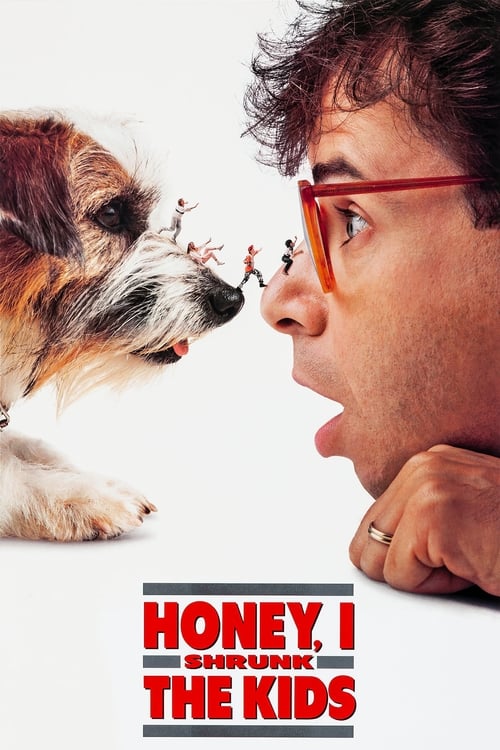
Honey, I Shrunk the Kids (1989)
Directed by Joe Johnston
No · Ultra Based
How we score movies →Consciousness Markers
The cast is predominantly white and reflects 1980s mainstream Hollywood demographics. No deliberate effort toward diverse casting is evident, though this was not a standard expectation for family films of this era.
The film exhibits no racial consciousness or engagement with issues of race. The suburban world presented is racially homogeneous and this homogeneity is presented without comment or awareness.
No LGBTQ+ themes, representation, or subtext appear in the film. The narrative contains no characters coded as queer and no discussion of sexual orientation or gender identity.
The film contains no feminist reframing or commentary. Female characters serve support roles in a narrative centered on male action and problem-solving.
No climate change messaging or environmental advocacy appears in the film. The narrative focuses entirely on a personal family adventure with no environmental dimension.
The film contains no anti-capitalist sentiment. The protagonist is a middle-class inventor and no critique of capitalism or wealth distribution appears in the narrative.
No body positivity messaging or advocacy for diverse body types appears in the film. The cast represents conventional Hollywood aesthetics of the 1980s without commentary.
No neurodivergent characters or representation appear in the film. No discussion of autism, ADHD, or other forms of neurodivergence is present.
The film contains no historical narrative or revisionist reframing of historical events. It is a contemporary family adventure with no historical dimension.
The film contains no preachy messaging or attempt to educate the audience about social justice matters. It is straightforward entertainment with no pedagogical intent regarding progressive causes.


Synopsis
The scientist father of a teenage girl and boy accidentally shrinks his and two other neighborhood teens to the size of insects. Now the teens must fight diminutive dangers as the father searches for them.
Why it received this score
Honey, I Shrunk the Kids is a 1989 Disney family comedy that predates modern progressive cultural consciousness by design. The film presents a suburban, white middle-class world populated by Rick Moranis as an inventor, his family, and neighborhood children who become caught in a scientific accident. The narrative concerns itself entirely with the adventure that follows, treating the shrinking as a plot device rather than an opportunity for any form of social commentary. Director Joe Johnston executes the material competently within the conventions of family entertainment from that era. No contemporary social consciousness markers appear in the film's construction or messaging. The female characters exist as supporting figures in a narrative centered on the father's quest to restore his children to normal size. The cast composition reflects the demographic homogeneity typical of mainstream Hollywood family entertainment in the late 1980s, presented without irony or intended statement about representation. This is not a criticism of the film itself, which succeeds admirably within its modest generic boundaries. Rather, it is a straightforward observation that the film engages with no dimension of modern progressive sensibility. It is a product of its time, made before such concerns became central to cultural discourse, and it makes no claim to address them.
Analysis generated by our Consciousness Algorithm
Critic Reviews
“Pic [story by Stuart Gordon, Brian Yuzna and Ed Naha] is in the best tradition of Disney and even better than that because it is not so juvenile that adults won’t be thoroughly entertained.”
“Director Joe Johnston, a veteran of Industrial Light and Magic, brings a wry Rube Goldberg approach to his first-ever feature. The sets are definitely plastic, but that slightly homemade look is refreshing in the hardware movie decade.”
“Honey, I Shrunk the Kids is the happiest surprise of this summer so far, a children's film from Walt Disney Productions that effortlessly renews the best tradition of that studio's live-action features.”
“Shrunk is a sometimes funny, occasionally clever comedy adventure. But the fun stuff consumes only about one-fourth of the film, nowhere near enough for a feature-length movie. [24 June 1989, p.C06]”