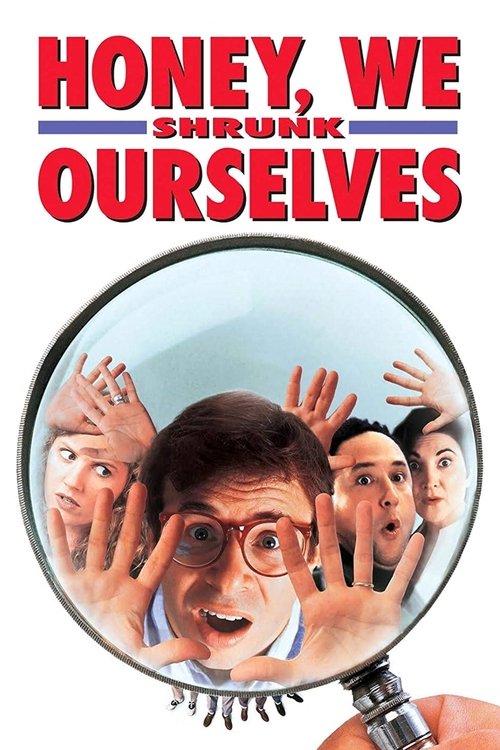
Honey, We Shrunk Ourselves (1997)
Directed by Dean Cundey
No — Honey, We Shrunk Ourselves is not woke, scoring 5 out of 100 on our wokeness meter.
Honey, We Shrunk Ourselves arrives as the third installment in a franchise that had already spent its premise, and as the first live-action feature Walt Disney Pictures sent directly to home video.
Consciousness Markers
Jenny spurns Ricky King for stealing a kiss without asking permission, and Patti voices pride in her for it, but this reads as a period-appropriate lesson about consent rather than a feminist program. Diane's line about no longer sweating the 'small' stuff is incidental.
The film delivers gentle parenting morals — let kids pursue their own interests, trust your teenagers, don't sweat the small stuff — but these are mild, warm-hearted takeaways rather than preachy instruction.
The Szalinski clan is a uniformly white suburban family; the only notable non-white cast member (Carlease Burke) appears in a negligible role with no narrative weight. No deliberate representation effort is discernible.
Wayne relinquishing the presidency of Szalinski Labs to his brother and returning to inventing is a mild pro-creativity, anti-management gesture, but the film is broadly celebratory of entrepreneurship rather than critical of capital.
No LGBTQ+ characters, subtext, or themes appear anywhere in the film. A 1997 Disney direct-to-video comedy makes no gesture in this direction.
No engagement with race, racism, or racial identity whatsoever. The film has no racial consciousness to speak of.
The shrink ray is electromagnetic, not ecological; no environmental themes or climate anxiety appear in the story.
No body positivity themes. Characters' sizes change via sci-fi gadgetry, not as commentary on body image.
Mitch's potassium deficiency is a plot device for medical urgency, not a depiction or celebration of neurodivergence.
No historical revisionism. The film is a contemporary family comedy with no historical subject matter.
Why it received this score
Honey, We Shrunk Ourselves arrives as the third installment in a franchise that had already spent its premise, and as the first live-action feature Walt Disney Pictures sent directly to home video. Dean Cundey, a cinematographer of real distinction, makes his directorial debut here, and the production proceeds with the brisk economy of a five-week shoot and a seven-million-dollar budget. Rick Moranis returns as Wayne Szalinski, the only actor to do so, and his electromagnetic shrink ray once again reduces the adults of a suburban household to the size of pocket change. What follows is a stretch of kitchen-floor peril involving a cockroach, a bowl of onion dip, and four parents learning to trust their children. The cultural soil here is firmly 1997, and the harvest is thin.
The film's social consciousness is faint and mostly incidental. Jenny rejects Ricky King for stealing a kiss without asking, and her mother's approval registers as a period-appropriate lesson about consent, delivered gently and then abandoned. The parenting advice is warmer still: let the boy play baseball, trust the teenager, do not sweat the small stuff. None of this amounts to a program. The Szalinski clan is uniformly white and comfortably suburban, and the lone non-white performer in the cast appears in a role of no narrative consequence. There is no engagement with race, no environmental anxiety, no meditation on the body, no interest in neurodivergence beyond a potassium deficiency that functions purely as a ticking clock. The film is content to be a comedy about very small people in a very large living room.
We search for ideology and find only merchandising. The mild anti-management gesture, Wayne surrendering the presidency of his lab to his brother and returning to the workbench, is a nod toward creativity that stops well short of any critique of capital. The film celebrates entrepreneurship, the nuclear family, and the Tiki Man, in that order. It is a harmless artifact, amiable and slight, and it asks nothing of its audience beyond ninety minutes of attention. We classify it accordingly, without resentment. Not every vintage rewards the cellar.
Analysis generated by our Consciousness Algorithm


Synopsis
The joke's on absent-minded scientist Wayne Szalinski when his troublesome invention shrinks him, his brother and their wives so effectively that their children think they've completely disappeared. Of course, this gives the kids free rein to do anything they want, unaware that their parents are watching every move.
Questions about Honey, We Shrunk Ourselves
Is Honey, We Shrunk Ourselves woke?
No — Honey, We Shrunk Ourselves is not woke, scoring 5 out of 100 on our wokeness meter. That earns it a verdict of Ultra Based.
Does Honey, We Shrunk Ourselves have any woke elements?
Very few. None of the 10 markers reaches 30, the level where a marker counts as present; the highest is Feminist Agenda at 12.
How does Honey, We Shrunk Ourselves compare to other 1997 movies?
It ranks #75 of the 109 films from 1997 we've scored; their average is 12. The wokest is Happy Together (65).
Is Honey, We Shrunk Ourselves the most woke Honey, I Shrunk the Kids movie?
No. It ranks #2 of the 3 Honey, I Shrunk the Kids films we've scored; the wokest is Honey, I Blew Up the Kid (6).