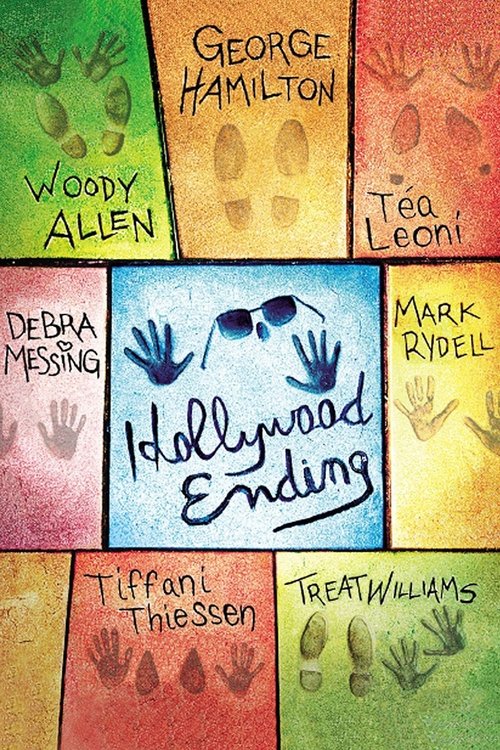
Hollywood Ending (2002)
Directed by Woody Allen
No — Hollywood Ending is not woke, scoring 5 out of 100 on our wokeness meter.
Hollywood Ending arrives in 2002 as a showbiz comedy about a washed-up director, Val Waxman, who lands a comeback picture through his ex-wife's studio connections and then goes psychosomatically blind before the cameras roll.
Consciousness Markers
There is mild, toothless satire of the Hollywood studio system and its executives, but it is showbiz inside-baseball rather than an 'eat the rich' economic critique.
Ellie (Téa Leoni) holds the studio power position and supports her ex-husband, but the film remains a male-ego comeback story with no feminist critique or agenda.
The plot hinges on a psychosomatic 'hysterical blindness' and Val's neuroticism, but these are comic plot devices rather than a neurodivergence-awareness statement.
Allen's dialogue is wry and observational, but the film makes no attempt to preach or instruct the audience on social matters.
The cast is overwhelmingly white and drawn from Allen's usual upper-middle-class New York milieu; no meaningful effort at diverse or inclusive casting.
No LGBTQ+ characters, themes, or subtext appear anywhere in the film.
Race is entirely absent as a subject; the film's world is uniformly white and uninterrogated.
No environmental or climate themes whatsoever.
No body-positivity themes; the film's running gag about a much-younger girlfriend leans the opposite direction.
No historical revisionism; the film is a contemporary showbiz comedy with no historical subject matter.
Why it received this score
Hollywood Ending arrives in 2002 as a showbiz comedy about a washed-up director, Val Waxman, who lands a comeback picture through his ex-wife's studio connections and then goes psychosomatically blind before the cameras roll. The film is a vanity project in the most literal sense, built around its author's familiar persona of the nervous, overanalyzed Manhattan creative. Its world is uniformly white, uniformly comfortable, and entirely uninterested in examining the terms of its own casting. Race never surfaces as a subject. Neither does sexuality, nor the environment, nor any question of economic justice beyond the mild indignation of a director reduced to shooting deodorant commercials in northern Canada.
The occasional gesture toward social awareness is faint and mostly structural. Téa Leoni's Ellie occupies a studio executive's chair and offers her former husband both financing and loyalty, a configuration that flirts with a critique of the male ego before dissolving into a story about a man winning back his wife and his sight. A running joke about Val's much younger girlfriend signals where the film's sympathies actually lie. The psychosomatic blindness driving the plot is treated as a comic mechanism, a convenient affliction, not an occasion to educate anyone about the mind's relationship to stress. There is a light dusting of contempt for studio executives, but it is inside-baseball, the kind of grumbling that flatters the industry it pretends to skewer.
Woody Allen's dialogue retains its wry, observational tempo, and the film never once stops to lecture its audience on how to behave or think. Its cultural footprint is close to nonexistent. It was the first Allen picture denied a theatrical release in the United Kingdom, and American ticket sales fell short of five million dollars. In 2016 two British critics ranked it as the worst film of his career. What we have here is a man making a movie about the difficulty of making movies, and doing so with a self-regard that no amount of jazz on the soundtrack can soften. It asks for sympathy and offers only the sound of its own voice.
Analysis generated by our Consciousness Algorithm


Synopsis
Woody Allen stars as Val Waxman, a two-time Oscar winner turned washed-up, neurotic director in desperate need of a comeback. When it comes, Waxman finds himself backed into a corner: Work for his ex-wife Ellie or forfeit his last shot. Is Val blinded by love when he opts for the reconnect? Is love blind when it comes to Ellie's staunch support? Literally and figuratively, the proof is the picture.
Questions about Hollywood Ending
Is Hollywood Ending woke?
No — Hollywood Ending is not woke, scoring 5 out of 100 on our wokeness meter. That earns it a verdict of Ultra Based.
Does Hollywood Ending have any woke elements?
Very few. None of the 10 markers reaches 30, the level where a marker counts as present; the highest is Eat the Rich at 10.
How does Hollywood Ending compare to other 2002 movies?
It ranks #103 of the 150 films from 2002 we've scored; their average is 12. The wokest is Far from Heaven (78).
How is the Woke Score calculated?
An AI-assisted process researches the film and its reception, scores it 0–100 on ten markers, then combines those into one 0–100 Woke Score. It measures a specific set of 2020s cultural themes, not film quality.