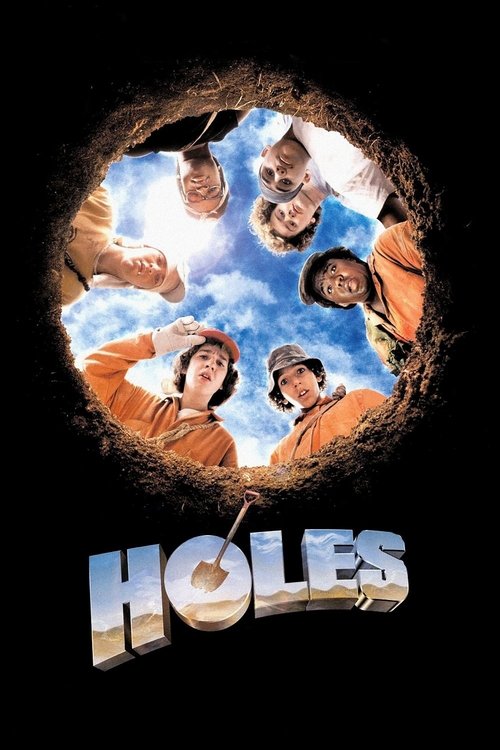
Holes (2003)
Directed by Andrew Davis
No — Holes is not especially woke, scoring 26 out of 100 on our wokeness meter.
Andrew Davis made a prison film for children in 2003, and the result has aged into something more interesting than its premise suggests.
Consciousness Markers
The flashback subplot of Sam, a Black onion merchant, being murdered by townspeople for kissing a white woman is a genuine, unflinching depiction of historical racial violence that drives the plot.
The ensemble is genuinely diverse for 2003, with Black actors (Dulé Hill, Khleo Thomas, Rick Fox) and a Latino presence woven naturally into the camp's inmate roster without commentary.
The Walker family's greed and the exploitation of juvenile inmates as unpaid treasure-hunters carry a mild class-and-exploitation critique, though it stays within family-adventure bounds.
Kate 'Kissin' Kate' Barlow is a schoolteacher-turned-outlaw and the Warden is a cold female antagonist, but these are genre archetypes rather than a feminist thesis.
The film treats its themes of injustice and redemption with intelligence but never stops to preach at the audience, remaining a story-first family adventure.
The 19th-century flashbacks are fictional folklore rather than a re-reading of real history through a modern ideological lens.
The drought that befalls Green Lake is framed as a supernatural curse for a lynching, not an environmentalist parable about climate change.
No LGBTQ+ characters, themes, or subtext appear anywhere in the film.
The book's obesity-and-weight-loss arc for Stanley was deliberately removed for the film, leaving no body-positivity content.
Zero's illiteracy is a socioeconomic and educational circumstance, not a depiction of neurodivergence.
Why it received this score
Andrew Davis made a prison film for children in 2003, and the result has aged into something more interesting than its premise suggests. Camp Green Lake is a labor camp dressed up as character building, and the inmates who populate it arrive without announcement or apology. Dulé Hill, Khleo Thomas, Rick Fox, and a roster of young actors of varying backgrounds fill the tents with a matter-of-fact diversity that most studio family films of the era could not manage. More striking is the flashback thread concerning Sam, a Black onion merchant murdered by townspeople for the crime of kissing a white woman. The film does not soften this. It lets the lynching sit there, drives the plot with it, and moves on.
What the film declines to do is equally instructive. Stanley Yelnats is obese in the source novel and slims down across the dig, a detail the filmmakers discarded for practical reasons. The result is a body-positivity vacuum where a body-positivity text might have been. No queer threads surface. Kissin' Kate and the Warden are hard women in a hard genre, not a thesis. Zero's illiteracy reads as a failure of schools and money, not neurology.
There is a mild eat-the-rich hum beneath the sand: the Walker family's avarice, the unpaid juvenile labor, a fortune hoarded across generations. It never becomes a sermon. The film trusts its audience to find the injustice without a narrator pointing at it. The drought over Green Lake is a curse for a killing, not a parable about the weather. That restraint is the rarest thing here. A family adventure that respects children enough to show them a murder and then let them think about it.
Analysis generated by our Consciousness Algorithm
Part of


Synopsis
After being wrongfully convicted for stealing a pair of shoes, Stanley Yelnats is sent away to Camp Green Lake, a boys detention facility where inmates are forced to dig holes all day in the hot desert sun as a form of character building. As he endures the brutal routine, Stanley begins to uncover a hidden truth behind the camp, one that connects to a dangerous secret—and possibly Stanley’s family itself.
Questions about Holes
Is Holes woke?
No — Holes is not especially woke, scoring 26 out of 100 on our wokeness meter. That earns it a verdict of Based.
Does Holes have any woke elements?
2 of the 10 markers register at 30 or above, led by Racial Consciousness (45) and Representation Casting (40). On Racial Consciousness: The flashback subplot of Sam, a Black onion merchant, being murdered by townspeople for kissing a white woman is a genuine, unflinching depiction of historical racial violence that drives the plot.
How does Holes compare to other 2003 movies?
It ranks #15 of the 150 films from 2003 we've scored; their average is 12. The wokest is Mona Lisa Smile (60).
How is the Woke Score calculated?
An AI-assisted process researches the film and its reception, scores it 0–100 on ten markers, then combines those into one 0–100 Woke Score. It measures a specific set of 2020s cultural themes, not film quality.