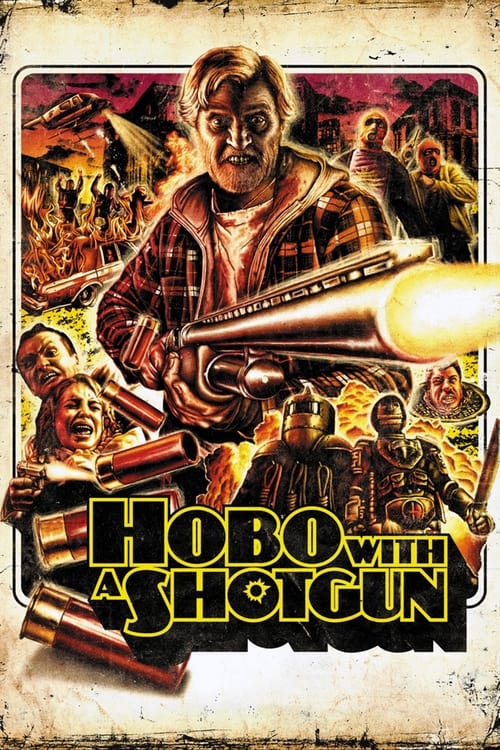
Hobo with a Shotgun (2011)
Directed by Jason Eisener
No — Hobo with a Shotgun is not woke, scoring 11 out of 100 on our wokeness meter.
Rutger Hauer rides into Hope Town by boxcar and discovers a municipality so rotten that its welcome sign has been amended to read Scum Town.
Consciousness Markers
Abby, a prostitute, evolves into a genuine co-hero who arms a crowd, kills a demon, and maims the crime lord, giving the film a notable female-empowerment arc, though it plays out through exploitation tropes rather than an explicit feminist thesis.
The villains are a crime lord and his sadistic sons rather than capitalists, but the film does carry a crude class-anger streak about the homeless being preyed upon by the powerful, and the Hobo's dream is a small lawnmowing business.
The Hobo delivers a monologue to newborns in a maternity ward about the future generation, and the film gestures at justice for the downtrodden, but the messaging is delivered as exploitation spectacle rather than earnest preaching.
The cast is overwhelmingly white and the film makes no effort at diverse or representative casting; the only notable non-default presence is a female co-lead, which is a genre convention rather than a statement.
There are no LGBTQ+ characters, relationships, or themes anywhere in the film.
The film's social concern is class and homelessness, not race; there is no racial commentary or consciousness of any kind.
No environmental or climate themes appear in the film.
There is no body-positivity content; the film trades in grotesque and exploitative depictions of bodies.
No neurodivergent characters or themes are present.
The film is a fictional grindhouse pastiche with no historical subject matter to revise.
Why it received this score
Rutger Hauer rides into Hope Town by boxcar and discovers a municipality so rotten that its welcome sign has been amended to read Scum Town. He wants a lawnmower. He buys a shotgun instead. This is a Canadian production expanded from a fake trailer that once unspooled before Grindhouse, and it wears that provenance like a badge. The whole enterprise is a pastiche of 1970s exploitation cinema: oversaturated color, cartoonish bloodshed, dialogue delivered at a shout. The film knows exactly what it is, and it declines to apologize.
The grievances on display are economic. Hope Town is run by a crime lord and his sadistic sons, men who torture the homeless for sport and incinerate a school bus full of children who were merely friendly to vagrants. The Hobo's modest ambition is a small lawnmowing business, which stands as the screenplay's entire theory of the good life. There is no racial commentary here, no environmental anxiety, no interest in the body except as a surface to be punctured. The cast is white and the politics are street-level and blunt.
What the film does offer is Abby, a prostitute who spends the back half transforming into a genuine co-hero. She arms a crowd, kills one of the armored demons sent to collect the Hobo, and incapacitates the crime lord by stabbing him with the bone protruding from her severed arm. That is an empowerment arc, though it arrives wrapped in the genre's most lurid packaging. Earlier, the Hobo lectures a maternity ward of newborns on the world they are inheriting, and the film reaches for something like a moral. It gets there through spectacle, not sermon. Justice prevails, the police are turned upon by the people they failed, and the credits roll over a song from an animated series about raccoons. The classification is straightforward, and the film would be insulted by any other.
Analysis generated by our Consciousness Algorithm


Synopsis
A vigilante homeless man pulls into a new city and finds himself trapped in urban chaos, a city where crime rules and where the city's crime boss reigns. Seeing an urban landscape filled with armed robbers, corrupt cops, abused prostitutes and even a pedophile Santa, the Hobo goes about bringing justice to the city the best way he knows how - with a 20-gauge shotgun. Mayhem ensues when he tries to make things better for the future generation. Street justice will indeed prevail.
Questions about Hobo with a Shotgun
Is Hobo with a Shotgun woke?
No — Hobo with a Shotgun is not woke, scoring 11 out of 100 on our wokeness meter. That earns it a verdict of Ultra Based.
Does Hobo with a Shotgun have any woke elements?
Very few. None of the 10 markers reaches 30, the level where a marker counts as present; the highest is Feminist Agenda at 22.
How does Hobo with a Shotgun compare to other 2011 movies?
It ranks #81 of the 245 films from 2011 we've scored; their average is 11. The wokest is Paul (68).
How is the Woke Score calculated?
An AI-assisted process researches the film and its reception, scores it 0–100 on ten markers, then combines those into one 0–100 Woke Score. It measures a specific set of 2020s cultural themes, not film quality.