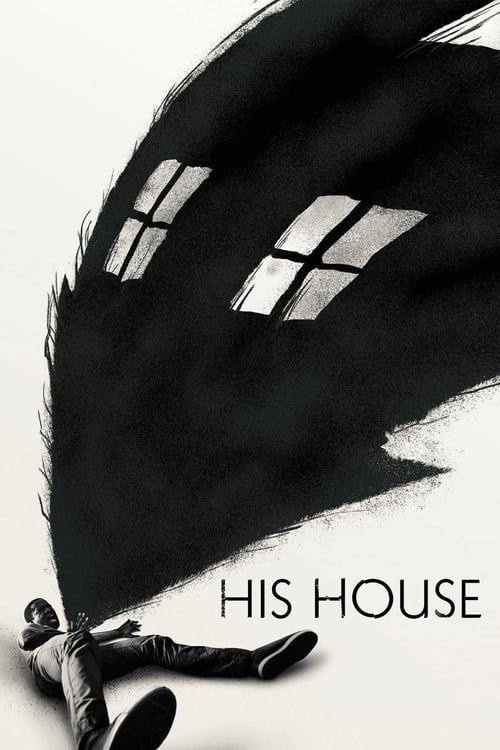
His House (2020)
Directed by Remi Weekes
Yes — His House is woke, scoring 60 out of 100 on our wokeness meter.
His House arrives as a folk horror item about a South Sudanese couple, Bol and Rial, deposited into a peeling council house on the outskirts of London after a crossing of the Channel that cost them their daughter.
Consciousness Markers
Racial consciousness is central: the couple faces racist hostility from neighbours, a case worker who hopes they are 'the good ones,' and a dehumanizing asylum bureaucracy. The refugee experience and British racism are the film's political spine.
The film is entirely centered on Black South Sudanese refugee characters, with a predominantly Black principal cast led by Sope Dirisu and Wunmi Mosaku. The representation is intrinsic to the story rather than grafted on, but it is substantial and deliberate.
Rial is a co-protagonist with real agency who clings to her culture, resists assimilation, and ultimately drives the resolution by slitting the apeth's throat. The film is not structured as a feminist polemic, but it grants its female lead decisive power.
The film carries a clear social conscience about the refugee experience and British racism, but critics noted it folds these into haunted-house thrills rather than delivering direct moral instruction. The messaging is present but dramatized rather than preached.
The film is explicitly about trauma and PTSD in the refugee experience, with the haunting functioning as a manifestation of psychological damage. This is a mental-health theme rather than a neurodivergence-as-identity statement, so it registers only modestly.
There are no LGBTQ+ characters, relationships, or themes anywhere in the narrative.
There is no environmental or climate-related content in the film.
The film critiques immigration bureaucracy and social hostility, but it does not advance an anti-capitalist or class-warfare thesis.
No body positivity themes or body-diverse messaging are present.
The film depicts the South Sudan conflict and massacre as historical backdrop, but it is a fictional horror narrative rather than a revisionist reframing of recorded history.
Why it received this score
His House arrives as a folk horror item about a South Sudanese couple, Bol and Rial, deposited into a peeling council house on the outskirts of London after a crossing of the Channel that cost them their daughter. Remi Weekes directs with real control, and the film has the good sense to let its hauntings operate as hauntings first. The walls breathe. Something moves behind the plaster. The couple's case worker, played by Matt Smith with a smile that curdles, hopes they are two of "the good ones," which tells us plenty about what the British state expects of those it grudgingly admits.
The film's cultural awareness is not decoration. Rial and Bol are Black refugees from South Sudan, and the film never once apologizes for or explains them. The racism they meet is specific and casual: a neighbour's contempt, a bureaucrat's suspicion, a system that treats survival as a privilege to be revoked. Bol tries to assimilate, singing football songs and abandoning the food he grew up eating. Rial refuses, keeps her daughter's necklace, eats on the floor, holds on. That refusal is where the film's spine lives.
Rial is not a passenger in her own story. She is the one who identifies the apeth, the one who understands the debt, and the one who ends the thing with a knife to its throat. This is a film that grants its female lead the decisive blow without announcing that it is doing so, which is the difference between a character and a thesis. The horror doubles as trauma, an unquiet mind made visible, though the film treats this as psychological damage instead of an identity to be celebrated. And it stays dramatized throughout. The message about the refugee experience and British hostility is unmistakable, yet it arrives through corridors and screaming, not through sermons. We are left with a film that carries a conscience and a knife, and it knows which to lead with.
Analysis generated by our Consciousness Algorithm


Synopsis
After making a harrowing escape from war-torn South Sudan, a young refugee couple struggle to adjust to their new life in a small English town that has an unspeakable evil lurking beneath the surface.
Questions about His House
Is His House woke?
Yes — His House is woke, scoring 60 out of 100 on our wokeness meter. That earns it a verdict of Woke.
What makes His House woke?
4 of the 10 markers register at 30 or above, led by Racial Consciousness (82), Representation Casting (75) and Feminist Agenda (35). On Racial Consciousness: Racial consciousness is central: the couple faces racist hostility from neighbours, a case worker who hopes they are 'the good ones,' and a dehumanizing asylum bureaucracy.
How does His House compare to other 2020 movies?
It ranks #14 of the 227 films from 2020 we've scored; their average is 21. The wokest is One Night in Miami... (83).
How is the Woke Score calculated?
An AI-assisted process researches the film and its reception, scores it 0–100 on ten markers, then combines those into one 0–100 Woke Score. It measures a specific set of 2020s cultural themes, not film quality.