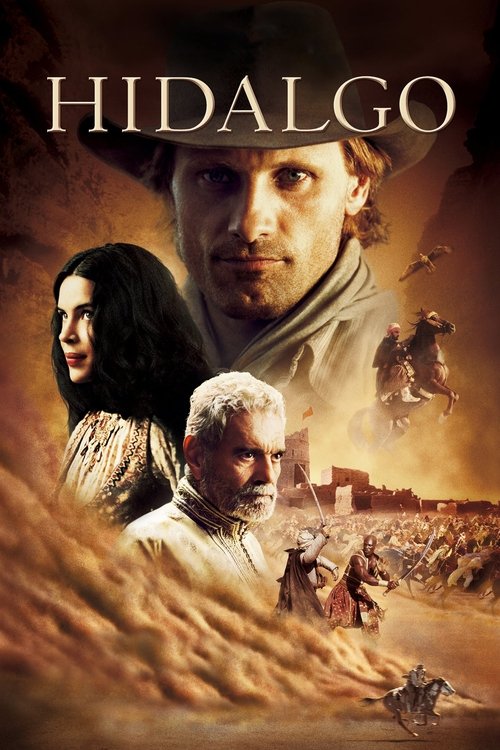
Hidalgo (2004)
Directed by Joe Johnston
No — Hidalgo is not especially woke, scoring 30 out of 100 on our wokeness meter.
Hidalgo arrives from 2004, a year when a studio could still spend one hundred million dollars on a horse picture and call the result an epic.
Consciousness Markers
The film foregrounds Hopkins' Lakota mother, his guilt over carrying the order that enabled the Wounded Knee Massacre, and the government's eradication of wild mustangs. It also depicts Arab contempt for the 'infidel' on an 'impure' horse, giving race and heritage real narrative weight.
The cast features Middle Eastern actors (Omar Sharif, Zuleikha Robinson, Saïd Taghmaoui) and Native American performers (Floyd Red Crow Westerman, David Midthunder), with a mixed-race Lakota protagonist at the center. This diversity is organic to the story rather than a modern checkbox exercise.
Jazira is a determined sheikh's daughter who resists being married off as a fifth wife, rejects the veil, and asserts her desire to live her own life, advising and aiding Hopkins throughout. The thread is present but subordinate to the adventure plot.
The film presents a heavily disputed legend — including a race historians say never occurred and a contested Lakota ancestry claim — as historical fact, and reframes the frontier narrative through Native American guilt and perspective. This is historical embellishment more than modern ideological revisionism.
There is some moralizing about the treatment of Native Americans and the fate of wild mustangs, but the film is primarily a rip-roaring adventure and rarely stops to preach.
The government's rounding up of mustangs for eradication and Lady Davenport's bribery and scheming carry faint anti-establishment and anti-aristocratic notes, but there is no coherent eat-the-rich thesis.
The epilogue notes Hopkins was an outspoken supporter of wild mustangs and he releases the herd into the wild, a mild animal-conservation gesture rather than any climate or environmental crusade.
No LGBTQ+ characters or themes appear anywhere in the film.
No body-positivity themes or messaging are present.
No neurodivergent characters or themes are depicted.
Why it received this score
Hidalgo arrives from 2004, a year when a studio could still spend one hundred million dollars on a horse picture and call the result an epic. Joe Johnston directs Viggo Mortensen as Frank Hopkins, a Pony Express rider who carries a Lakota mother, a government paycheck, and a mustang named Hidalgo into a three thousand mile race across the Najd. The film offers sandstorms, locusts, sword fights, and Omar Sharif observing Buffalo Bill's Wild West show with the patience of a man who has watched empires come and go. It also claims, in its marketing, to be true. Historians have spent two decades suggesting otherwise. The film does not much care.
The cultural furniture here proves more interesting than the plot mechanics. Hopkins' Lakota heritage and his guilt over Wounded Knee give the story a spine, and the production hired Lakota consultants for the ceremonial scenes. The Arabian court is populated with actual Middle Eastern performers, which in 2004 counted as a minor miracle. Jazira, the sheikh's daughter, resists becoming a fifth wife, discards the veil, and instructs the hero on desert survival, though the film keeps her in the supporting role where adventure pictures of that era parked their women. She satisfies every romantic obligation the genre demands and not a duty more.
Absent entirely are the other markers of contemporary virtue. No queer characters, no body-positive messaging, no neurodivergent arc. The nearest thing to a social program is Hopkins buying the government's mustangs and setting them loose, a gesture of animal husbandry that doubles as a mild conservation note. Lady Davenport's bribery earns a few swipes at aristocracy. The film lectures only when it forgets it is having fun, which is rare. It is a relic, and a reasonably charming one.
Analysis generated by our Consciousness Algorithm


Synopsis
Set in 1890, this is the story of a Pony Express courier who travels to Arabia to compete with his horse, Hidalgo, in a dangerous race for a massive contest prize, in an adventure that sends the pair around the world...
Questions about Hidalgo
Is Hidalgo woke?
No — Hidalgo is not especially woke, scoring 30 out of 100 on our wokeness meter. That earns it a verdict of Based.
Does Hidalgo have any woke elements?
4 of the 10 markers register at 30 or above, led by Racial Consciousness (45), Representation Casting (40) and Feminist Agenda (30). On Racial Consciousness: The film foregrounds Hopkins' Lakota mother, his guilt over carrying the order that enabled the Wounded Knee Massacre, and the government's eradication of wild mustangs.
How does Hidalgo compare to other 2004 movies?
It ranks #14 of the 178 films from 2004 we've scored; their average is 12. The wokest is Tropical Malady (62).
How is the Woke Score calculated?
An AI-assisted process researches the film and its reception, scores it 0–100 on ten markers, then combines those into one 0–100 Woke Score. It measures a specific set of 2020s cultural themes, not film quality.