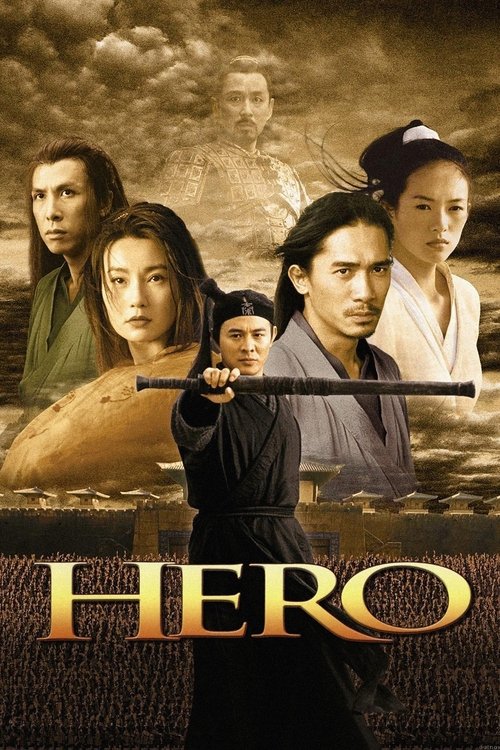
Hero (2002)
Directed by Zhang Yimou
No — Hero is not woke, scoring 8 out of 100 on our wokeness meter.
Zhang Yimou's Hero arrives bearing the weight of a philosophical argument, which it delivers with the patience of a man explaining a chess problem to someone who has already conceded.
Consciousness Markers
The film delivers an explicit philosophical thesis about peace, unification, and the ideal warrior through dialogue and the 'All Under Heaven' motif, though it is not the modern social-justice lecture.
Flying Snow and Moon are skilled female warriors given real screen presence, but this is a longstanding wuxia genre convention rather than a feminist statement.
An entirely Chinese cast, but this is the natural default for a mainland Chinese wuxia production rather than casting done for representation purposes. No Western-style representational intent.
The film dramatizes the Warring States period with competing narratives and a sympathetic King of Qin, but this reimagining serves an authoritarian-unification thesis rather than a progressive revision of history.
No LGBTQ+ characters, themes, or subtext anywhere in the film.
The film's political theme is Chinese unification ('All Under Heaven'), a nationalist rather than racial-justice concern. No racial consciousness content.
No environmental or climate themes present.
No critique of capitalism, wealth, or class. If anything the film's message leans toward sacrifice for centralized order.
No body-positivity themes; the film is stylized martial-arts spectacle.
No neurodivergence or mental-health themes.
Why it received this score
Zhang Yimou's Hero arrives bearing the weight of a philosophical argument, which it delivers with the patience of a man explaining a chess problem to someone who has already conceded. Nameless, a Qin prefect, recounts to the king how he dispatched three assassins, and the film replays the tale in competing versions until the truth settles into a thesis: peace requires unification, and the ideal warrior must abandon the desire to kill. The "All Under Heaven" motif is stated outright, in calligraphy and in dialogue, and the final act exists largely to ensure we have absorbed it. This is sermonizing of a high order, gorgeous and unhurried, and it is not the modern variety. Its congregation is asked to accept a centralized empire, not to interrogate a social hierarchy.
The cast is entirely Chinese, which here reflects the ordinary gravity of a mainland wuxia production rather than any casting mandate. Flying Snow and Fading Moon wield swords with real authority, but the genre has always permitted women to be lethal, and the film grants them no argument beyond their blades. We are watching a convention, not a manifesto.
The most interesting maneuver is the rehabilitation of the King of Qin, who begins as a tyrant and ends as a compassionate, solitary figure deserving of the peace he will impose. That is a revision of the historical record, but it bends toward order and sacrifice, not toward any liberatory reading of the past. The result is a beautiful, patient film with an argument it very much wants us to accept, and no particular interest in the causes that agitate the present decade.
Analysis generated by our Consciousness Algorithm


Synopsis
During China's Warring States period, a district prefect arrives at the palace of Qin Shi Huang, claiming to have killed the three assassins who had made an attempt on the king's life three years ago.
Questions about Hero
Is Hero woke?
No — Hero is not woke, scoring 8 out of 100 on our wokeness meter. That earns it a verdict of Ultra Based.
Does Hero have any woke elements?
Very few. None of the 10 markers reaches 30, the level where a marker counts as present; the highest is Lecture Energy at 20.
How does Hero compare to other 2002 movies?
It ranks #75 of the 150 films from 2002 we've scored; their average is 12. The wokest is Far from Heaven (78).
How is the Woke Score calculated?
An AI-assisted process researches the film and its reception, scores it 0–100 on ten markers, then combines those into one 0–100 Woke Score. It measures a specific set of 2020s cultural themes, not film quality.