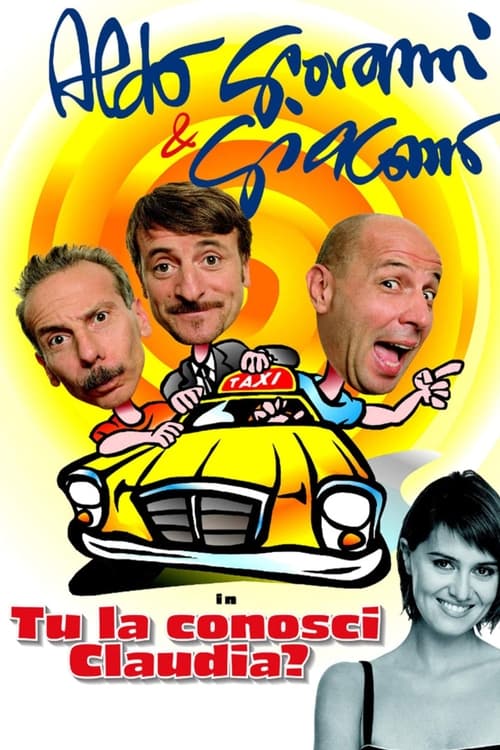
Have You Met Claudia? (2004)
Directed by Massimo Venier
No — Have You Met Claudia? is not woke, scoring 2 out of 100 on our wokeness meter.
Italian cinema has produced many things.
Consciousness Markers
The cast is a standard Italian ensemble for a 2004 comedy, with one Black actor (Ruffin Doh Zeneyoun) in a minor supporting role. No deliberate diversity casting or commentary on representation.
A woman is the object of three men's pursuit and the plot resolves around her choosing a partner; this is traditional romantic-comedy structure, not a feminist statement.
No LGBTQ+ characters, themes, or subtext anywhere in the love-triangle plot.
No engagement with race, racism, or racial identity as themes.
No environmental or climate themes present.
No critique of wealth, capitalism, or class structures; the film is a light relationship farce.
No body-positivity themes or messaging about body image.
A psychoanalyst and a depressed character appear, but depression is treated as a plot device for romance, not as neurodivergence advocacy.
No historical revisionism; the film is a contemporary fictional comedy.
The film is a breezy farce with no preachy messaging or moral instruction to the audience.
Why it received this score
Italian cinema has produced many things. In December of 2004 it produced this. Do You Know Claudia? (released in some markets as Have You Met Claudia?) assembles the comedy trio Aldo, Giovanni and Giacomo for a farce about three men orbiting the same woman. Giovanni is the dull husband. Giacomo is the depressed divorcé. Aldo is the cabbie with whom she is already conducting an affair. Claudia, played by Paola Cortellesi, moves between them with the serene patience of someone who has read the script and knows it ends with a pregnancy test. The film breaks the fourth wall occasionally, presumably to remind us that none of this matters.
The cultural inventory here is remarkably sparse. No character contends with race as a lived reality. There is a Black supporting actor, Taribo, who exists to drive a scene and then evaporate, which is not the same thing as representation and the film never pretends otherwise. No LGBTQ thread intrudes on the triangle. The environment goes unmentioned. Nobody questions the arrangement of wealth. Bodies are simply bodies, deployed for slapstick. Depression appears in the person of Giacomo, but it functions as a mood to be cured by a woman's attention, which is a plot mechanism and not a statement about mental health. The whole apparatus is a machine for delivering romantic resolution to a man who has done little to deserve it.
The film offers competence instead. The pacing is brisk, the performers are professional, and the screenplay has no interest in instructing anyone about anything. That absence is itself a kind of historical document. A comedy made now from this premise would need to justify itself, would need a thesis, would need to announce its politics in the first act and defend them in the third. This one simply wants the audience to laugh at a man mistaking a stranger for his wife's husband. We can note the craftsmanship and the emptiness in the same breath. The sommelier would call it a light, uncomplicated vintage, pleasant enough, and entirely of its time.
Analysis generated by our Consciousness Algorithm
Synopsis
Claudia is married with Giovanni, a rather dull type. Meek Giacomo is happily divorced, until he meets her. Aldo is a colorful cabbie with whom she had an affair. Who'll win her heart?
Questions about Have You Met Claudia?
Is Have You Met Claudia? woke?
No — Have You Met Claudia? is not woke, scoring 2 out of 100 on our wokeness meter. That earns it a verdict of Ultra Based.
Does Have You Met Claudia? have any woke elements?
Very few. None of the 10 markers reaches 30, the level where a marker counts as present; the highest is Feminist Agenda at 5.
How does Have You Met Claudia? compare to other 2004 movies?
It ranks #145 of the 178 films from 2004 we've scored; their average is 12. The wokest is Tropical Malady (62).
How is the Woke Score calculated?
An AI-assisted process researches the film and its reception, scores it 0–100 on ten markers, then combines those into one 0–100 Woke Score. It measures a specific set of 2020s cultural themes, not film quality.