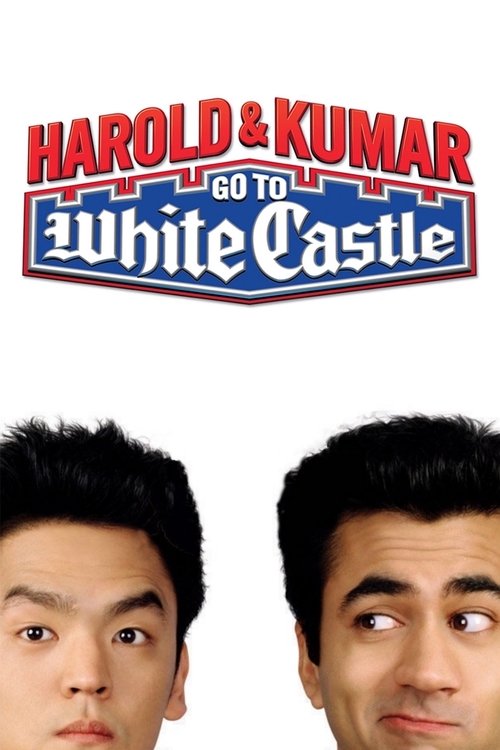
Harold & Kumar Go to White Castle (2004)
Directed by Danny Leiner
No — Harold & Kumar Go to White Castle is not especially woke, scoring 30 out of 100 on our wokeness meter.
There is a moment in Harold & Kumar Go to White Castle when a police officer invents a jaywalking charge out of whole cloth, and the film's two leads respond with the specific, exhausted familiarity of men who have rehearsed this conversation before.
Consciousness Markers
The film's central conceit is two Asian American leads (Korean American Harold, Indian American Kumar) in a mainstream buddy comedy, a deliberate choice the writers defended against studio pressure to whitewash or recast with a white/black duo.
The film actively engages racial stereotypes — the racist cop encounter, Kumar's fear of conforming to the 'Indian doctor' cliché, and the leads' American-born identity — subverting them rather than ignoring them.
The stereotype subversion is baked into the comedy rather than preached; the film never stops to deliver a moral lesson to the audience.
Harold's coworkers dump their workload on him for a mild workplace-exploitation beat, but the film is a corporate tie-in with White Castle and carries no eat-the-rich thesis.
Maria exists largely as a romantic goal, and the female characters are props for gags; no feminist agenda is articulated.
The Freakshow foursome gag is a gross-out punchline, not an LGBTQ+ theme; no queer content or sensibility is present.
No environmental or climate content whatsoever; the quest is for sliders, not sustainability.
No body-positivity themes; the humor leans on conventional gross-out and physical-comedy beats.
No neurodivergence is depicted or addressed.
No historical subject matter is revised or reinterpreted.
Why it received this score
There is a moment in Harold & Kumar Go to White Castle when a police officer invents a jaywalking charge out of whole cloth, and the film's two leads respond with the specific, exhausted familiarity of men who have rehearsed this conversation before. The scene is funny. It is also the film's operating principle. Harold Lee and Kumar Patel are Asian American leads in a mainstream buddy comedy, a casting decision the writers defended against studio suggestions to pair a white man with a Black man instead. The screenplay builds ethnic-specific scenes into its structure as a defensive measure, so that the characters cannot be quietly recast or reimagined as foreign exchange students. That is deliberate cultural engineering, and it deserves the recognition it receives here.
The racial material runs deeper than casting. Kumar deliberately tanks a medical school interview because he cannot bear the weight of the Indian doctor cliché, and his father's threat to cut him off lands with genuine domestic sting. This is subversion baked into the jokes, not a sermon delivered between them. The film never pauses to instruct the audience on what it has just shown, which keeps the lecture-energy reading low. Harold's coworkers dumping their paperwork on him registers as mild workplace exploitation and nothing more; the movie is, after all, a feature-length advertisement for a fast-food chain, and no eat-the-rich thesis survives contact with a tie-in beverage cup. Maria exists mostly as a destination, and the film offers no feminist argument on her behalf.
The rest of the ledger is bare. There is no queer content, no environmental preoccupation, no body-positivity theme, no neurodivergence, and no history to revise. What remains is a stoner road picture with a cheetah, a hang glider, and a self-aware Neil Patrick Harris, executed with enough precision to make the sociological scaffolding feel like part of the fun. A rare case of a film that knows exactly what it is doing and declines to announce it.
Analysis generated by our Consciousness Algorithm


Synopsis
Nerdy accountant Harold and his irrepressible friend, Kumar, get stoned watching television and find themselves utterly bewitched by a commercial for White Castle. Convinced there must be one nearby, the two set out on a late-night odyssey that takes them deep into New Jersey. Somehow, the boys manage to run afoul of rednecks, cops and even a car-stealing Neil Patrick Harris before getting anywhere near their beloved sliders.
Questions about Harold & Kumar Go to White Castle
Is Harold & Kumar Go to White Castle woke?
No — Harold & Kumar Go to White Castle is not especially woke, scoring 30 out of 100 on our wokeness meter. That earns it a verdict of Based.
Does Harold & Kumar Go to White Castle have any woke elements?
2 of the 10 markers register at 30 or above, led by Representation Casting (72) and Racial Consciousness (65). On Representation Casting: The film's central conceit is two Asian American leads (Korean American Harold, Indian American Kumar) in a mainstream buddy comedy, a deliberate choice the writers defended against studio pressure to whitewash or recast with a white/black duo.
How does Harold & Kumar Go to White Castle compare to other 2004 movies?
It ranks #14 of the 178 films from 2004 we've scored; their average is 12. The wokest is Tropical Malady (62).
Is Harold & Kumar Go to White Castle the most woke Harold & Kumar movie?
Yes. It scores highest of the 3 Harold & Kumar films we've scored.