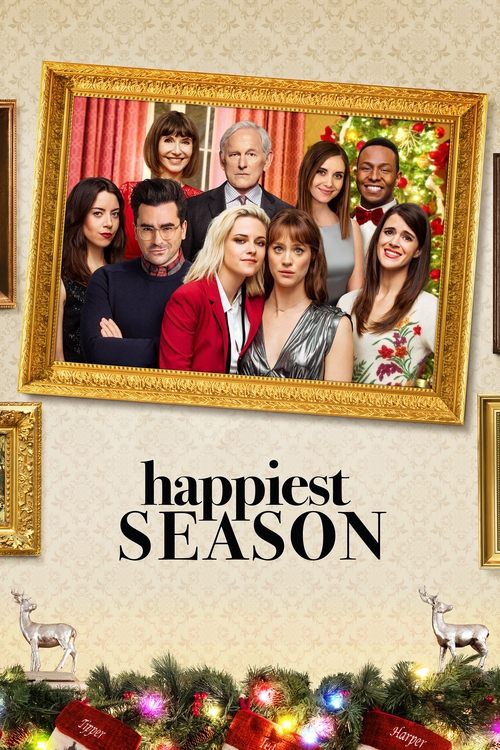
Happiest Season (2020)
Directed by Clea DuVall
Yes — Happiest Season is woke, scoring 60 out of 100 on our wokeness meter.
Happiest Season arrives with a distinction it wears lightly: the first lesbian Christmas romantic comedy from a major Hollywood studio.
Consciousness Markers
The entire plot revolves around a lesbian couple, coming out, and familial acceptance, earning a GLAAD Media Award.
Centers a lesbian romance with out queer actors in lead roles and a queer director, a landmark for major-studio holiday rom-coms.
A woman-directed film with a female ensemble that critiques patriarchal family-image politics and the pressures placed on sisters.
Includes earnest monologues about the fear of coming out and the need for acceptance, but remains a light rom-com.
No racial themes or commentary; supporting characters of color exist without the narrative engaging race.
No environmental themes or references.
The mayoral campaign donor subplot is about personal integrity, not economic critique.
No body-positivity themes or commentary.
No neurodivergence themes or characters.
No historical revisionism; contemporary fictional setting.
Why it received this score
Happiest Season arrives with a distinction it wears lightly: the first lesbian Christmas romantic comedy from a major Hollywood studio. Clea DuVall directs and co-writes, drawing on her own family history, and the result is a holiday film where the mistletoe hangs over a closet door. Kristen Stewart plays Abby, an orphan with a dim view of December, who accompanies her girlfriend Harper (Mackenzie Davis) home for the Caldwell family festivities, only to learn that Harper has never mentioned she is gay. Abby is introduced as the orphan roommate. The proposal she had planned will have to wait.
The machinery of the season kicks in: the mayoral campaign, the donor dinner, the competitive sister, the stolen necklace that lands in the wrong handbag. Underneath the tinsel is a study of a family that treats appearance as an asset. The Caldwell parents curate their daughters the way a campaign curates a photograph, and DuVall lets the sisters articulate the cost, in arguments and in one very public Christmas Eve meltdown. Dan Levy's John supplies the film's most sober passage, a monologue about being thrown out at seventeen and not spoken to for thirteen years. The sermonizing is present but brief. This is still a rom-com, and it knows when to pour the cocoa.
The film keeps its concerns narrow. Race goes unremarked. The environment, the class system, the body, the mind: none of it draws the camera's attention. The donor subplot is about a father's integrity, not the machinery of money. This is a tightly focused picture, and that focus is its strength. It wants to tell one story well, about fear and forgiveness and a family photograph that finally has room for everyone.
Analysis generated by our Consciousness Algorithm

Synopsis
A young woman's plans to propose to her girlfriend while at her family's annual holiday party are upended when she discovers her partner hasn't yet come out to her conservative parents.
Questions about Happiest Season
Is Happiest Season woke?
Yes — Happiest Season is woke, scoring 60 out of 100 on our wokeness meter. That earns it a verdict of Woke.
What makes Happiest Season woke?
4 of the 10 markers register at 30 or above, led by LGBTQ+ Themes (98), Representation Casting (78) and Feminist Agenda (55). On LGBTQ+ Themes: The entire plot revolves around a lesbian couple, coming out, and familial acceptance, earning a GLAAD Media Award.
How does Happiest Season compare to other 2020 movies?
It ranks #14 of the 227 films from 2020 we've scored; their average is 21. The wokest is One Night in Miami... (83).
How is the Woke Score calculated?
An AI-assisted process researches the film and its reception, scores it 0–100 on ten markers, then combines those into one 0–100 Woke Score. It measures a specific set of 2020s cultural themes, not film quality.