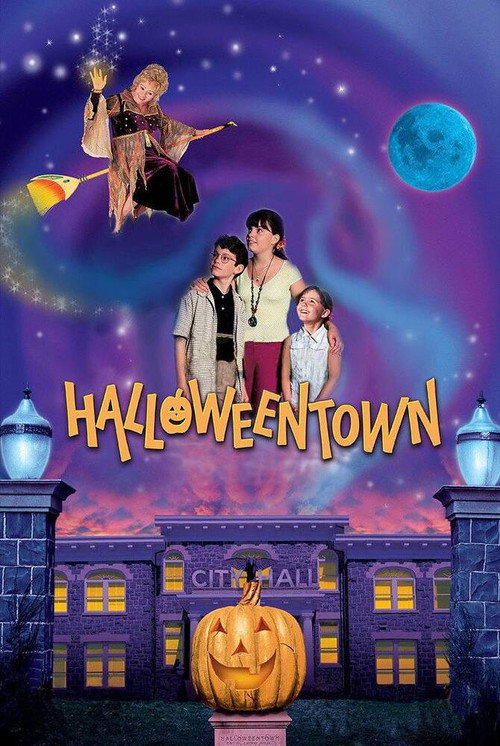
Halloweentown (1998)
Directed by Duwayne Dunham
No — Halloweentown is not woke, scoring 12 out of 100 on our wokeness meter.
Halloweentown arrives from 1998 as the fourth Disney Channel Original Movie, directed by Duwayne Dunham and anchored by Debbie Reynolds as a grandmother who is also a witch.
Consciousness Markers
Three generations of women (Marnie, Gwen, Aggie) drive the plot and save the town, but this reads as a natural girl-protagonist adventure rather than a deliberate feminist thesis.
The cast is uniformly white with no color-conscious or inclusive casting choices; the ensemble reflects default 1990s Disney Channel demographics without comment.
No LGBTQ+ characters, themes, or subtext appear anywhere in the film.
The film engages no racial themes, commentary, or diverse representation whatsoever.
No environmental or climate-related messaging is present.
The villain's motive is romantic jealousy and power, not economic critique; no class or anti-capitalist themes exist.
No body-positivity themes or messaging about body image appear.
No neurodivergent characters or themes are depicted.
The film is a fantasy with no historical subject matter to revise.
A lighthearted, whimsical children's fantasy that entertains rather than preaches; no moralizing monologues or issue-driven messaging.
Why it received this score
Halloweentown arrives from 1998 as the fourth Disney Channel Original Movie, directed by Duwayne Dunham and anchored by Debbie Reynolds as a grandmother who is also a witch. A thirteen-year-old named Marnie discovers her powers, follows her grandmother through a portal, and finds the town where the monsters go once October ends. There are warlocks, a talisman, a jack-o'-lantern, and a goblin who has been temporarily improved into a handsome teenager. The plot resolves when three generations of women defeat a villain nursing a grudge over a marriage that got away. In the taxonomy of these matters, it is a remarkably quiet specimen.
We searched for the customary markers and came up nearly empty. The cast is white and remains white, with no gesture toward inclusive hiring and no line of dialogue that acknowledges race exists. No character is gay. No character is neurodivergent. Nobody possesses a body the script feels obliged to celebrate. The environment goes unmentioned. Kalabar, the villain, is not a landlord, a corporation, or an allegory for either. He is a mayor with a broken heart and an appetite for conquest. Nothing here preaches. Nothing scolds. The film wants to hand you candy and a sequel, in that order.
The one area of interest is the feminist floor the story stands on without ever announcing it. Marnie drives the action, her mother and grandmother carry the moral weight, and the boys amount to a tagalong brother and a goblin with poor social timing. This is not a thesis. It is the ordinary inheritance of a children's tale built around a girl, and the film never pauses to explain itself. We classify it as a relic of a gentler television era: charming, brief, and ideologically inert. The sommelier swirls the glass and finds nothing to say.
Analysis generated by our Consciousness Algorithm


Synopsis
On her 13th birthday, Marnie learns she's a witch, discovers a secret portal, and is transported to Halloweentown — a magical place where ghosts and ghouls, witches and werewolves live apart from the human world. But she soon finds herself battling wicked warlocks, evil curses, and endless surprises.
Questions about Halloweentown
Is Halloweentown woke?
No — Halloweentown is not woke, scoring 12 out of 100 on our wokeness meter. That earns it a verdict of Ultra Based.
Does Halloweentown have any woke elements?
Very few. None of the 10 markers reaches 30, the level where a marker counts as present; the highest is Feminist Agenda at 20.
How does Halloweentown compare to other 1998 movies?
It ranks #38 of the 118 films from 1998 we've scored; their average is 12. The wokest is Show Me Love (60).
How is the Woke Score calculated?
An AI-assisted process researches the film and its reception, scores it 0–100 on ten markers, then combines those into one 0–100 Woke Score. It measures a specific set of 2020s cultural themes, not film quality.