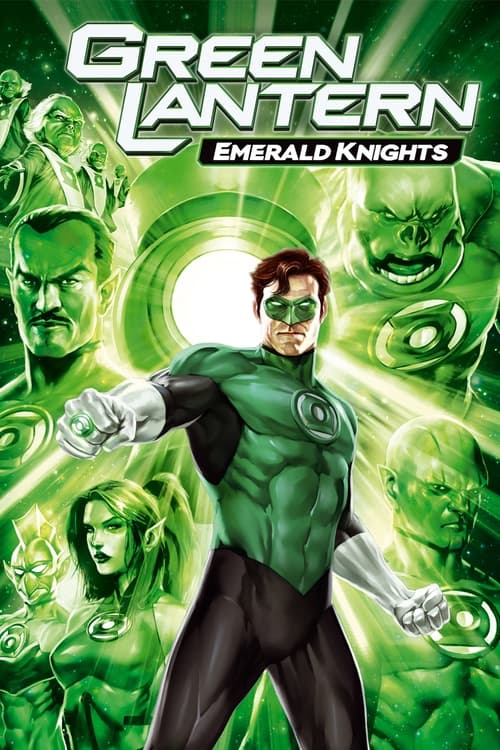
Green Lantern: Emerald Knights (2011)
Directed by Jay Oliva
No — Green Lantern: Emerald Knights is not woke, scoring 17 out of 100 on our wokeness meter.
Green Lantern: Emerald Knights arrives as the eleventh entry in the DC Universe Animated Original Movies line, a direct-to-video anthology that stitches five short tales around a single framing device: Hal Jordan preparing the rookie Arisia for an approaching catastrophe by recounting the exploits of the Corps.
Consciousness Markers
The voice cast includes several women of color (Kelly Hu, Grey DeLisle, Gwendoline Yeo) and the framing story centers on a female recruit, Arisia, though this reflects comic-book source material rather than a deliberate diversity mandate.
Arisia is a nervous new recruit who ultimately devises the plan that defeats Krona, and Laira's segment features a female Lantern defeating her father in combat, giving the film modest female agency without an explicit feminist thesis.
The framing device is instructional (Hal teaching Arisia), but the lessons are about courage and ring-slinging rather than any social or political sermon.
No LGBTQ+ characters, relationships, or themes appear anywhere in the anthology.
The film is set entirely among alien species and contains no engagement with race or racial politics.
The threat is an anti-matter entity, not an environmental or climate crisis; no ecological themes are present.
No economic critique or class-based commentary exists in the film.
No body-image or body-acceptance themes are present.
No neurodivergent characters or themes are depicted.
The film is pure space-fantasy fiction with no historical subject matter to revise.
Why it received this score
Green Lantern: Emerald Knights arrives as the eleventh entry in the DC Universe Animated Original Movies line, a direct-to-video anthology that stitches five short tales around a single framing device: Hal Jordan preparing the rookie Arisia for an approaching catastrophe by recounting the exploits of the Corps. The structure is instructional by design, a senior officer tutoring a nervous recruit, though the lessons concern courage, ring-slinging, and the value of imagination in combat. Nothing in the curriculum touches social or political instruction. The film wants to entertain the faithful, and it mostly does.
The progressive content here is modest and largely inherited. Arisia, voiced by Elisabeth Moss, is a jittery newcomer who eventually devises the plan that defeats Krona, which grants her a measure of agency. Laira, a female Lantern, defeats her father in single combat on her homeworld. The voice cast includes Kelly Hu, Grey DeLisle, and Gwendoline Yeo in supporting roles. These are real elements, but they flow from comic-book source material and ensemble logic, not from a deliberate diversity mandate. Elsewhere the ledger is empty. No LGBTQ characters appear. The setting is entirely alien, so racial politics never arise. The antagonist is an anti-matter entity, not a warming planet. No economic critique is offered. No body-image themes, no neurodivergent characters, no historical subject matter to revise.
What remains is a competent, lightly reverent piece of fan service, well animated and decently acted, with the thin characterization that critics noted at the time. It teaches its young recruit about bravery. That is the whole sermon.
Analysis generated by our Consciousness Algorithm
Part of


Synopsis
As the home planet of the Green Lantern Corps faces a battle with an ancient enemy, Hal Jordan prepares new recruit Arisia for the coming conflict by relating stories of the first Green Lantern and several of Hal's comrades.
Questions about Green Lantern: Emerald Knights
Is Green Lantern: Emerald Knights woke?
No — Green Lantern: Emerald Knights is not woke, scoring 17 out of 100 on our wokeness meter. That earns it a verdict of Ultra Based.
Does Green Lantern: Emerald Knights have any woke elements?
1 of the 10 markers register at 30 or above, led by Representation Casting (30). On Representation Casting: The voice cast includes several women of color (Kelly Hu, Grey DeLisle, Gwendoline Yeo) and the framing story centers on a female recruit, Arisia, though this reflects comic-book source material rather than a deliberate diversity mandate.
How does Green Lantern: Emerald Knights compare to other 2011 movies?
It ranks #45 of the 245 films from 2011 we've scored; their average is 11. The wokest is Paul (68).
How is the Woke Score calculated?
An AI-assisted process researches the film and its reception, scores it 0–100 on ten markers, then combines those into one 0–100 Woke Score. It measures a specific set of 2020s cultural themes, not film quality.