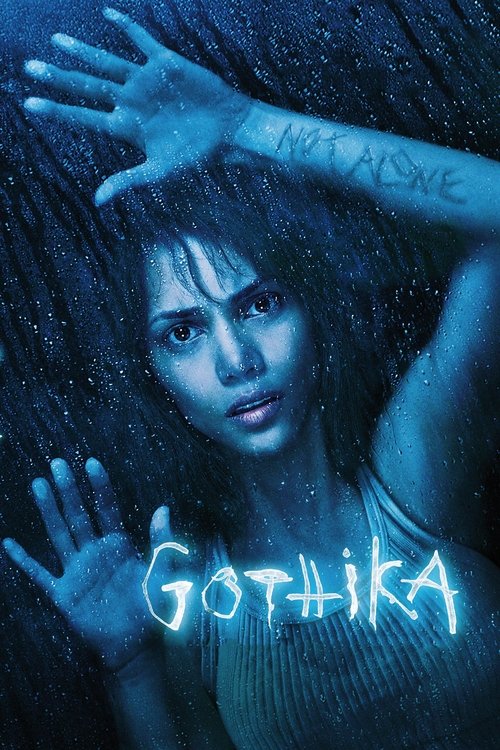
Gothika (2003)
Directed by Mathieu Kassovitz
No — Gothika is not especially woke, scoring 23 out of 100 on our wokeness meter.
Gothika arrived in 2003 with a premise any studio would envy: a criminal psychologist wakes as an inmate in her own institution, accused of butchering her husband, her memory conveniently missing.
Consciousness Markers
Halle Berry headlines as a Black female psychiatrist, with Charles S. Dutton, Dorian Harewood, and Penélope Cruz rounding out a notably diverse cast for a 2003 studio horror film, though the roles carry no identity commentary.
A female lead anchors a women-behind-bars revenge narrative in which male predators (her husband and the sheriff) are exposed and punished, and female solidarity between Miranda and Chloe drives the resolution, though it plays as exploitation-horror rather than thesis.
No LGBTQ+ characters, themes, or subtext appear anywhere in the film.
Despite a Black lead, the film engages no racial themes, commentary, or historical reckoning whatsoever.
No environmental or climate content of any kind.
No economic critique or class-based messaging; the villains are individual predators, not systems or capital.
No body-positivity themes; the film trades in conventional horror imagery of victimized bodies.
Mental illness and the psychiatric institution appear only as gothic horror tropes (insanity, repressed memory, the asylum), deployed for dread rather than as affirming neurodivergent representation.
No historical events or figures are reinterpreted; the story is entirely fictional.
The film makes no didactic social arguments and delivers no moralizing monologues; it is a straightforward supernatural thriller.
Why it received this score
Gothika arrived in 2003 with a premise any studio would envy: a criminal psychologist wakes as an inmate in her own institution, accused of butchering her husband, her memory conveniently missing. Halle Berry anchors the thing, and the casting around her is admirably varied for a mainstream horror picture of that era, with Charles S. Dutton, Dorian Harewood, and Penélope Cruz filling out the ward and the corridors. The film never remarks on any of it. Race exists here the way weather exists in a parking garage: present, unmentioned, and not the point.
What the film does have is a serviceable engine of female grievance. Miranda is terrorized by men she trusted, and the climax exposes both her husband and the local sheriff as serial predators who abused and killed women for years. Female solidarity, chiefly the bond between Miranda and the inmate Chloe, carries the resolution across the finish line. This is revenge-horror comfort food, served lurid and unsentimental. The movie wants us to hiss at villains, not to reconsider the patriarchy.
Elsewhere the cupboard is bare. There is no economic critique, no environmental anxiety, no queer subtext, no reimagining of history, and no affirmation of neurodivergent experience despite the asylum setting. The psychiatric hospital functions purely as gothic furniture, a place for flickering lights and the specific fear of being disbelieved. No character delivers a speech about the way things ought to be. Director Mathieu Kassovitz is here to make us jump, and he does, capably and without a message. The patient declines to teach.
Analysis generated by our Consciousness Algorithm


Synopsis
After a car crash, criminal psychologist Dr. Miranda Grey regains consciousness only to find that she's a patient in the same mental institution that currently employs her. She's been accused of murdering her husband Dr. Douglas Grey — but she has no memory of committing the crime. As she tries to regain her memory and convince her co-worker, Dr. Pete Graham, of her innocence, a vengeful spirit uses her as an earthly pawn, which further convinces everyone of her guilt.
Questions about Gothika
Is Gothika woke?
No — Gothika is not especially woke, scoring 23 out of 100 on our wokeness meter. That earns it a verdict of Based.
Does Gothika have any woke elements?
2 of the 10 markers register at 30 or above, led by Representation Casting (40) and Feminist Agenda (35). On Representation Casting: Halle Berry headlines as a Black female psychiatrist, with Charles S.
How does Gothika compare to other 2003 movies?
It ranks #21 of the 150 films from 2003 we've scored; their average is 12. The wokest is Mona Lisa Smile (60).
How is the Woke Score calculated?
An AI-assisted process researches the film and its reception, scores it 0–100 on ten markers, then combines those into one 0–100 Woke Score. It measures a specific set of 2020s cultural themes, not film quality.