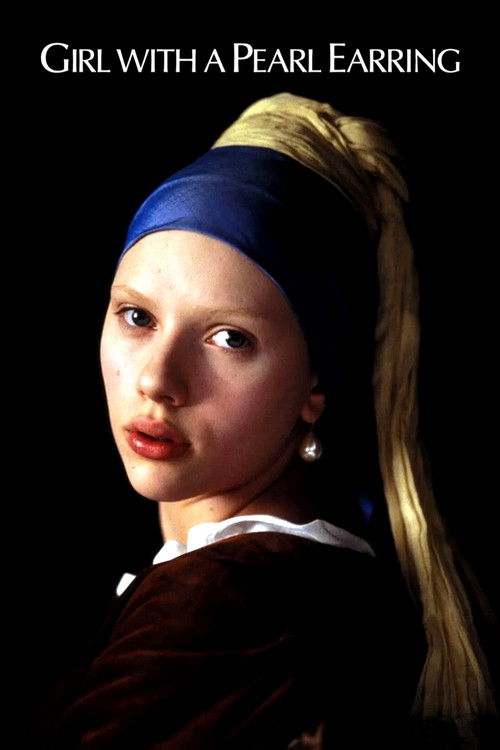
Girl with a Pearl Earring (2003)
Directed by Peter Webber
No — Girl with a Pearl Earring is not woke, scoring 8 out of 100 on our wokeness meter.
This is a film of surfaces and silences.
Consciousness Markers
The story centers on Griet's constrained agency and her quiet determination to be free in a patriarchal household, but it presents this as period drama rather than a modern feminist statement.
The film gestures at the commodification of art through the predatory patron van Ruijven and the link between art, money, and power, but never develops an anti-capitalist argument.
The cast is almost entirely white, reflecting the 17th-century Dutch setting; there is no deliberate diverse or color-conscious casting.
No LGBTQ+ characters or themes appear anywhere in the film.
Race is entirely absent as a theme; the film concerns a homogeneous 17th-century Dutch society.
No environmental or climate themes are present.
No body-positivity themes or messaging are present.
No neurodivergence themes or characters are present.
The film is speculative historical fiction built around a real painting and painter, not a social-justice reinterpretation of history.
The film is famously quiet and restrained, with minimal dialogue and no didactic or preachy messaging.
Why it received this score
This is a film of surfaces and silences. Peter Webber's 2003 adaptation of Tracy Chevalier's novel places Griet, a peasant maid, inside the Delft household of Johannes Vermeer. The camera lingers on light, paint, and skin. Dialogue is sparse. The film has no interest in instructing its audience, and its quiet is the point. It is a period drama that behaves like a period drama, which in this case means it observes constraint without announcing a thesis about it.
The closest it comes to contemporary progressive sensibilities is Griet's limited agency. She is watched, traded, and nearly assaulted by a predatory patron. Her determination to be free is real, but the film presents it as historical circumstance, not as a manifesto. It does not modernize her into a heroine with a platform. The art world's economics also get a glancing critique. Van Ruijven's patronage turns painting into currency and status. The film notices the link between art, money, power, and sex. It does not build an argument about capital. The observation is a mood, not a position.
Everything else is absent. The cast is white because seventeenth-century Delft was white, and the film makes no color-conscious gesture. Race, sexuality, climate, body image, and neurodivergence are not themes. The story is speculative history around a real painting, not a revisionist project. It refuses to lecture. For a viewer seeking modern cultural markers, the pantry is bare. For a viewer seeking restraint, the room is well lit. The final zoom to the actual painting lands as a modest curatorial trick. The film remains a handsome, patient, almost stubbornly apolitical object.
Analysis generated by our Consciousness Algorithm
Synopsis
This film, adapted from a work of fiction by author Tracy Chevalier, tells a story about the events surrounding the creation of the painting "Girl With A Pearl Earring" by 17th century Dutch master Johannes Vermeer. A young peasant maid working in the house of painter Johannes Vermeer becomes his talented assistant and the model for one of his most famous works.
Questions about Girl with a Pearl Earring
Is Girl with a Pearl Earring woke?
No — Girl with a Pearl Earring is not woke, scoring 8 out of 100 on our wokeness meter. That earns it a verdict of Ultra Based.
Does Girl with a Pearl Earring have any woke elements?
Very few. None of the 10 markers reaches 30, the level where a marker counts as present; the highest is Feminist Agenda at 20.
How does Girl with a Pearl Earring compare to other 2003 movies?
It ranks #74 of the 150 films from 2003 we've scored; their average is 12. The wokest is Mona Lisa Smile (60).
How is the Woke Score calculated?
An AI-assisted process researches the film and its reception, scores it 0–100 on ten markers, then combines those into one 0–100 Woke Score. It measures a specific set of 2020s cultural themes, not film quality.