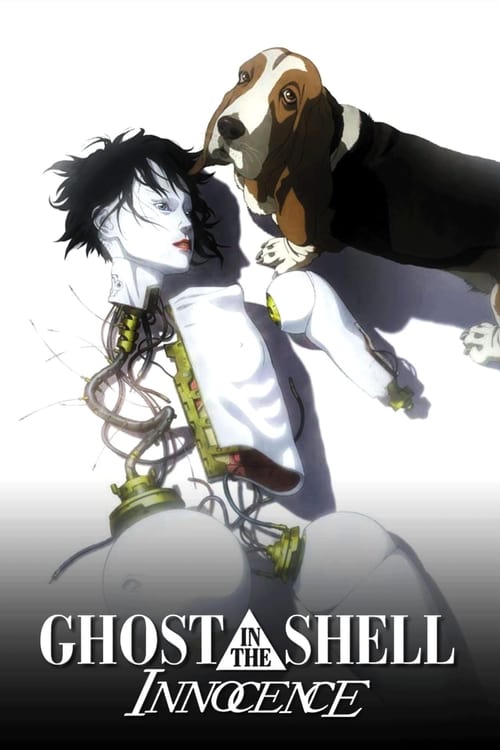
Ghost in the Shell 2: Innocence (2004)
Directed by Mamoru Oshii
No — Ghost in the Shell 2: Innocence is not woke, scoring 17 out of 100 on our wokeness meter.
Mamoru Oshii returns to the world of cyberbrains and shelled bodies with the solemnity of a man delivering a lecture to a room he suspects is not listening.
Consciousness Markers
The film is famously dense with philosophical quotation (Descartes, Buddha, Confucius, Milton, etc.), giving it a heavy didactic texture, though the lecturing is existential rather than social-justice oriented.
The villainous corporation LOCUS SOLUS traffics young girls and illegally duplicates their consciousness for profit, giving the film a standard cyberpunk anti-corporate streak, though it is not framed as a systemic economic critique.
The forensic specialist is named 'Haraway' after feminist theorist Donna Haraway, and the gynoid-trafficking plot gestures at the exploitation of women, but this is thematic texture rather than an articulated feminist agenda.
A Japanese production with an entirely Japanese voice cast; there is no deliberate diversity-casting effort in the modern sense.
No LGBTQ+ characters, themes, or subtext appear anywhere in the film.
The film engages philosophy, technology, and identity but has no racial themes or commentary.
No environmental or climate themes are present.
No body-positivity themes; the film's treatment of dolls and shells is philosophical, not about body acceptance.
No neurodivergence themes or characters are present.
The film is set in a fictional 2032 and makes no historical revisionist claims.
Why it received this score
Mamoru Oshii returns to the world of cyberbrains and shelled bodies with the solemnity of a man delivering a lecture to a room he suspects is not listening. The plot concerns a line of gynoids, doll-like sex androids, that have begun murdering their owners and then destroying themselves. Batou, the basset hound-owning cyborg detective, and Togusa, a man stubbornly clinging to his remaining flesh, follow the trail into a corporation called LOCUS SOLUS, a yakuza bar, and the mansion of a hacker who lives inside a marionette. Oshii shoots it all in gold and deep shadow, and the result is gorgeous, oppressive, and about as easy to follow as a doctoral defense conducted in a language we nearly speak.
The film's social conscience is of an older, colder vintage. A corporation traffics young girls and duplicates their consciousness into commercial products, which is a standard cyberpunk grievance against commerce, gestured at instead of argued. One forensic specialist is named Haraway, presumably after Donna Haraway, and the exploitation of the gynoids carries a faint feminist residue. These are textures, not theses. The film is far more interested in dolls, ghosts, and the question of whether a copied soul counts as a soul at all. Its politics are atmospheric. Its metaphysics are load-bearing.
Where the film does exert pressure is in its relentless quoting. Descartes, Confucius, Buddha, Milton, the Tridentine Mass: all are dragged in to lend gravity, and the effect is a lecture with a very high production budget. The earnestness is complete and the sermons are existential, not social. We are left with a beautiful, exhausting artifact from 2004, before certain vocabularies hardened into ritual. It asks what makes a being real. It does not ask us to applaud the question.
Analysis generated by our Consciousness Algorithm
Synopsis
Cyborg detective Batou is assigned to investigate a series of murders committed by gynoids—doll-like cyborgs, which all malfunctioned, killed, then self-destructed afterwards. The brains of the gynoids initialize in order to protect their manufacturer's software, but in one gynoid, which Batou himself neutralized, one file remains: a voice speaking the phrase "Help me."
Questions about Ghost in the Shell 2: Innocence
Is Ghost in the Shell 2: Innocence woke?
No — Ghost in the Shell 2: Innocence is not woke, scoring 17 out of 100 on our wokeness meter. That earns it a verdict of Ultra Based.
Does Ghost in the Shell 2: Innocence have any woke elements?
1 of the 10 markers register at 30 or above, led by Lecture Energy (30). On Lecture Energy: The film is famously dense with philosophical quotation (Descartes, Buddha, Confucius, Milton, etc.), giving it a heavy didactic texture, though the lecturing is existential rather than social-justice oriented.
How does Ghost in the Shell 2: Innocence compare to other 2004 movies?
It ranks #39 of the 178 films from 2004 we've scored; their average is 12. The wokest is Tropical Malady (62).
How is the Woke Score calculated?
An AI-assisted process researches the film and its reception, scores it 0–100 on ten markers, then combines those into one 0–100 Woke Score. It measures a specific set of 2020s cultural themes, not film quality.