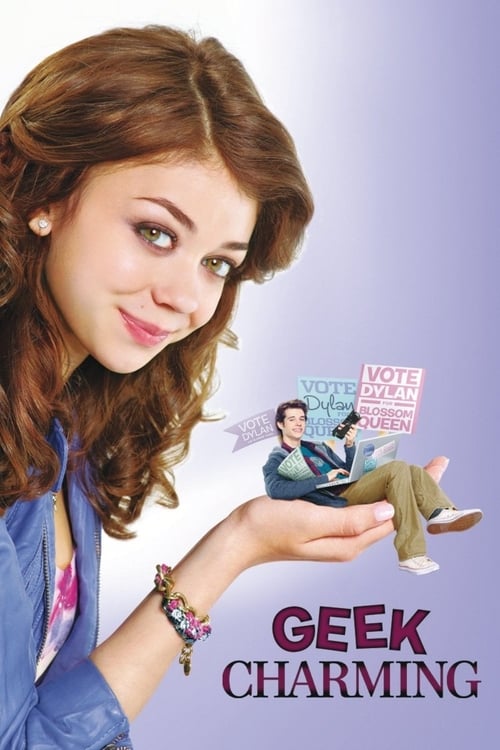
Geek Charming (2011)
Directed by Jeffrey Hornaday
No — Geek Charming is not woke, scoring 10 out of 100 on our wokeness meter.
Geek Charming arrives from the Disney Channel's 2011 pipeline, a made-for-television romance in which a documentary-minded film geek named Josh turns his camera on Dylan, the reigning popular girl of Woodlands Academy.
Consciousness Markers
Supporting cast includes actors of color such as Vanessa Morgan and David Del Rio, but the leads are white and diversity is not a thematic focus.
Mild moralizing about being yourself and not judging others, typical of teen films, but not preachy or ideological.
No LGBTQ+ characters or themes.
Female protagonist but no feminist critique; the plot centers on popularity and romance within conventional gender roles.
No exploration of race or racial issues.
No environmental themes.
No critique of capitalism or economic inequality; wealth is a backdrop for popularity.
No body positivity themes.
No neurodivergent characters or themes; 'geek' is a social label, not a clinical condition.
No historical revisionism.
Why it received this score
Geek Charming arrives from the Disney Channel's 2011 pipeline, a made-for-television romance in which a documentary-minded film geek named Josh turns his camera on Dylan, the reigning popular girl of Woodlands Academy. The premise promises an exposé of the high school social order. The film delivers a courtship instead. The camera is a device for proximity, not inquiry, and the social hierarchy it threatens to interrogate is restored, gently, by the closing credits. We have seen this film many times. It remains watchable. It remains slight.
On the matter of representation, the supporting cast includes performers of color, among them Vanessa Morgan and David Del Rio, and the film neither comments on this nor builds anything from it. That is the whole of the ledger. There is no LGBTQ presence, no engagement with race as a subject, no environmental concern, no economic critique. Wealth functions here as a prop, the handbag in the fountain, the house, and never as a system to be examined. Dylan's transformation is a matter of manners, not politics. Josh's film club is a social refuge, not a diagnostic of neurodivergence, and the word geek describes a lunch table, not a mind.
The film does moralize, mildly, about seeing people for who they are and not judging by the surface. This is the standard instruction of the teen genre, delivered without a pulpit. No viewer will feel scolded. The result is a modest, good-natured picture that aspires to nothing beyond its own charm, and in 2011 that was sufficient. The cultural weather has since changed. The film has not changed with it, because it was never built to. It sits quietly as an artifact of a gentler commercial moment.
Analysis generated by our Consciousness Algorithm


Synopsis
Film geek Josh is looking for the subject of his new documentary when a chance meeting puts the perfect star in his sights—Dylan, his school's most popular junior. But Dylan's hopes of using the film to become Blossom Queen don't quite match with Josh's goal to make a hard-hitting exposé about popularity. Will Josh shoot the film as planned, or show Dylan as the truly interesting person she is?
Questions about Geek Charming
Is Geek Charming woke?
No — Geek Charming is not woke, scoring 10 out of 100 on our wokeness meter. That earns it a verdict of Ultra Based.
Does Geek Charming have any woke elements?
Very few. None of the 10 markers reaches 30, the level where a marker counts as present; the highest is Representation Casting at 20.
How does Geek Charming compare to other 2011 movies?
It ranks #88 of the 245 films from 2011 we've scored; their average is 11. The wokest is Paul (68).
How is the Woke Score calculated?
An AI-assisted process researches the film and its reception, scores it 0–100 on ten markers, then combines those into one 0–100 Woke Score. It measures a specific set of 2020s cultural themes, not film quality.