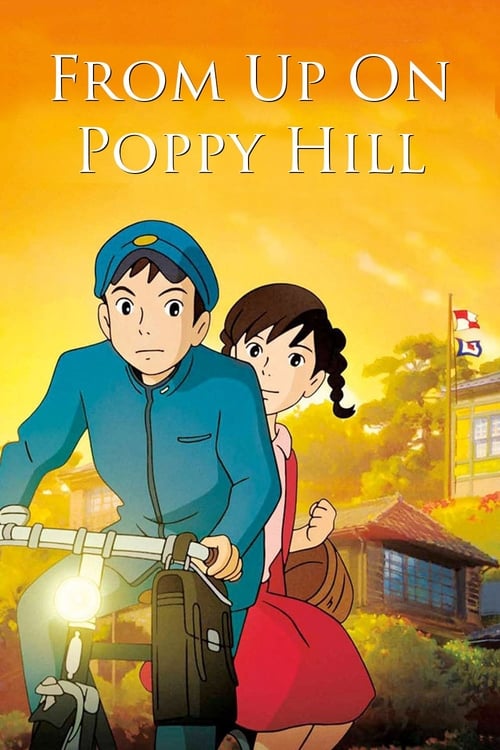
From Up on Poppy Hill (2011)
Directed by Goro Miyazaki
No — From Up on Poppy Hill is not woke, scoring 5 out of 100 on our wokeness meter.
Studio Ghibli's 2011 outing, directed by Gorō Miyazaki and adapted from a 1980 manga, sets itself in Yokohama in 1963, a nation dusting itself off and preparing to host the Olympics.
Consciousness Markers
Students clash with a businessman/school-board chairman over demolishing their clubhouse for Olympic redevelopment, a mild youth-versus-establishment, change-versus-tradition tension, though it resolves through persuasion rather than class critique.
Umi is a capable, self-possessed protagonist who runs a boarding house and organizes a student renovation effort, but this is characterful period drama rather than any articulated feminist thesis.
A gentle, nostalgic coming-of-age romance that largely avoids preaching; any thematic content is embedded in the story rather than delivered as a lecture.
A wholly Japanese production with a Japanese cast and setting; characters exist naturally without any casting agenda or commentary.
No LGBTQ+ characters, themes, or subtext of any kind appear in the film.
The film engages postwar Japanese history but contains no racial or ethnic consciousness themes.
No environmental or climate themes are present; the conflict is over preserving an old clubhouse, not ecological concerns.
No body-positivity themes or messaging appear.
No neurodivergent characters or themes are depicted.
The film is a period drama set in 1963 with a historically grounded backdrop, but it does not reframe or revise history along modern ideological lines.
Why it received this score
Studio Ghibli's 2011 outing, directed by Gorō Miyazaki and adapted from a 1980 manga, sets itself in Yokohama in 1963, a nation dusting itself off and preparing to host the Olympics. Umi Matsuzaki runs a boarding house, raises signal flags each morning, and looks after her siblings while her mother studies abroad. She meets Shun, a boy who writes poetry about her flags and rides a tugboat to school. A clubhouse called the Latin Quarter faces demolition. Students clean it up. A businessman on the school board wants it gone. There is a buried family secret involving a photograph and three naval men.
The film's social awareness is modest and mostly atmospheric. Umi is a capable protagonist who organizes a renovation and holds a household together, though the film never argues a thesis about it. The students do collide with a board chairman who represents redevelopment and institutional power, and the resolution arrives through persuasion and a tour of the premises. That is youth against establishment, tradition against change, and it evaporates the moment the chairman softens. Nothing here preaches. The politics are the soft hum of a period piece, not a sermon.
What remains is craft: the shimmering harbor, the cluttered rooms, the 1961 pop song placed with care. The buried secret is handled with the restraint of a story that trusts its audience. A modern viewer scanning for ideological instruction will find almost none, and that is the film's quiet virtue. It is nostalgic, gentle, and content to be a coming-of-age romance about a girl and her flags. We classify it, we file it, and we move on.
{"thematic_tags": ["book_adaptation"]}
Analysis generated by our Consciousness Algorithm


Synopsis
Yokohama, 1963. Japan is picking itself up from the devastation of World War II and preparing to host the 1964 Olympics—and the mood is one of both optimism and conflict as the young generation struggles to throw off the shackles of a troubled past. Against this backdrop of hope and change, a friendship begins to blossom between high school students Umi and Shun—but a buried secret from their past emerges to cast a shadow on the future and pull them apart.
Questions about From Up on Poppy Hill
Is From Up on Poppy Hill woke?
No — From Up on Poppy Hill is not woke, scoring 5 out of 100 on our wokeness meter. That earns it a verdict of Ultra Based.
Does From Up on Poppy Hill have any woke elements?
Very few. None of the 10 markers reaches 30, the level where a marker counts as present; the highest is Eat the Rich at 15.
How does From Up on Poppy Hill compare to other 2011 movies?
It ranks #165 of the 245 films from 2011 we've scored; their average is 11. The wokest is Paul (68).
How is the Woke Score calculated?
An AI-assisted process researches the film and its reception, scores it 0–100 on ten markers, then combines those into one 0–100 Woke Score. It measures a specific set of 2020s cultural themes, not film quality.