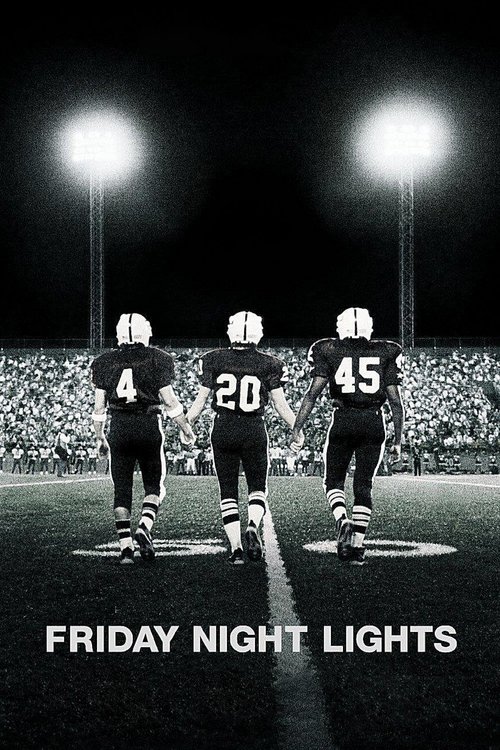
Friday Night Lights (2004)
Directed by Peter Berg
No — Friday Night Lights is not especially woke, scoring 20 out of 100 on our wokeness meter.
Peter Berg's 2004 adaptation of H. G. Bissinger's book arrives with its thesis already bolted to the chassis: the town of Odessa, Texas, has commodified its teenagers, and the bill comes due in torn knee ligaments.
Consciousness Markers
The ensemble includes Black and Latino players (Derek Luke, Jay Hernandez, Lee Thompson Young, Lee Jackson) who reflect the genuine demographics of the 1988 Permian roster, so the diversity is authentic rather than performative, though it remains a notably multiracial cast for a Texas football drama.
Boobie Miles's arc carries a real undercurrent about a Black athlete being used for his body and discarded once broken, and the town's booster culture is quietly racialized, though the film never foregrounds or lectures on race.
The film critiques the booster economy and the commodification of teenage athletes by a football-obsessed town, but it frames this as a local cultural pathology rather than a systemic indictment of capitalism.
Coach Gaines's 'be perfect' halftime speech and the film's closing moralizing about the town's unhealthy obsession carry some sermonizing, but it is inspirational sports-drama rhetoric rather than social-justice preaching.
Connie Britton's Sharon Gaines gets a handful of grounded moments as the coach's wife weathering the town's abuse, but the film is overwhelmingly a male locker-room narrative with no feminist thesis.
There is no LGBTQ+ content, subtext, or character in the film whatsoever.
No environmental or climate themes appear in the film.
No body-positivity themes; the film is built around athletic physical performance and injury.
No neurodivergent characters or themes are present.
The film takes substantial dramatic liberties with the real 1988 season, but these are conventional sports-movie compressions rather than an ideological rewriting of history through a modern lens.
Why it received this score
Peter Berg's 2004 adaptation of H. G. Bissinger's book arrives with its thesis already bolted to the chassis: the town of Odessa, Texas, has commodified its teenagers, and the bill comes due in torn knee ligaments. The ensemble is cast to match the actual 1988 Permian roster, Black and Latino players moving through the huddle and the locker room without a single line of explanation. Derek Luke's Boobie Miles carries the sharpest edge here, a young man whose body is a municipal asset until the MRI says otherwise. His quiet sobbing in his uncle's car is the film's most honest passage on race, precisely because nobody stops to announce it.
Elsewhere the progressive ledger stays sparse. There is no LGBTQ presence of any kind, no environmental conscience, no interest in body positivity beyond the athletic ideal, and no neurodivergent interiority. Connie Britton gets a handful of grounded scenes as the coach's wife absorbing the town's abuse, though the film remains a male locker-room narrative with no feminist argument to make. The critique of booster culture lands as a local pathology, a small-town sickness, not an indictment of the economic order that produced it.
Berg does allow himself some sermonizing. The be-perfect halftime address and the closing text about a town's unhealthy obsession carry a faint pulpit odor, though this is inspirational sports rhetoric, not social instruction. The film's many liberties with the real 1988 season are the ordinary compressions of the genre, the coin toss relocated, the opponents shuffled, the Marshall game reversed for dramatic convenience. A sturdy, well-made drama that mostly keeps its lessons to itself.
Analysis generated by our Consciousness Algorithm
Part of


Synopsis
A small, turbulent town in Texas obsesses over their high school football team to an unhealthy degree. When the star tailback, Boobie Miles, is seriously injured during the first game of the season, all hope is lost, and the town's dormant social problems begin to flare up. It is left to the inspiring abilities of new coach Gary Gaines to instill in the other team members -- and, by proxy, the town itself -- a sense of self-respect and honor.
Questions about Friday Night Lights
Is Friday Night Lights woke?
No — Friday Night Lights is not especially woke, scoring 20 out of 100 on our wokeness meter. That earns it a verdict of Based.
Does Friday Night Lights have any woke elements?
2 of the 10 markers register at 30 or above, led by Representation Casting (40) and Racial Consciousness (35). On Representation Casting: The ensemble includes Black and Latino players (Derek Luke, Jay Hernandez, Lee Thompson Young, Lee Jackson) who reflect the genuine demographics of the 1988 Permian roster, so the diversity is authentic rather than performative, though it remains a notably multiracial cast for a Texas football drama.
How does Friday Night Lights compare to other 2004 movies?
It ranks #36 of the 178 films from 2004 we've scored; their average is 12. The wokest is Tropical Malady (62).
How is the Woke Score calculated?
An AI-assisted process researches the film and its reception, scores it 0–100 on ten markers, then combines those into one 0–100 Woke Score. It measures a specific set of 2020s cultural themes, not film quality.