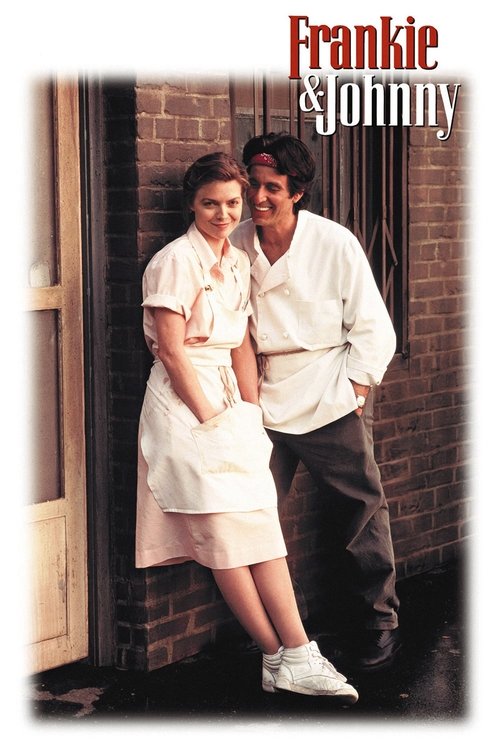
Frankie and Johnny (1991)
Directed by Garry Marshall
No — Frankie and Johnny is not woke, scoring 8 out of 100 on our wokeness meter.
Frankie and Johnny arrives from 1991, adapted by Terrence McNally from his own play and directed by Garry Marshall with an eye for diner-table warmth.
Consciousness Markers
The diner ensemble includes Latino (Héctor Elizondo) and Black (Glenn Plummer) performers in natural supporting roles, but this is unremarkable 1991 ensemble casting with no commentary attached.
Frankie is a guarded, self-determined woman navigating trauma and refusing a man's advances on her own terms, but the film is a conventional romance rather than a feminist statement.
The film is a character-driven romance that never pauses to deliver social messaging or moral instruction.
A Black co-worker appears in the diner staff, but race is never a subject of the film.
The blue-collar diner setting gestures at working-class life, but there is no critique of wealth, capital, or class power.
Nathan Lane appears in the cast but plays a straight character; the film contains no LGBTQ+ themes, characters, or subtext.
No environmental themes whatsoever.
The film's central controversy was casting the conventionally beautiful Pfeiffer as a 'plain' waitress, which runs directly against body-positivity sensibilities.
No neurodivergent characters or themes.
A contemporary romantic drama with no historical revisionism.
Why it received this score
Frankie and Johnny arrives from 1991, adapted by Terrence McNally from his own play and directed by Garry Marshall with an eye for diner-table warmth. Its social consciousness is a faint pulse, the kind of thing we now inspect under a microscope and find mostly lint. The supporting ensemble includes Héctor Elizondo and Glenn Plummer in natural, unremarked roles, which gives the film a mild representational texture. Nathan Lane appears, but he plays a straight character, so the LGBTQ register is silent. There is no climate anxiety, no neurodivergent arc, no revisionist history. This is a romance about lonely people, a jukebox, and Debussy.
Frankie herself is guarded and self-determined in a way that earns a modest feminist nod. She refuses Johnny repeatedly, discloses past abuse, and names the miscarriage that left her unable to have children. The film lets her set terms. Then it becomes a conventional courtship in which persistence wins. The casting controversy does the rest. Michelle Pfeiffer was considered too beautiful to play a plain waitress, and Kathy Bates later said Marshall rejected her for not looking pretty enough. A film that treats ordinary looks as a barrier to romance cannot score well on body positivity. Its notion of plain is a movie star in a cardigan.
The diner setting gestures at working-class life, though nobody eats the rich. Race exists as staffing, not subject. The film never pauses to lecture, which keeps its sermonizing impulse low. We are left with a soft, watchable romance with two glamorous performers pretending to be ordinary. It is not offensive. It is not instructive. It is a thin vintage, drinkable at the counter, not worth cellaring. The sommelier sets down the glass and reaches for the next bottle.
Analysis generated by our Consciousness Algorithm
Part of


Synopsis
When Johnny is released from prison following a forgery charge, he quickly lands a job as a short-order cook at a New York diner. Following a brief fling with waitress Cora, he develops an attraction for Cora's friend and fellow waitress Frankie. While Frankie resists Johnny's charms initially, she eventually relents when her best friend, Tim, persuades her to give Johnny a chance.
Questions about Frankie and Johnny
Is Frankie and Johnny woke?
No — Frankie and Johnny is not woke, scoring 8 out of 100 on our wokeness meter. That earns it a verdict of Ultra Based.
Does Frankie and Johnny have any woke elements?
Very few. None of the 10 markers reaches 30, the level where a marker counts as present; the highest is Representation Casting at 25.
How does Frankie and Johnny compare to other 1991 movies?
It ranks #33 of the 68 films from 1991 we've scored; their average is 14. The wokest is Paris Is Burning (77).
How is the Woke Score calculated?
An AI-assisted process researches the film and its reception, scores it 0–100 on ten markers, then combines those into one 0–100 Woke Score. It measures a specific set of 2020s cultural themes, not film quality.