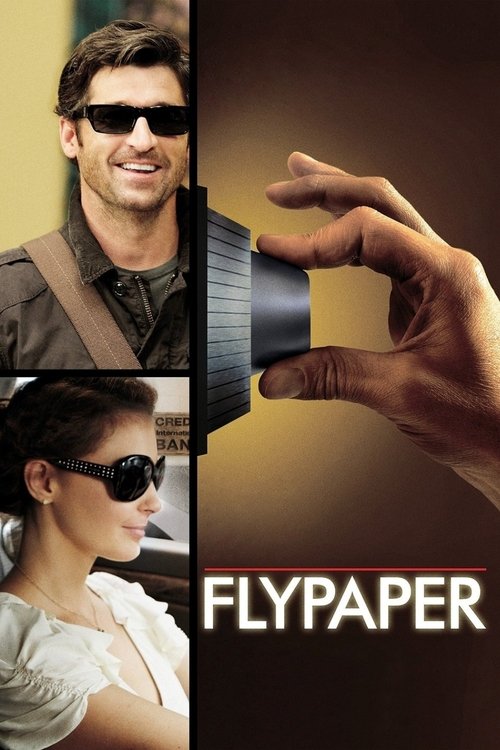
Flypaper (2011)
Directed by Rob Minkoff
No — Flypaper is not woke, scoring 8 out of 100 on our wokeness meter.
Flypaper arrives from 2011 with the weary confidence of a heist comedy that has studied its predecessors closely and learned almost nothing from them.
Consciousness Markers
The cast includes Mekhi Phifer, Octavia Spencer, Adrian Martinez, and Natalia Safran in supporting roles, but their presence is incidental to the heist plot and never remarked upon. This is natural ensemble casting, not a statement.
Ashley Judd's Kaitlin is revealed as a master bank robber, but this is a plot twist rather than a feminist thesis; the film is a boys'-club caper comedy with a femme fatale flourish.
A bank heist is inherently about taking money, but the film treats robbery as farce and puzzle-box rather than as a critique of wealth or capitalism.
No LGBTQ+ characters, themes, or subtext appear anywhere in the film.
Race is never a subject of the film; the multiethnic cast simply exists within a generic crime-comedy framework.
No environmental or climate themes whatsoever.
No body-positivity themes or messaging present.
Tripp's obsessive coin-configuration quirk and Mitch's panic attack are played for comedy, not as neurodivergence representation or advocacy.
No historical revisionism; the film is a contemporary fictional caper.
The film makes no attempt to lecture the audience on social or political matters; it is a lightweight, twist-driven comedy.
Why it received this score
Flypaper arrives from 2011 with the weary confidence of a heist comedy that has studied its predecessors closely and learned almost nothing from them. Rob Minkoff, a director best known for animated lions and small talking mice, assembles two competing crews of robbers inside a single Credit International branch, then lets them bumble through explosives, double crosses, and a body count the screenplay treats as set dressing. The plot is a locked-room puzzle wearing a ski mask. Patrick Dempsey's Tripp flutters about the lobby deducing things, Ashley Judd's teller endures him, and Tim Blake Nelson and Pruitt Taylor Vince steal the picture as a pair of Deliverance rejects who cannot open an ATM.
The ensemble is notably multiethnic, with Mekhi Phifer, Octavia Spencer, Adrian Martinez, and Natalia Safran filling out the margins. Their presence is casual and unremarked, which is to say the film casts them and then forgets them, a practice we might charitably call naturalism and less charitably call indifference. Nothing in the script asks race to mean anything, and nothing in the script asks anything to mean anything. The lone gesture toward gender arrives in the final minutes, when Judd's Kaitlin is revealed as a master thief in her own right. It is a twist, not a thesis. The boys' club simply gains a new member.
On the matter of instruction, the film is innocent. It wants to amuse, not to edify, and it holds no brief against banks, wealth, or the systems that produce them. A robbery here is a mechanism, not a metaphor. What remains is a slight, twist-heavy trifle that premiered at Sundance, earned mixed notices, and vanished. We have sat through worse sermons. We have rarely sat through a sillier vault.
Analysis generated by our Consciousness Algorithm


Synopsis
A man caught in the middle of two simultaneous robberies at a bank desperately tries to protect the teller with whom he's secretly in love.
Questions about Flypaper
Is Flypaper woke?
No — Flypaper is not woke, scoring 8 out of 100 on our wokeness meter. That earns it a verdict of Ultra Based.
Does Flypaper have any woke elements?
Very few. None of the 10 markers reaches 30, the level where a marker counts as present; the highest is Representation Casting at 15.
How does Flypaper compare to other 2011 movies?
It ranks #107 of the 245 films from 2011 we've scored; their average is 11. The wokest is Paul (68).
How is the Woke Score calculated?
An AI-assisted process researches the film and its reception, scores it 0–100 on ten markers, then combines those into one 0–100 Woke Score. It measures a specific set of 2020s cultural themes, not film quality.