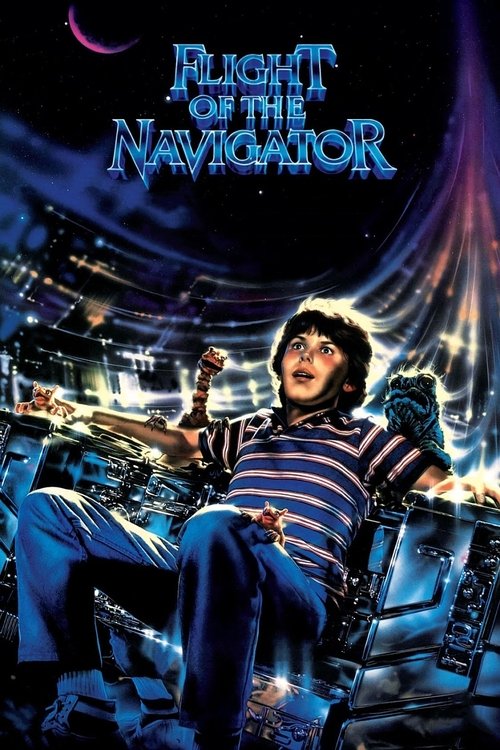
Flight of the Navigator (1986)
Directed by Randal Kleiser
No — Flight of the Navigator is not woke, scoring 3 out of 100 on our wokeness meter.
"Flight of the Navigator" arrives from 1986, a Disney-distributed science fiction adventure about a boy who falls into a ravine and wakes eight years later, still twelve, his brain stuffed with star charts by a chrome drone ship.
Consciousness Markers
Sarah Jessica Parker's Carolyn is a competent NASA intern who aids David, but she exists as a supporting helper rather than any statement of feminist intent.
The film delivers light exposition about time dilation and the debunked '10% of the brain' myth, but it is plot mechanics rather than moralizing.
The cast is uniformly white, with no diverse casting choices made or commented upon; the film predates any such considerations.
There are no LGBTQ+ characters, themes, or subtext anywhere in the film.
Race is entirely absent as a subject; the film features no engagement with racial themes whatsoever.
No environmental or climate themes appear; the alien's mission is biological specimen collection, not ecological commentary.
There is no critique of wealth, capitalism, or class; NASA is portrayed as a benign if bureaucratic institution.
Body image and physical appearance are not themes of the film.
No neurodivergent characters or themes are present; David's enhanced brain is alien technology, not a neurodivergence narrative.
The film is a fictional sci-fi adventure with no historical revisionism.
Why it received this score
"Flight of the Navigator" arrives from 1986, a Disney-distributed science fiction adventure about a boy who falls into a ravine and wakes eight years later, still twelve, his brain stuffed with star charts by a chrome drone ship. It is a gentle, well-liked film. It is also a document of an era that had not yet been asked the questions we now bring to it. The cast is uniformly white, a fact the film neither hides nor examines. There is no LGBTQ presence, no subtext, no gesture in that direction. Race never surfaces as a subject at all, which is its own kind of silence.
Sarah Jessica Parker's Carolyn McAdams, a NASA intern, is competent and helpful, and this is where the film's progressive content begins and ends. She assists the hero and is sent back to the facility for her trouble. No thesis is advanced on her behalf. The antagonist is bureaucratic inertia inside a government agency, not wealth or class, so the appetite for eating the rich goes unfed. The alien collects biological specimens, which is a mission statement, not an environmental parable. On body image, neurodivergence, and the rewriting of history, the film is silent. David's overloaded mind is alien hardware, not a study of a differently wired child.
The film does lecture, mildly, about time dilation and the durable myth that humans use ten percent of their brains. It is exposition, delivered to move the plot, not to improve us. A remake has been floated with a female protagonist, which suggests the original would require substantial retrofitting to meet contemporary expectations. As it stands, it is a charming artifact, and almost entirely innocent of the cultural markers we now tally.
Analysis generated by our Consciousness Algorithm
Part of

Synopsis
12-year-old David is accidentally knocked out in the forest near his home, but when he awakens eight years have passed. His family is overjoyed to have him back, but is just as perplexed as he is that he hasn't aged. When a NASA scientist discovers a UFO nearby, David gets the chance to unravel the mystery and recover the life he lost.
Questions about Flight of the Navigator
Is Flight of the Navigator woke?
No — Flight of the Navigator is not woke, scoring 3 out of 100 on our wokeness meter. That earns it a verdict of Ultra Based.
Does Flight of the Navigator have any woke elements?
Very few. None of the 10 markers reaches 30, the level where a marker counts as present; the highest is Feminist Agenda at 5.
How does Flight of the Navigator compare to other 1986 movies?
It ranks #40 of the 62 films from 1986 we've scored; their average is 7. The wokest is Star Trek IV: The Voyage Home (42).
How is the Woke Score calculated?
An AI-assisted process researches the film and its reception, scores it 0–100 on ten markers, then combines those into one 0–100 Woke Score. It measures a specific set of 2020s cultural themes, not film quality.