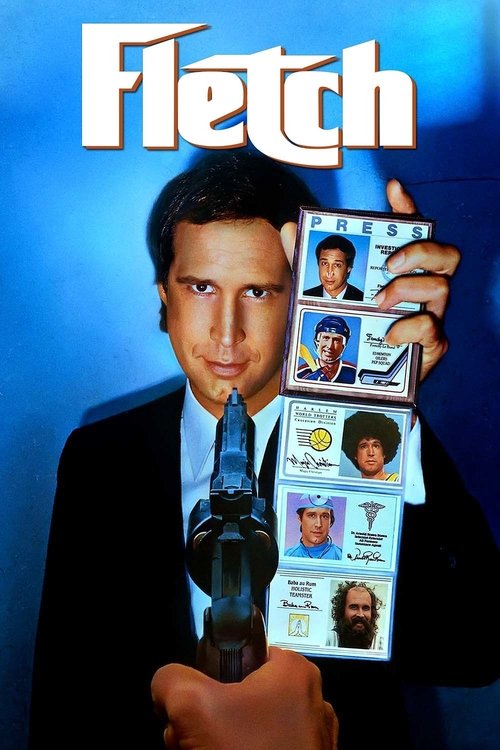
Fletch (1985)
Directed by Michael Ritchie
No — Fletch is not woke, scoring 0 out of 100 on our wokeness meter.
Fletch arrives from 1985 bearing a single joke told in many accents.
Consciousness Markers
Cast is predominantly white with a few Black supporting players and a Kareem Abdul-Jabbar cameo, but the film makes no modern representational statement or commentary.
No LGBTQ+ characters, themes, or subtext.
Gail is a wealthy heiress and briefly helps subdue the villain, but the film has no feminist agenda or gender-conscious critique.
Drug trafficking and police corruption are the focus; race is not a thematic concern.
No environmental or climate themes.
Wealthy villain and insurance fraud appear as plot devices, not as an anti-capitalist critique.
No body-positivity themes or messaging.
No neurodivergent characters or themes.
No historical revisionism; it is a contemporary 1980s crime comedy.
The film is a sarcastic comedy with no preachy or lecture-like messaging.
Why it received this score
Fletch arrives from 1985 bearing a single joke told in many accents. Chevy Chase plays an investigative reporter who adopts disguises the way other men change shirts, and the film's pleasures are almost entirely a function of his willingness to commit to a bad wig. The plot concerns an insurance scheme, a bigamous aviation executive, and a corrupt police chief running heroin through the beach. None of this is freighted with contemporary meaning. It is a crime comedy that wants to be liked, and mostly it is.
The picture holds a strange position in the canon. It was adapted from Gregory Mcdonald's novels, survived a decade of studio rejection, and became a modest hit on the strength of its star's smirk. The supporting players drift through with professional ease. A wealthy villain schemes, a tennis club snob gets his tab abused, an heiress swings a racket at the climax. The film observes class resentment, but only as a source of gags. Money is a plot device, not a thesis. The Lakers appear, Kareem Abdul-Jabbar among them, purely because the hero likes basketball.
Assessing this against the social consciousness of the present decade yields a clean sweep of nothing. There is no representational argument, no gender critique, no environmental appeal, no examination of race or capital or the body or the mind. The movie is sarcastic rather than preachy, and its sarcasm is aimed at authority figures who deserve it, which is a mood, not a message. We are left with a well-executed vehicle for a specific comedic personality, dated in its attitudes and entirely untroubled by them. The classification is straightforward. Zero across the board, and the film would not have it any other way.
Analysis generated by our Consciousness Algorithm
Part of


Synopsis
When investigative reporter Irwin "Fletch" Fletcher goes undercover to write a piece on the drug trade at a local beach, he's approached by wealthy businessman Alan Stanwyk, who offers him $50,000 to murder him. With sarcastic wit and a knack for disguises, Fletch sets out to uncover Stanwyk's story.
Questions about Fletch
Is Fletch woke?
No — Fletch is not woke, scoring 0 out of 100 on our wokeness meter. That earns it a verdict of Ultra Based.
Does Fletch have any woke elements?
No. All 10 markers score zero.
How does Fletch compare to other 1985 movies?
It ranks #51 of the 68 films from 1985 we've scored; their average is 8. The wokest is The Color Purple (62).
How is the Woke Score calculated?
An AI-assisted process researches the film and its reception, scores it 0–100 on ten markers, then combines those into one 0–100 Woke Score. It measures a specific set of 2020s cultural themes, not film quality.