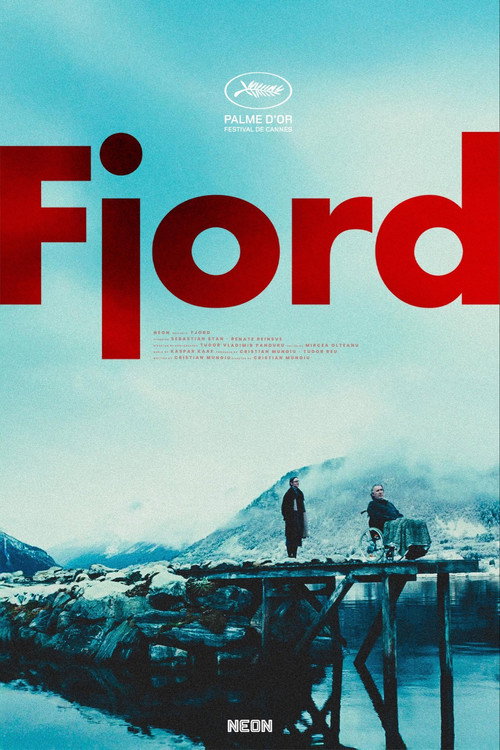
Fjord (2026)
Directed by Cristian Mungiu
No — Fjord is not woke, scoring 8 out of 100 on our wokeness meter.
Cristian Mungiu, the Romanian director who built his reputation by depicting the grinding human cost of institutional cruelty in films like "4 Months, 3 Weeks and 2 Days," arrives in Norway with a film that conservative Christian media has embraced and progressive film critics have called "thorny."
Consciousness Markers
Sebastian Stan, a Romanian-American actor, plays a Romanian immigrant protagonist, which represents a degree of authentic ethnic casting. However, the film does not frame this as a corrective gesture or signal its own virtue in doing so — the casting serves the story rather than a diversity mandate.
The film is loosely based on the 2015 Bodnariu case and implicitly revisits the public narrative around that event, offering a sympathetic portrayal of the religious family rather than the child welfare institutions. This constitutes a mild reframing of recent history, though not a sweeping revisionist project.
Mungiu maintains studied moral ambiguity and resists the sermon, but his stated intention to model open dialogue and critique polarization does introduce a faint current of therapeutic messaging. The film lectures nobody in particular, which is itself a kind of lecture about how we should all stop lecturing.
The Romanian family's status as ethnic outsiders in a Nordic community is a genuine tension in the film, but the script frames this through religious and cultural difference rather than racial identity politics. The film does not invoke race as an analytical framework.
The female Norwegian social workers and teachers who initiate the child welfare investigation are the institutional antagonists of the piece, which is essentially the inverse of a feminist framing. There is no discernible feminist agenda in the narrative.
No LGBTQ+ themes are present. The film centers on a conservative evangelical Christian family, and the secular Norwegian community is not characterized through any LGBTQ+ lens.
No climate themes are present. The Norwegian fjord setting is atmospheric, not polemical.
No anti-capitalist themes are present. The film's conflict is between religious tradition and secular state authority, not between economic classes.
No body positivity themes are present. The bruises on the child's body are evidence in a legal and moral dispute, not a statement about physical self-acceptance.
No neurodivergence themes are present or referenced in any available research.
Why it received this score
Cristian Mungiu, the Romanian director who built his reputation by depicting the grinding human cost of institutional cruelty in films like "4 Months, 3 Weeks and 2 Days," arrives in Norway with a film that conservative Christian media has embraced and progressive film critics have called "thorny." Both camps are correct, which is the whole point, and which will satisfy almost nobody completely. This is a film that wins the Palme d'Or by being genuinely unresolvable, a quality that is rarer and more difficult than it sounds.
The premise is deceptively simple. A Romanian evangelical family relocates to a small Norwegian coastal village. The neighbors are kind. The fjord is beautiful. Then a schoolteacher notices bruises on a child, and the machinery of the Scandinavian welfare state begins to turn. What is bracing about "Fjord" is that the film's sympathies lie with the religious outsiders, not with the secular institutions that believe themselves to be acting in the child's best interest. In the current cultural climate, this is a genuinely subversive position for a major European art film to occupy, and it earned Mungiu exactly the kind of polarized reception that confirms he found a live wire. The film's representation of a Romanian immigrant family is authentic rather than performative, grounded in Sebastian Stan's quietly devastating work as a man watching his world be adjudicated by people who do not share his values and will not be argued with.
The film scores low on the spectrum of progressive social consciousness not because it is retrograde but because it actively interrogates the institutions that produce that consciousness. It does not celebrate state authority, diversity bureaucracies, or the secular certainty that progressive norms are universal goods. It asks, with maddening patience, whether well-meaning people can cause serious harm when they mistake cultural difference for pathology. The answer the film offers is not an answer at all. Mungiu has made a film about the danger of being too sure you are right, which is, if we are being precise about it, the exact opposite of the sensibility we are here to measure.
Analysis generated by our Consciousness Algorithm
Synopsis
After moving from Romania to a remote Norwegian village to rebuild their lives, a family finds hope in their welcoming neighbors, but their fragile new beginning is threatened when their young daughter arrives at school covered in bruises.
Questions about Fjord
Is Fjord woke?
No — Fjord is not woke, scoring 8 out of 100 on our wokeness meter. That earns it a verdict of Ultra Based.
Does Fjord have any woke elements?
1 of the 10 markers register at 30 or above, led by Representation Casting (30). On Representation Casting: Sebastian Stan, a Romanian-American actor, plays a Romanian immigrant protagonist, which represents a degree of authentic ethnic casting.
How does Fjord compare to other 2026 movies?
It ranks #442 of the 800 films from 2026 we've scored; their average is 23. The wokest is Between Us (89).
How is the Woke Score calculated?
An AI-assisted process researches the film and its reception, scores it 0–100 on ten markers, then combines those into one 0–100 Woke Score. It measures a specific set of 2020s cultural themes, not film quality.