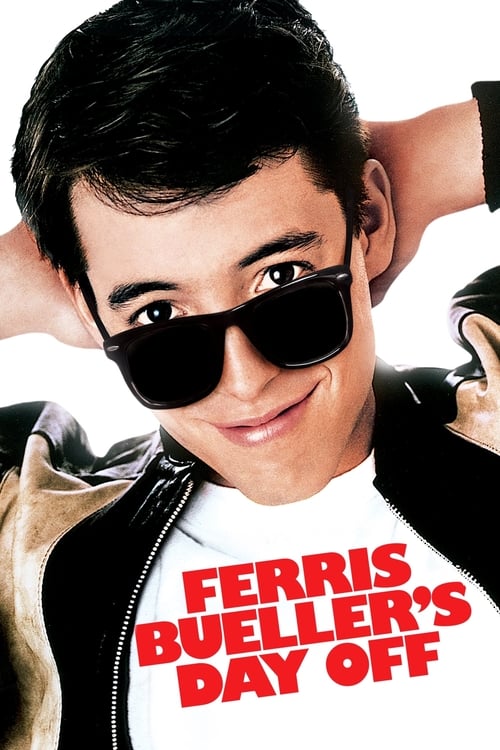
Ferris Bueller's Day Off (1986)
Directed by John Hughes
No — Ferris Bueller's Day Off is not woke, scoring 3 out of 100 on our wokeness meter.
John Hughes wrote the screenplay for Ferris Bueller's Day Off in under a week, and the film carries the loose confidence of something composed by a man who knew exactly what he wanted.
Consciousness Markers
Sloane is largely a passive girlfriend figure, and Jeanie's arc resolves into helping her brother. There is no feminist critique of patriarchy or gendered power.
The film celebrates truancy and mocks institutional authority (the dean, the boring economics teacher), but its rebellion is anti-authority rather than anti-capitalist. The Ferrari and upscale restaurant are objects of aspiration, not critique.
The film is a breezy comedy with no preachy messaging. Ben Stein's droning economics lecture is a joke about tedium, not a sermon.
The cast is overwhelmingly white, with no meaningful racial or ethnic diversity and no commentary on representation. A 1986 John Hughes teen comedy operating entirely within its demographic default.
No LGBTQ+ characters, themes, or subtext of any kind. Charlie Sheen's brief cameo as a delinquent carries no queer coding.
No engagement with race, racism, or racial identity whatsoever. The Chicago setting is rendered as a white suburban playground.
No environmental themes or climate messaging present.
No body positivity themes; the film does not engage with body image or size diversity.
Cameron's hypochondria and anxiety are played for comedy and character texture, not framed as neurodivergence or neurodiversity advocacy.
No historical revisionism; the film is a contemporary 1980s teen caper with no historical subject matter to revise.
Why it received this score
John Hughes wrote the screenplay for Ferris Bueller's Day Off in under a week, and the film carries the loose confidence of something composed by a man who knew exactly what he wanted. A suburban Chicago teenager fakes an illness, commandeers a Ferrari he has no business touching, and spends one Wednesday dragging his girlfriend and his anxious best friend through the Sears Tower, the Art Institute, a Cubs game, and a parade float. It is a caper. It is also a document of 1986, with all the demographic assumptions that entails.
The cast is white, the suburbs are white, and the film never pauses to consider that this might be a choice worth examining. Race does not enter the frame, and neither does any reflection on it. Sloane exists to be Ferris's girlfriend and to look lovely on a parade float; Jeanie's rebellion collapses into helping her brother escape their parents. The film's relationship to gender is the relationship of a teenage boy to his own reflection: content, unbothered, and entirely self-interested. Cameron's hypochondria and spiraling dread are played for laughs and for pathos, not as a window onto neurodivergence. Nobody here worries about body image, the climate, or the machinery of capital.
The rebellion on offer is anti-authority, not anti-capitalist. Dean Rooney is the villain because he is a petty bureaucrat with a grudge, not because he represents a system. The Ferrari is a treasure, the upscale restaurant is a treat, and the Mercantile Exchange is a lark. Ben Stein's droning economics teacher is a joke about tedium, which is the closest the film comes to a sermon, and the sermon is in favor of napping. The result is a comedy of real charm and almost no ideological ambition, which is likely why it sits in the National Film Registry instead of on a seminar syllabus.
Analysis generated by our Consciousness Algorithm
Part of


Synopsis
After high school slacker Ferris Bueller successfully fakes an illness in order to skip school for the day, he goes on a series of adventures throughout Chicago with his girlfriend Sloane and best friend Cameron, all the while trying to outwit his wily school principal and fed-up sister.
Questions about Ferris Bueller's Day Off
Is Ferris Bueller's Day Off woke?
No — Ferris Bueller's Day Off is not woke, scoring 3 out of 100 on our wokeness meter. That earns it a verdict of Ultra Based.
Does Ferris Bueller's Day Off have any woke elements?
Very few. None of the 10 markers reaches 30, the level where a marker counts as present; the highest is Eat the Rich at 5.
How does Ferris Bueller's Day Off compare to other 1986 movies?
It ranks #40 of the 62 films from 1986 we've scored; their average is 7. The wokest is Star Trek IV: The Voyage Home (42).
How is the Woke Score calculated?
An AI-assisted process researches the film and its reception, scores it 0–100 on ten markers, then combines those into one 0–100 Woke Score. It measures a specific set of 2020s cultural themes, not film quality.