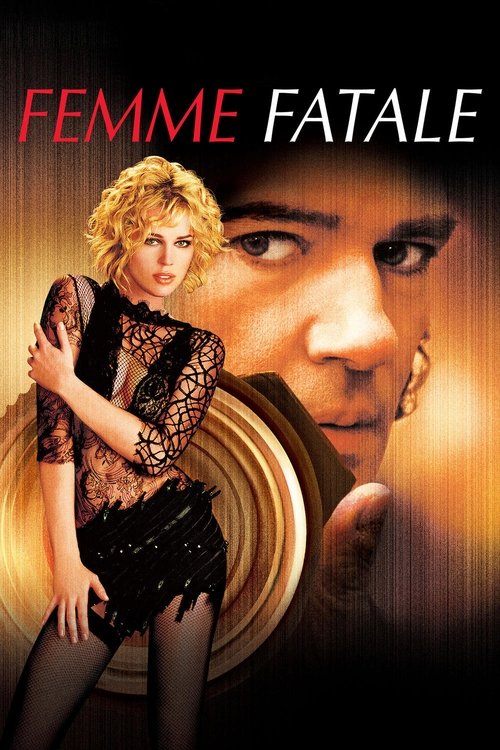
Femme Fatale (2002)
Directed by Brian De Palma
No — Femme Fatale is not woke, scoring 9 out of 100 on our wokeness meter.
Brian De Palma's Femme Fatale arrives from 2002 with the confidence of a magician who has misplaced half the deck.
Consciousness Markers
Laure Ash is a powerful, autonomous agent who operates outside societal norms, but her agency is rooted in criminal deception and sexual manipulation, fitting a classic noir mold rather than a modern feminist critique.
While the final twist reveals a queer relationship between Laure and Veronica, the film is primarily framed within a highly stylized, heterosexual noir structure.
The film relies heavily on established, traditionally Western Hollywood archetypes, offering minimal commentary on diverse representation.
The plot involves theft from the wealthy, but the critique is focused on personal survival and power dynamics, not systemic economic critique.
The film features no significant exploration of race or racial dynamics.
The environmental impact of the diamond heist or the setting is entirely ignored.
The film utilizes sexualized imagery and objectification as a core element of its erotic thriller genre, which is the antithesis of body positivity.
There is no evidence of any character exhibiting neurodivergent traits or having their mental health explored.
The film is a fictional thriller and does not attempt to reinterpret any historical events.
The film is a fast-paced, highly stylized thriller, not a didactic piece designed to deliver social commentary.
Why it received this score
Brian De Palma's Femme Fatale arrives from 2002 with the confidence of a magician who has misplaced half the deck. Rebecca Romijn's Laure Ash slides through a Cannes diamond heist, a stolen identity, and a Parisian scheme involving a paparazzo played by Antonio Banderas. The film is sleek, ludicrous, and entirely committed to its own reflection. It treats seduction as a currency and the camera as a co-conspirator. Any modern social project is absent. The narrative cares about double-crosses, voyeurism, and the pleasure of a well-staged bad idea. There is no racial inquiry, no environmental conscience, and no interest in reinterpreting history. The diamond theft is a crime of personal advantage, not a sermon on wealth distribution. The rich are robbed because they have diamonds, not because the screenplay has read a manifesto.
Laure is a powerful figure, autonomous and ruthless, but her power flows through the familiar noir channels of sexual manipulation and criminal deceit. This is not a feminist reclamation so much as a revival of the classic femme fatale, updated with better lighting and worse judgment. The late twist reveals a same-sex partnership between Laure and Veronica, yet the relationship appears as a final puzzle piece inside a heterosexual erotic-thriller frame. It is a plot mechanism, not a sustained exploration of queer life. The film's visual grammar depends on objectification, which places it at odds with contemporary body-positive sensibilities. Neurodivergence does not enter the frame. Neither does climate. The movie has other appetites.
What we get instead is pure De Palma: mirrors, dreams, doubles, and a plot that folds back on itself like a napkin in an expensive restaurant. The film is not preachy. It does not lecture. It has no interest in moral instruction, which is its most honest quality. Its cultural awareness is limited to the mechanics of desire and deception. The result is a cult object for people who like their thrillers slippery and their ethics unresolved. As a document of social consciousness, it is a near-empty ledger. As a piece of stylish mischief, it remains stubbornly watchable. The film earns its low marks not through offense but through indifference to the concerns of the current moment. It would rather be sexy and confusing than righteous. That is a choice, and De Palma makes it with a straight face.
Analysis generated by our Consciousness Algorithm


Synopsis
A $10-million diamond rip-off, a stolen identity, a new life married to a diplomat. Laure Ash has risked big, won big. But then a tabloid shutterbug snaps her picture in Paris, and suddenly, enemies from Laure's secret past know who and where she is. And they all want their share of the diamond heist. Or her life. Or both.
Questions about Femme Fatale
Is Femme Fatale woke?
No — Femme Fatale is not woke, scoring 9 out of 100 on our wokeness meter. That earns it a verdict of Ultra Based.
Does Femme Fatale have any woke elements?
1 of the 10 markers register at 30 or above, led by Feminist Agenda (30). On Feminist Agenda: Laure Ash is a powerful, autonomous agent who operates outside societal norms, but her agency is rooted in criminal deception and sexual manipulation, fitting a classic noir mold rather than a modern feminist critique.
How does Femme Fatale compare to other 2002 movies?
It ranks #66 of the 150 films from 2002 we've scored; their average is 12. The wokest is Far from Heaven (78).
How is the Woke Score calculated?
An AI-assisted process researches the film and its reception, scores it 0–100 on ten markers, then combines those into one 0–100 Woke Score. It measures a specific set of 2020s cultural themes, not film quality.