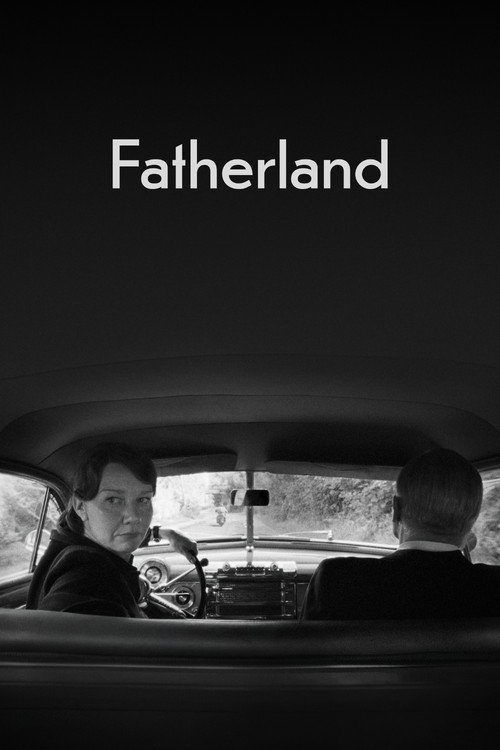
Fatherland (2026)
Directed by Paweł Pawlikowski
No — Fatherland is not especially woke, scoring 28 out of 100 on our wokeness meter.
Paweł Pawlikowski's Fatherland arrives as the third panel in his postwar European triptych, following Ida and Cold War, and it carries the family resemblance one would expect: 1.37:1 black-and-white, 82 minutes, a landscape of rubble and moral wreckage, and the quiet conviction that history is something that happens to people who thought they were above it.
Consciousness Markers
Erika Mann is deliberately positioned as the film's moral compass: more confrontational, more clear-eyed, and more principled than her famous father. The screenplay frames Thomas's diplomatic stoicism as a form of self-interested evasion against which Erika's uncompromising integrity is measured. This is a genuine structural choice, not incidental.
The film explicitly frames both American capitalism and Soviet communism as ideological machines attempting to instrumentalize Thomas Mann's intellectual legacy for propaganda. Erika's denial of US citizenship due to her anti-capitalist politics is a plot element, and the script treats Western liberal democracy with the same cold skepticism it applies to the Soviet bloc.
The suicide of Klaus Mann, Erika's queer anti-Nazi brother, haunts the narrative as a recurring emotional wound. His queerness and his persecution are treated as historically grounded rather than symbolically loaded, but the film does invoke his identity as part of its broader portrait of who fascism destroyed.
Pawlikowski openly compressed and fictionalized the Mann family's actual 1949 trip into a five-day dramatic arc. The film also reframes Thomas Mann's legacy through a lens of complicity and moral evasion, positioning him as a figure whose self-image exceeded his actual courage. This is a considered interpretive stance, not neutral biography.
The film's tone is described by critics as austere and elliptical, which works against heavy-handed sermonizing. The themes of Nazi rehabilitation and Cold War moral equivalence are present but delivered through atmosphere and implication rather than speeches. Restrained by Pawlikowski's characteristic cool, the lecture energy stays low.
Sandra Hüller, one of contemporary European cinema's most prominent actresses, occupies the film's moral center as Erika Mann. This reflects biographical necessity rather than casting philosophy, though the choice to foreground a female lead in a story nominally about Thomas Mann is a conscious structural decision.
No evidence of racial consciousness themes in the film's content, setting, or critical reception. The postwar German context does not engage with this marker.
No climate or environmental themes are present or suggested. The film is set in 1949 and concerned entirely with political and personal identity in the aftermath of fascism.
No evidence of body positivity themes. The film's concerns are intellectual, historical, and familial.
No neurodivergence themes are present or referenced in the film or its critical reception.
Why it received this score
Paweł Pawlikowski's Fatherland arrives as the third panel in his postwar European triptych, following Ida and Cold War, and it carries the family resemblance one would expect: 1.37:1 black-and-white, 82 minutes, a landscape of rubble and moral wreckage, and the quiet conviction that history is something that happens to people who thought they were above it. The film follows Thomas Mann and his daughter Erika across a shattered Germany in 1949, as the Nobel laureate collects a prize in Frankfurt and then Weimar, accepting applause from two competing systems of governance that would each like to claim him as their own. He seems, on the available evidence, amenable to both.
The film's most considered structural choice is its elevation of Erika, played by Sandra Hüller with the focused intensity of someone who has stopped being surprised by disappointment, to the position of moral protagonist. Thomas is the famous one. Erika is the one who is paying attention. The screenplay does not hide its sympathies here: Erika was denied American citizenship for her anti-capitalist politics, her queer brother Klaus killed himself, and she has watched her father navigate the postwar landscape with the diplomatic flexibility of a man who has always found a way to remain comfortable. The film treats Western capitalism and Soviet totalitarianism as twin engines of co-optation, both equally interested in the Mann brand, neither particularly interested in the truth. This is not a subtle position, but Pawlikowski delivers it through accumulation and silence rather than argument, which keeps the lecture energy mercifully low.
Where the film's progressive sensibilities surface most clearly, they are at least anchored in documented history. Klaus Mann's queerness, Erika's political exile, the spectacle of former Nazi sympathizers reinventing themselves for the new order: these are not inventions imported from the present. They are the actual contents of 1949. The fictionalization is in the compression, not the ideology. Fatherland is a film with a point of view, and that point of view is that great men are often less great than their daughters. As cultural arguments go, this one has been available for some time. Pawlikowski makes it with formal elegance, and the result is the kind of film that wins Best Director at Cannes and leaves you with the mild, persistent discomfort of a historical lesson you already knew but had been hoping to avoid.
Analysis generated by our Consciousness Algorithm
Synopsis
In 1949, German writer Thomas Mann and his daughter Erika embark on a road trip across a Germany in ruins, from US-dominated Frankfurt to Soviet-controlled Weimar.
Questions about Fatherland
Is Fatherland woke?
No — Fatherland is not especially woke, scoring 28 out of 100 on our wokeness meter. That earns it a verdict of Based.
Does Fatherland have any woke elements?
1 of the 10 markers register at 30 or above, led by Feminist Agenda (30). On Feminist Agenda: Erika Mann is deliberately positioned as the film's moral compass: more confrontational, more clear-eyed, and more principled than her famous father.
How does Fatherland compare to other 2026 movies?
It ranks #243 of the 800 films from 2026 we've scored; their average is 23. The wokest is Between Us (89).
How is the Woke Score calculated?
An AI-assisted process researches the film and its reception, scores it 0–100 on ten markers, then combines those into one 0–100 Woke Score. It measures a specific set of 2020s cultural themes, not film quality.