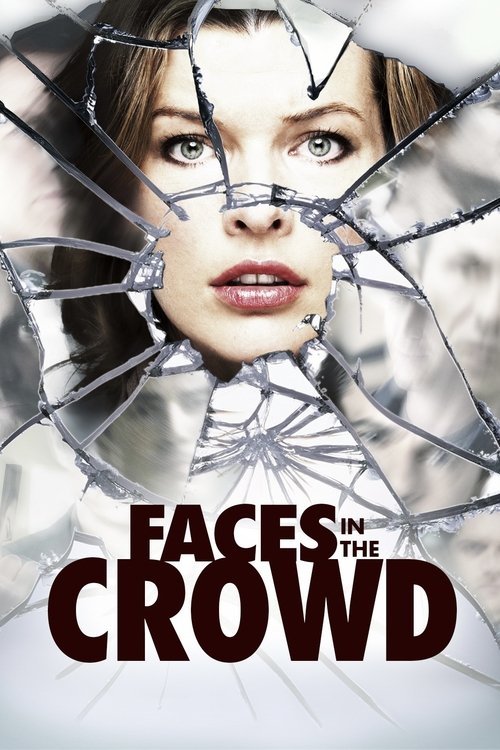
Faces in the Crowd (2011)
Directed by Julien Magnat
No — Faces in the Crowd is not especially woke, scoring 23 out of 100 on our wokeness meter.
Faces in the Crowd arrives from 2011 with the weary confidence of a thriller that knows exactly what it is: a gimmick wrapped around a serial killer.
Consciousness Markers
The film centers on a protagonist living with prosopagnosia (face blindness), a genuine neurological condition, and depicts her navigating daily life and a murder investigation with it — a substantive, if plot-driven, portrayal of a neurological difference.
A female lead (Milla Jovovich) anchors the film, with a supporting cast that includes actors of color such as David Atrakchi and Sandrine Holt, though the diversity is incidental rather than a stated priority.
The protagonist is a woman who survives an attack and actively works to stop her would-be killer, but the film frames this as standard thriller survival rather than a feminist statement.
The cast is somewhat multiethnic, but race is never addressed, commented upon, or thematically engaged.
The film explains face blindness as a plot mechanic but never pauses to deliver social or moral instruction to the audience.
No LGBTQ+ characters, themes, or subtext appear anywhere in the film.
No environmental or climate-related content whatsoever.
No critique of wealth, capitalism, or class structures is present.
No body-positivity themes or messaging appear in the film.
The film is a contemporary fictional thriller with no historical subject matter to revise.
Why it received this score
Faces in the Crowd arrives from 2011 with the weary confidence of a thriller that knows exactly what it is: a gimmick wrapped around a serial killer. Anna Marchant, played by Milla Jovovich, witnesses a murder, survives an attack, and wakes with prosopagnosia. Every face she sees rearranges itself the moment she looks away. The killer, a man with a necktie and a nickname, keeps closing in. It is a serviceable hook, executed with the visual grammar of a mid-budget Canadian coproduction, and it earned a zero percent rating from the handful of critics who bothered to watch it.
On the matter of neurological difference, the film deserves more credit than its reputation suggests. Prosopagnosia is a real condition, and the screenplay treats it as an actual mechanic of daily life, not a punchline. Anna learns to read gait, clothing, and voice. The movie explains the disorder patiently, and if it never turns into a sermon, that restraint works in its favor. The protagonist is a woman who fights back, which registers as baseline competence for the genre and nothing grander. The supporting cast includes performers of color, though the film never pauses to remark on it, and race is simply not a subject it engages. There is no romance between women here, no environmental lament, no indictment of the wealthy, no celebration of body diversity. The film has other concerns, or perhaps no concerns at all beyond the next scare.
The result is a modest, unfashionable piece of genre craftsmanship. It wants to frighten us with a man in a tie and a woman who cannot trust her own eyes. That is the whole ambition, and there is something almost quaint about a thriller with no larger argument to make. We classify it accordingly: a footnote, a curiosity, a film that arrived with no message and left the same way.
Analysis generated by our Consciousness Algorithm


Synopsis
Anna is living with "face-blindness" after surviving a serial killer's attack. As she lives with her condition, one in which facial features change each time she loses sight of them, the killer closes in.
Questions about Faces in the Crowd
Is Faces in the Crowd woke?
No — Faces in the Crowd is not especially woke, scoring 23 out of 100 on our wokeness meter. That earns it a verdict of Based.
Does Faces in the Crowd have any woke elements?
2 of the 10 markers register at 30 or above, led by Neurodivergence (40) and Representation Casting (30). On Neurodivergence: The film centers on a protagonist living with prosopagnosia (face blindness), a genuine neurological condition, and depicts her navigating daily life and a murder investigation with it — a substantive, if plot-driven, portrayal of a neurological difference.
How does Faces in the Crowd compare to other 2011 movies?
It ranks #20 of the 245 films from 2011 we've scored; their average is 11. The wokest is Paul (68).
How is the Woke Score calculated?
An AI-assisted process researches the film and its reception, scores it 0–100 on ten markers, then combines those into one 0–100 Woke Score. It measures a specific set of 2020s cultural themes, not film quality.