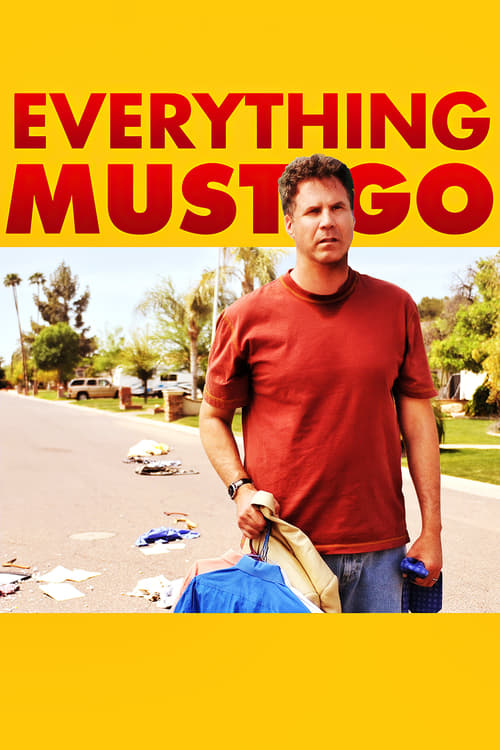
Everything Must Go (2011)
Directed by Dan Rush
No — Everything Must Go is not woke, scoring 8 out of 100 on our wokeness meter.
Everything Must Go arrives from 2010 with the quiet confidence of a film that knows precisely how small it wants to be.
Consciousness Markers
The cast includes Michael Peña and C.J. Wallace in supporting roles, but their presence is incidental to a story about a white alcoholic's downward spiral and is never framed as a statement.
Rebecca Hall's Samantha eventually asserts herself by telling her absent husband to come home or divorce, but this is a minor character beat rather than a sustained feminist argument.
The yard-sale premise gestures at detachment from material possessions, but it functions as a metaphor for personal loss rather than a critique of capitalism or wealth.
The film is a quiet, restrained character study that resists preaching; any moral lessons are implicit rather than delivered as a lecture.
No LGBTQ+ characters, themes, or subtext appear anywhere in the film.
Race is never addressed or thematized; the film is a suburban character study with no racial commentary.
No environmental or climate themes are present.
No body-positivity themes or messaging appear in the film.
Alcoholism and addiction are depicted, but these are not framed as neurodivergence.
The film is a contemporary fictional drama with no historical revisionism.
Why it received this score
Everything Must Go arrives from 2010 with the quiet confidence of a film that knows precisely how small it wants to be. Will Ferrell plays Nick Halsey, a salesman of sixteen years who relapses, loses his wife and his job in a single afternoon, and returns home to find his belongings arranged across the front lawn. He holds a yard sale. He hires a neighborhood boy to watch his things. He does not drink. That is the entire architecture of the picture, adapted from a Raymond Carver short story, and it moves with the patience of a man who has decided that a lawn chair is sufficient material for ninety minutes.
The social inventory here is modest to the point of near invisibility. Michael Peña appears as Nick's AA sponsor and C.J. Wallace as the boy Kenny, both of them present and unremarked, characters who happen to exist in a Phoenix suburb where such people exist. Nobody draws attention to them. Rebecca Hall's Samantha, pregnant and waiting on a husband who never arrives, eventually tells the man to come home or grant her a divorce, a flicker of self-assertion that lasts about as long as a flicker. Race goes unmentioned. The environment goes unmentioned. The yard sale suggests a man shedding his possessions, though the shedding is grief, not economics, and no viewer is asked to reconsider the arrangement of wealth.
What the film declines to do is lecture. There is no sermon, no closing argument, no moment where a character turns to the camera and explains what we ought to feel. Nick's suspicions about the Denver incident are resolved by a detail a more anxious screenplay would have flinched from, and the film simply lets it land, then lets him walk home. Restraint of this order reads, in the present climate, as almost exotic. Here is a film about a man who has lost things, and it is content to leave it there.
Analysis generated by our Consciousness Algorithm
Part of


Synopsis
When an alcoholic relapses, causing him to lose his wife and his job, he holds a yard sale on his front lawn in an attempt to start over. A new neighbor might be the key to his return to form.
Questions about Everything Must Go
Is Everything Must Go woke?
No — Everything Must Go is not woke, scoring 8 out of 100 on our wokeness meter. That earns it a verdict of Ultra Based.
Does Everything Must Go have any woke elements?
Very few. None of the 10 markers reaches 30, the level where a marker counts as present; the highest is Representation Casting at 15.
How does Everything Must Go compare to other 2011 movies?
It ranks #107 of the 245 films from 2011 we've scored; their average is 11. The wokest is Paul (68).
How is the Woke Score calculated?
An AI-assisted process researches the film and its reception, scores it 0–100 on ten markers, then combines those into one 0–100 Woke Score. It measures a specific set of 2020s cultural themes, not film quality.