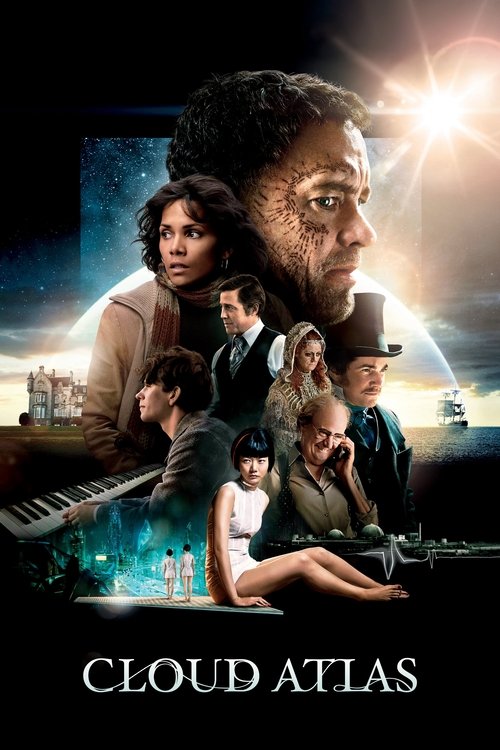
Cloud Atlas (2012)
Directed by Lana Wachowski
Partly · Woke-Adjacent
How we score movies →Consciousness Markers
Corporate villainy and systems of economic exploitation appear repeatedly across timelines. The film explicitly critiques capitalism and suggests that resistance to corrupt systems is a moral imperative.
The film frequently deploys philosophical monologues that explicitly articulate its moral and thematic concerns, sometimes at the expense of showing rather than telling.
The film features diverse casting across multiple timelines and ethnicities, but the use of prosthetic makeup for actors playing characters of different races generated significant controversy and undermines the stated progressive intent.
The film reframes historical narratives of slavery and colonialism from the perspective of resistance and moral awakening, presenting history as cyclical and moral rather than progressive.
The film engages with themes of slavery and colonial oppression in certain timelines and features characters of color in significant roles, but the racial makeup controversy complicates any claim to genuine racial consciousness.
Female characters appear across timelines but often in supporting roles. While Halle Berry's character in the contemporary segment has agency, the film does not foreground feminist themes or analysis.
A same-sex romance between male characters appears in the contemporary timeline, but receives limited screen time and development relative to the film's overall scope and runtime.
The post-apocalyptic future timeline exists but is not framed as resulting from environmental degradation or climate change, so this marker does not apply.
The film does not engage with body positivity themes or challenge conventional beauty standards in any deliberate way.
No characters are portrayed as neurodivergent or with neurodivergent representation in the film.


Synopsis
A set of six nested stories spanning time between the 19th century and a distant post-apocalyptic future. Cloud Atlas explores how the actions and consequences of individual lives impact one another throughout the past, the present and the future. Action, mystery and romance weave through the story as one soul is shaped from a killer into a hero and a single act of kindness ripples across centuries to inspire a revolution in the distant future. Based on the award winning novel by David Mitchell. Directed by Tom Tykwer and the Wachowskis.
Why it received this score
Cloud Atlas presents itself as a monument to progressive sensibilities, a sprawling meditation on the interconnectedness of all souls across time and the moral imperative to resist oppression. The Wachowskis, two of cinema's most visible transgender directors, bring their characteristic visual flair and thematic ambition to this adaptation of David Mitchell's unwieldy novel. The film deploys an ensemble cast across multiple timelines, with actors of various backgrounds inhabiting different roles, which generates both the film's most interesting artistic choice and its most controversial one. The use of prosthetic makeup and racial casting decisions, particularly white actors in darker makeup for certain roles, became a lightning rod for criticism despite the film's ostensible commitment to universal humanism and the transcendence of identity across reincarnation cycles.
The film's thematic concerns lean heavily into anti-capitalist critique, with corporate villainy and systems of exploitation recurring across the centuries. Characters resist and rebel against oppressive structures with a persistence that borders on preachy. The narrative architecture itself serves a progressive function: showing how individual acts of resistance and kindness generate ripples across history, suggesting that morality and justice are not bound by time or circumstance. The film also features a same-sex romance between two male characters in the contemporary timeline, though this element receives relatively modest screen time given the film's expansive scope.
Yet for all its progressive intentions, Cloud Atlas struggles with the gap between aspiration and execution. The film's earnestness about its themes occasionally tips into the hectoring, with philosophical monologues that spell out the moral lessons rather than allowing them to emerge from the narrative. The racial makeup choices, regardless of the film's intentions regarding the soul's transcendence of bodily form, register as uncomfortable viewing in retrospect. The film remains a fascinating artifact of 2012-era progressive filmmaking, ambitious in scope but uneven in its cultural sensibilities, a work that believed itself more enlightened than its actual choices permitted.
Analysis generated by our Consciousness Algorithm
Critic Reviews
“It fascinates in the moment. It's getting from one moment to the next that is tricky. Surely this is one of the most ambitious films ever made.”
“Its too-muchness is also the source of its power; I was absolutely never bored, and felt surprised when the movie ended. It's an amazing, baffling, thrilling and (for many, it would appear) irritating experience, and for my money the most beautiful and distinctive big-screen vision of the year.”
“It has laser gun fights, forbidden love, and a rollicking group breakout from a fascistic old folks' home. What more could anyone want? ”
“A manifesto in the form of an enormously budgeted quasi-sci-fi epic, Cloud Atlas is evidently personal, defiantly sincere, totally lacking in self-awareness, and borderline offensive in its gleeful endorsement of revenge violence against anyone who gets in the way of a good person's self-actualization. The rest of the time, it's just insipid, TV-esque in its limited visual imagination, and dramatically incoherent.”