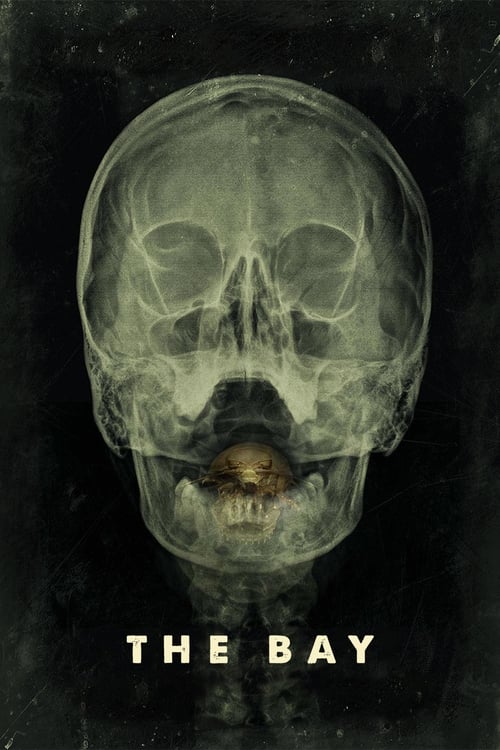
The Bay (2012)
Directed by Barry Levinson
Partly — The Bay is somewhat woke, scoring 51 out of 100 on our wokeness meter.
Barry Levinson, a director with a shelf of statuettes and a durable fondness for Maryland, turns to the found footage horror picture with the grim efficiency of a man who has read the market reports.
Consciousness Markers
An explicit eco-horror cautionary tale about pollution of the Chesapeake Bay by chicken-farm runoff, which Levinson claimed was '80 percent factual information' and intended to shed light on real environmental degradation.
The film indicts agribusiness for dumping toxins and steroids into the water, and the government for covering up the disaster and paying off survivors to stay silent.
The film functions as a faux eco-documentary with a clear didactic warning about environmental neglect, though the message is delivered through horror set-pieces rather than direct preaching.
The cast is moderately diverse, with a female lead (Kether Donohue) and a Black oceanographer (Nansi Aluka) among the ensemble, but diversity is incidental rather than a deliberate casting statement.
A female reporter serves as the primary narrator and documentarian, and a female oceanographer is among the truth-tellers, but the film makes no feminist argument.
The disaster afflicts a small town indiscriminately; there is no engagement with race as a theme or with environmental racism specifically.
No LGBTQ+ characters or themes appear anywhere in the film.
The film is body horror at its most visceral, with lesions and parasites eating hosts from the inside out — the antithesis of body positivity.
No neurodivergent characters or themes are present.
The film is a fictional found-footage horror, not a reworking of historical events.
Why it received this score
Barry Levinson, a director with a shelf of statuettes and a durable fondness for Maryland, turns to the found footage horror picture with the grim efficiency of a man who has read the market reports. The Bay assembles cell phone clips, Skype calls, and dashboard cameras into an account of a small town undone by mutant isopods breeding in water fouled by chicken farm runoff. The conceit is tidy. The menace is small, wet, and numerous.
The film's conscience is environmental, and it wears that conscience openly. Levinson claimed the material was eighty percent factual, and the screenplay obliges by indicting agribusiness for the steroids and the excrement, then indicting the government for the quarantine, the silence, and the payoff checks handed to survivors. The sermon arrives through lesions and screaming instead of a podium, which is the kinder method of delivery. A female reporter narrates the recovered footage, and a Black oceanographer is among the first to sound the alarm, though the film treats these details as staffing decisions, not statements. The town dies together, with no commentary on who comprised it.
What the film declines to bother with is nearly as instructive. There is no romance to distract from the parasites, no identity politics competing with the chitin, no redemptive arc for the body, which is treated here as a host and nothing more. We are left with a cautionary tale that works best when it stops explaining itself. The isopods, at least, have no agenda beyond appetite. In a genre crowded with messaging, that is almost restful. Ebert called it a faux eco-documentary and meant it as a complaint. He was correct on the classification.
Analysis generated by our Consciousness Algorithm
Part of


Synopsis
Chaos breaks out in a small Maryland town after an ecological disaster occurs.
Questions about The Bay
Is The Bay woke?
Partly — The Bay is somewhat woke, scoring 51 out of 100 on our wokeness meter. That earns it a verdict of Woke-Adjacent.
What makes The Bay woke?
4 of the 10 markers register at 30 or above, led by Climate Crusade (60), Eat the Rich (50) and Lecture Energy (45). On Climate Crusade: An explicit eco-horror cautionary tale about pollution of the Chesapeake Bay by chicken-farm runoff, which Levinson claimed was '80 percent factual information' and intended to shed light on real environmental degradation.
How does The Bay compare to other 2012 movies?
It ranks #9 of the 230 films from 2012 we've scored; their average is 12. The wokest is Killing Them Softly (92).
How is the Woke Score calculated?
An AI-assisted process researches the film and its reception, scores it 0–100 on ten markers, then combines those into one 0–100 Woke Score. It measures a specific set of 2020s cultural themes, not film quality.