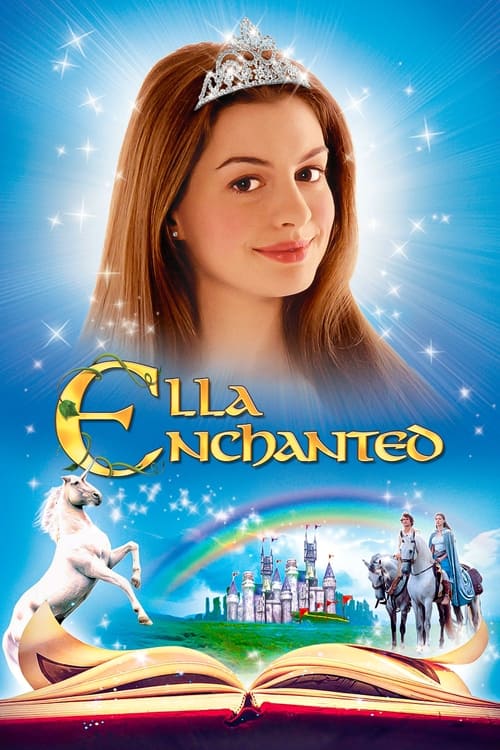
Ella Enchanted (2004)
Directed by Tommy O'Haver
No — Ella Enchanted is not especially woke, scoring 24 out of 100 on our wokeness meter.
Ella Enchanted arrived in 2004 as a modestly budgeted satire of the fairy tale, adapted loosely from Gail Carson Levine's novel, and it sank at the box office before settling into a comfortable cult afterlife.
Consciousness Markers
Explicitly framed as a feminist reworking of Cinderella: Ella's arc is about self-determination, breaking the curse of enforced obedience, and commanding herself to be free rather than waiting to be rescued.
A 2004 fairy-tale comedy with a notably multiracial cast: Vivica A. Fox as the fairy godmother, Parminder Nagra as Ella's best friend, Jimi Mistry as Benny, and Heidi Klum as a giantess. The diversity is present without being foregrounded or commented upon.
The self-determination message and the closing 'new era of equality' toast carry a mild moral, but the film delivers it through satire and song rather than preaching.
The subplot about oppressive laws against elves and giants, and Char's closing toast to 'equality among all citizens,' gestures at social-justice allegory but is framed around fantasy species rather than race.
No LGBTQ+ characters, themes, or subtext appear anywhere in the film.
No environmental or climate themes are present.
The villain is a usurping regent motivated by power, not by capital; there is no economic critique.
No body-positivity themes or messaging appear in the film.
No neurodivergent characters or themes; the dim-witted stepsister is played for comedy, not representation.
The film is a satirical fairy tale, not a reworking of real historical events.
Why it received this score
Ella Enchanted arrived in 2004 as a modestly budgeted satire of the fairy tale, adapted loosely from Gail Carson Levine's novel, and it sank at the box office before settling into a comfortable cult afterlife. The premise is a good one: a newborn receives the gift of obedience from a careless fairy and spends the rest of the film trying to shed it. Anne Hathaway sings, charms, and carries the whole contraption on her shoulders. The film is aware of its own silliness and mostly enjoys it.
The feminist reading here is not subtle, but it is also not scolding. Ella's problem is literalized as a curse that forces her to obey any command, and her liberation comes when she orders herself to stop. That is a clean metaphor for self-determination, and the film lets it land without a sermon. The Cinderella machinery gets rearranged: the prince is a decent sort, the stepfamily is petty instead of monstrous, and the rescue is self-administered. A closing toast about a new era of equality supplies the moral, delivered through a dance number, which is the correct delivery system for a moral.
The cast is noticeably multiracial in a way the film never announces. Vivica A. Fox plays the fairy godmother, Parminder Nagra is the childhood friend, Jimi Mistry spends much of the running time as a talking book, and Heidi Klum towers as a giantess. Nobody remarks on any of it, which in 2004 was its own quiet statement. A subplot about laws oppressing elves and giants gestures toward social allegory, though it keeps the argument safely inside the realm of fantasy species. The film has no interest in the bedroom, the climate, the economy, the body, or the mind. It wants to be a lark with a spine, and it succeeds at roughly that.
Analysis generated by our Consciousness Algorithm


Synopsis
Ella lives in a magical world in which each child, at the moment of their birth, is given a virtuous "gift" from a fairy godmother. Ella's so-called gift, however, is obedience. This birthright proves itself to be quite the curse once Ella finds herself in the hands of several unscrupulous characters whom she quite literally cannot disobey. Determined to gain control of her life and decisions, Ella sets off on a journey to find her fairy godmother who she hopes will lift the curse. The path, however, isn't easy -- Ella must outwit a slew of unpleasant obstacles including ogres, giants, wicked stepsisters, elves and Prince Charmont's evil uncle, who wants to take over the crown and rule the kingdom.
Questions about Ella Enchanted
Is Ella Enchanted woke?
No — Ella Enchanted is not especially woke, scoring 24 out of 100 on our wokeness meter. That earns it a verdict of Based.
Does Ella Enchanted have any woke elements?
2 of the 10 markers register at 30 or above, led by Feminist Agenda (55) and Representation Casting (42). On Feminist Agenda: Explicitly framed as a feminist reworking of Cinderella: Ella's arc is about self-determination, breaking the curse of enforced obedience, and commanding herself to be free rather than waiting to be rescued.
How does Ella Enchanted compare to other 2004 movies?
It ranks #25 of the 178 films from 2004 we've scored; their average is 12. The wokest is Tropical Malady (62).
How is the Woke Score calculated?
An AI-assisted process researches the film and its reception, scores it 0–100 on ten markers, then combines those into one 0–100 Woke Score. It measures a specific set of 2020s cultural themes, not film quality.