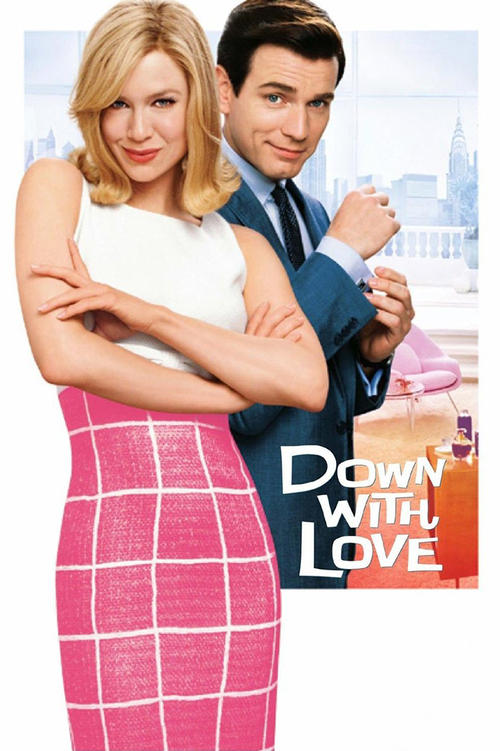
Down with Love (2003)
Directed by Peyton Reed
No — Down with Love is not especially woke, scoring 24 out of 100 on our wokeness meter.
Peyton Reed's 2003 romance concerns an advice author named Barbara Novak, who arrives in Manhattan in 1962 with a book instructing women to forgo love, take lovers without commitment, and substitute chocolate for husbands.
Consciousness Markers
The entire premise centers on a feminist advice author whose book 'Down with Love' urges women to reject romance and embrace independence, sparking a global rebellion of women against men; the film is a sustained battle-of-the-sexes comedy, though its satirical pastiche framing undercuts any straightforward messaging.
The film culminates in a two-minute torrent-of-words speech from Barbara that wraps up the plot and its sexual-politics thesis, though the overall tone remains playful screwball comedy rather than preachy.
The film recreates 1962 New York as a stylized pastiche and grafts an anachronistic, post-feminist conclusion onto period attitudes, lightly rewriting the era's sexual politics for modern eyes.
A minor comedic subplot has Vikki assume Peter must be gay because he lacks assertiveness, but this is a misunderstanding played for laughs rather than genuine LGBTQ+ representation.
The principal cast is entirely white (Zellweger, McGregor, Paulson, Hyde Pierce, Dratch, Randall), with no diverse casting or representation of any kind.
No racial themes, commentary, or non-white characters of significance appear in the film.
No environmental or climate-related content whatsoever.
The publishing-industry satire targets vanity and sexism, not wealth or capitalism; no eat-the-rich sentiment.
No body-positivity themes; the film trades in conventional 1960s glamour aesthetics.
No neurodivergence themes or characters.
Why it received this score
Peyton Reed's 2003 romance concerns an advice author named Barbara Novak, who arrives in Manhattan in 1962 with a book instructing women to forgo love, take lovers without commitment, and substitute chocolate for husbands. The volume sells. Women worldwide revolt against their men, which is the sort of outcome publishing executives dream about and rarely achieve. The picture stages this as a pastiche of the Doris Day and Rock Hudson comedies, complete with split screens, rear projection, and Tony Randall himself, present as a living citation.
The sexual politics here are the engine, not the upholstery. Barbara's crusade gives the film its structure, and the battle between the sexes drives every scene. That is a genuine engagement with feminist ideas, though the film keeps one eyebrow raised throughout, which dilutes the sermon. Elsewhere the ledger is thin. The cast is uniformly white. A running gag has one character conclude that a diffident man must be gay, a misunderstanding played for a laugh and nothing more. Race, climate, class, and body image go untouched.
What lingers is the closing aria, two minutes of verbiage in which Barbara untangles the plot and its thesis in a single breath. It lectures, but it also tap-dances, and the period detail has been quietly renovated so that 1962 can arrive at a conclusion 1962 would not have reached. The result is a confection with a thesis, arch, knowing, and unwilling to commit to its own argument. We have seen worse. We have also seen films that meant it.
Classification notes: no Academy Awards, no sequel or remake lineage, no source novel, no superheroes, and a box office run that opened wide behind The Matrix Reloaded. The film belongs to none of the standard categories, which is itself a small distinction in a landscape that rarely offers one.
{"thematic_tags": []}
Analysis generated by our Consciousness Algorithm


Synopsis
In 1962 New York City, love blossoms between a playboy journalist and a feminist advice author.
Questions about Down with Love
Is Down with Love woke?
No — Down with Love is not especially woke, scoring 24 out of 100 on our wokeness meter. That earns it a verdict of Based.
Does Down with Love have any woke elements?
2 of the 10 markers register at 30 or above, led by Feminist Agenda (60) and Lecture Energy (30). On Feminist Agenda: The entire premise centers on a feminist advice author whose book 'Down with Love' urges women to reject romance and embrace independence, sparking a global rebellion of women against men; the film is a sustained battle-of-the-sexes comedy, though its satirical pastiche framing undercuts any straightforward messaging.
How does Down with Love compare to other 2003 movies?
It ranks #19 of the 150 films from 2003 we've scored; their average is 12. The wokest is Mona Lisa Smile (60).
How is the Woke Score calculated?
An AI-assisted process researches the film and its reception, scores it 0–100 on ten markers, then combines those into one 0–100 Woke Score. It measures a specific set of 2020s cultural themes, not film quality.