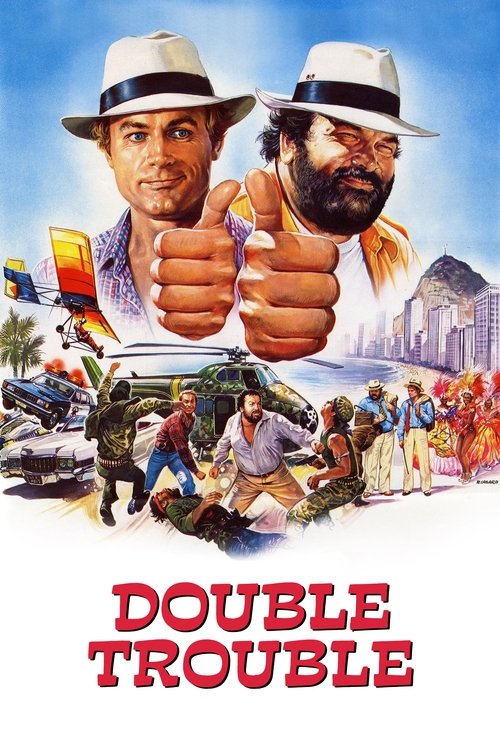
Double Trouble (1984)
Directed by Enzo Barboni
No — Double Trouble is not woke, scoring 4 out of 100 on our wokeness meter.
Double Trouble arrives from 1984 with the confidence of a film that knows exactly what it is: a Terence Hill and Bud Spencer vehicle in which punching is a form of dialogue.
Consciousness Markers
The film is set in Rio de Janeiro with Brazilian billionaire characters, but the leads and most of the cast are white Italian actors in brownface-adjacent roles; the diversity is incidental scenery, not a casting statement.
The film lightly satirizes jet-set billionaires and their pampered lifestyle, but the look-alike heroes eagerly embrace the wealth rather than critiquing it, so no genuine eat-the-rich message emerges.
The villain is a woman (Donna Olympia), but she is a scorned-lover femme fatale motivated by a family grudge, not a vehicle for any feminist critique.
No LGBTQ+ characters, themes, or subtext of any kind appear in this 1984 buddy action comedy.
Despite the Brazilian setting, the film engages no racial themes, commentary, or consciousness whatsoever.
No environmental or climate themes are present.
No body positivity themes; the film trades on standard action-comedy physicality.
No neurodivergent characters or themes are depicted.
The film is a fictional caper with no historical subject matter to revise.
This is a breezy slapstick brawl comedy with zero preachy or didactic messaging.
Why it received this score
Double Trouble arrives from 1984 with the confidence of a film that knows exactly what it is: a Terence Hill and Bud Spencer vehicle in which punching is a form of dialogue. Two Portuguese Brazilian billionaire cousins hire two look-alikes, a stuntman and a saxophonist, to absorb assassination attempts. The plot requires Rio de Janeiro, yet the cast is overwhelmingly Italian and white, with Brazilian faces mostly serving as scenery. That gives the film a faint contemporary charge as a case study in representation by geography, though nobody involved seems to have intended a statement. The setting is a postcard. The casting is a coincidence.
The social consciousness on display is minimal and mostly accidental. A female villain, Donna Olympia, exists as a scorned lover and family-grudge mechanism, not as any kind of feminist argument. Her grievances are personal, her comeuppance is a punchline, and the film has no interest in her interior life beyond the needs of the twist. The jet-set billionaire milieu receives a light ribbing, but the heroes enjoy the wealth too much for any genuine eat-the-rich critique to take hold. They drive off in the cousins' car after cashing checks. That is not an indictment of capital. That is a valet ticket.
Elsewhere the film is a vacuum of modern markers. No LGBTQ themes, no racial consciousness, no climate anxiety, no body positivity, no neurodivergence, no historical revision, and no lecture energy. It is a slapstick brawl with doppelgängers, mercenaries, and a farmhouse showdown. The closest it comes to a message is that wealthy people can be replaced by more competent brawlers and that a saxophone may be used as a weapon. As cultural artifacts go, it is harmless, dated, and weirdly soothing. We score it accordingly: a relic of pure entertainment, unburdened by the urge to teach us anything.
Analysis generated by our Consciousness Algorithm


Synopsis
A stuntman and a saxophonist stand in for two billionaires threatened by killers.
Questions about Double Trouble
Is Double Trouble woke?
No — Double Trouble is not woke, scoring 4 out of 100 on our wokeness meter. That earns it a verdict of Ultra Based.
Does Double Trouble have any woke elements?
Very few. None of the 10 markers reaches 30, the level where a marker counts as present; the highest is Eat the Rich at 8.
How does Double Trouble compare to other 1984 movies?
It ranks #25 of the 51 films from 1984 we've scored; their average is 7. The wokest is Revenge of the Nerds (30).
How is the Woke Score calculated?
An AI-assisted process researches the film and its reception, scores it 0–100 on ten markers, then combines those into one 0–100 Woke Score. It measures a specific set of 2020s cultural themes, not film quality.