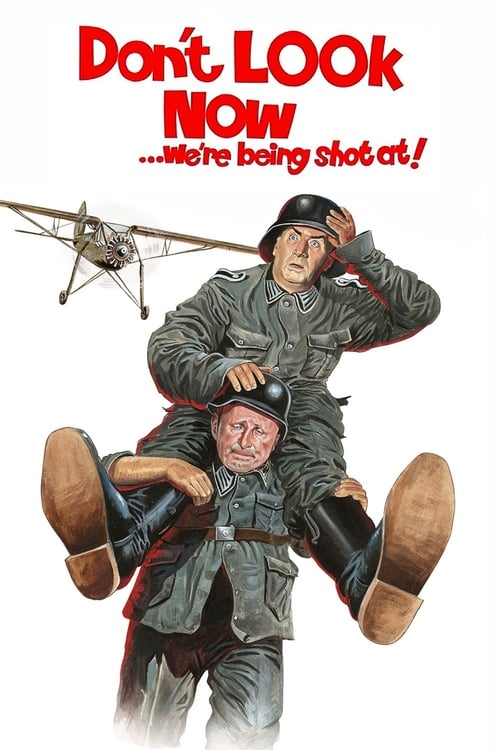
Don't Look Now... We're Being Shot At! (1966)
Directed by Gérard Oury
No — Don't Look Now... We're Being Shot At! is not woke, scoring 0 out of 100 on our wokeness meter.
The French have a gift for making catastrophe look like an afternoon errand.
Consciousness Markers
The cast is entirely white French and British performers; no diversity-conscious casting is present or attempted.
No LGBTQ+ characters, themes, or subtext appear anywhere in the film.
Women appear as helpers (a puppeteer, a nun) but the film makes no feminist argument and treats them as conventional supporting figures.
The film concerns French-British-German wartime dynamics with no engagement of racial consciousness whatsoever.
No environmental or climate themes are present in this 1942-set farce.
The film is a light comedy of errors with no critique of capitalism or class economics.
No body-positivity themes or messaging appear in the film.
A cross-eyed soldier is used purely as a slapstick gag, not as neurodivergent representation.
The film is a fictional wartime comedy and makes no revisionist claims about history.
This is a broad slapstick comedy with no didactic or preachy messaging of any kind.
Why it received this score
The French have a gift for making catastrophe look like an afternoon errand. Gérard Oury's La Grande Vadrouille, which traveled abroad under a different and more excitable name, drops a Royal Air Force bomber over Paris in 1942 and scatters its crew into the reluctant care of a house painter and an opera conductor. The ensuing journey toward the demarcation line involves stolen German uniforms, wine casks, a puppet theatre, and a glider launch that no aviation authority would sanction. The picture was the most popular French release of 1966, with over seventeen million admissions, and it remains among the most attended films in that country's history. It is a machine built for laughter, and it works.
Examined through the lens of contemporary cultural expectation, the film offers nothing at all. The cast is uniformly European and uniformly pale. Women appear as a puppeteer and a nun, both helpful, neither the subject of any argument about their place in the world. The Germans are buffoons, the British are stiff, the French are resourceful, and nobody pauses to interrogate the arrangement. A cross-eyed soldier saves the day by missing his shot, a gag played for pure slapstick and nothing else. There is no commentary on capital, no environmental conscience, no interior life examined for its difference. The war is a backdrop, not a sermon.
This is not a deficiency. It is a timestamp. The film belongs to a comedic tradition that asked only whether the joke landed, and the joke lands with the regularity of a metronome. We have spent decades since teaching our comedies to mean something, and the results have been mixed. Here the meaning is simply that a nun driving a wagon full of fugitives is funny, and that a conductor and a painter bickering in German uniforms is funnier still. The sommelier's verdict: a clean vintage, untouched by the preoccupations we now track, and entirely at peace with that.
Analysis generated by our Consciousness Algorithm

Synopsis
During World War II, two French civilians and a downed British Bomber Crew set out from Paris to cross the demarcation line between Nazi-occupied Northern France and the South. From there they will be able to escape to England. First, they must avoid German troops – and the consequences of their own blunders.
Questions about Don't Look Now... We're Being Shot At!
Is Don't Look Now... We're Being Shot At! woke?
No — Don't Look Now... We're Being Shot At! is not woke, scoring 0 out of 100 on our wokeness meter. That earns it a verdict of Ultra Based.
Does Don't Look Now... We're Being Shot At! have any woke elements?
No. All 10 markers score zero.
How does Don't Look Now... We're Being Shot At! compare to other 1966 movies?
It ranks #14 of the 18 films from 1966 we've scored; their average is 7. The wokest is Daisies (28).
How is the Woke Score calculated?
An AI-assisted process researches the film and its reception, scores it 0–100 on ten markers, then combines those into one 0–100 Woke Score. It measures a specific set of 2020s cultural themes, not film quality.