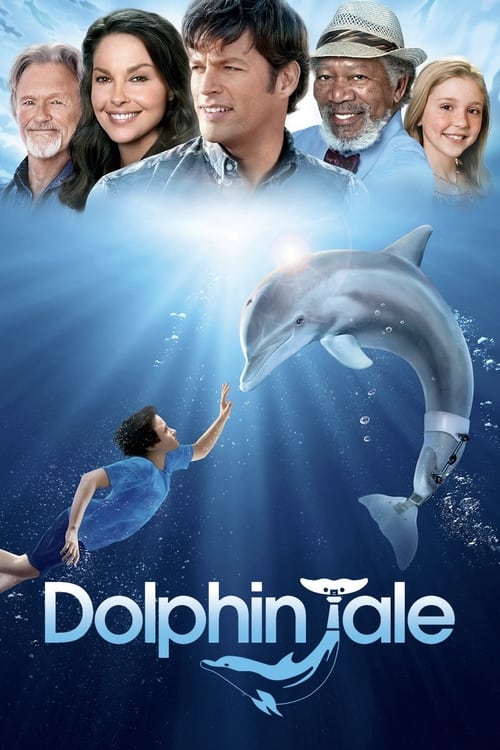
Dolphin Tale (2011)
Directed by Charles Martin Smith
No — Dolphin Tale is not woke, scoring 12 out of 100 on our wokeness meter.
Dolphin Tale arrives from 2011, a gentler era, bearing a bottlenose dolphin named Winter who loses her tail to a crab trap and a lonely eleven-year-old named Sawyer who finds her.
Consciousness Markers
The film sympathetically portrays amputees—both human and dolphin—and the use of prosthetics, promoting acceptance of physical difference, though not in an explicitly body-positive ideological register.
The cast is predominantly white, with Morgan Freeman in a supporting role; the film makes no thematic point about representation or diverse casting.
There are no LGBTQ+ characters, relationships, or themes.
Female characters appear as mothers, veterinarians, trainers, and aquarium owners, but the film advances no feminist agenda or gender-political critique.
The film does not engage with racial identity, systemic racism, or racial consciousness.
Marine rescue and animal welfare are central, but there is no climate-change advocacy or environmental crusade.
A real-estate developer threatens the aquarium, but the resolution is charitable compromise rather than anti-capitalist critique.
Sawyer is lonely and academically behind, but the film does not frame him as neurodivergent or explore neurodiversity.
It is based on a true story and takes dramatic liberties, but it does not reinterpret history through a modern ideological lens.
The film is earnest and inspirational but avoids explicit social or political lecturing.
Why it received this score
Dolphin Tale arrives from 2011, a gentler era, bearing a bottlenose dolphin named Winter who loses her tail to a crab trap and a lonely eleven-year-old named Sawyer who finds her. The film is earnest, well-made, and entirely without agenda. It wants us to feel something about a prosthetic tail, and it succeeds. The machinery is familiar: an ailing aquarium, a hurricane, a board of directors ready to sell the land, a real estate developer who can be talked around. The resolution is a fundraiser and a generous check, which is to say the film believes in charity, not in the redistribution of anything. There is no structural critique here, only a developer who changes his mind after watching children swim with a dolphin.
Morgan Freeman appears as a prosthetics designer at a veterans' hospital, lending his customary gravity to scenes about fitting limbs. The film treats amputation with unforced tenderness. Winter's injury mirrors that of Sawyer's cousin Kyle, an injured soldier, and the parallel is drawn plainly, with no lecture attached. Children with prosthetic limbs visit the aquarium, and the camera regards them with warmth and no commentary. That is the film's quiet strength and the only place where its social instincts register at all. It is acceptance as a fact of the story, not a thesis.
Elsewhere the film is resolutely traditional. The cast is white, the family structures are conventional, and the politics are those of a small-town institution asking its neighbors for help. Nothing is preached. Nobody is scolded. The film was popular enough to spawn a sequel, which remains the most reliable indicator of a movie that offended no one. We are left with a competent, sincere, faintly damp story about a dolphin who swims again. It is not a film with a message. It is a film with a tail.
Analysis generated by our Consciousness Algorithm


Synopsis
A sea of animal rescuers — and a lonely boy in need of a friend – nurse an injured dolphin back to health after it loses its tail in a trap.
Questions about Dolphin Tale
Is Dolphin Tale woke?
No — Dolphin Tale is not woke, scoring 12 out of 100 on our wokeness meter. That earns it a verdict of Ultra Based.
Does Dolphin Tale have any woke elements?
Very few. None of the 10 markers reaches 30, the level where a marker counts as present; the highest is Body Positivity at 20.
How does Dolphin Tale compare to other 2011 movies?
It ranks #71 of the 245 films from 2011 we've scored; their average is 11. The wokest is Paul (68).
How is the Woke Score calculated?
An AI-assisted process researches the film and its reception, scores it 0–100 on ten markers, then combines those into one 0–100 Woke Score. It measures a specific set of 2020s cultural themes, not film quality.